Everything is Photograph: A Life of André Kertész by Patricia Albers

Though André Kertész is now recognized as one of the seminal photographers of the 20th century, for many years he languished in obscurity. First in his native Hungary, then in Paris, where he lived from 1925 to 1936, Kertész emerged as a pioneer of a new kind of photography—lyrical, but fortified by a peerless sense of composition. In America, where he spent the remainder of his life, recognition came late. For decades he was forced into uninspiring commercial work. In 1957, he told his friend the Hungarian-French photographer Brassaï, “I am dead. You are looking at a dead man.”

Not quite. As Patricia Albers recounts in Everything Is Photograph—the first full-length biography of Kertész—he would turn out to be a rare thing: a “dead” artist who lived to witness his own resurrection.

Born in Budapest in 1894, Kertész had a romantic view of the world from an early age. As a lovestruck teenager, he planned to win over his girlfriend’s parents by serenading them on a wooden shepherd’s flute. “I look for the poetic in everything,” he wrote in his diary at the time.

Kertész with Elizabeth Salamon in 1921.

After Kertész’s father died of tuberculosis, in 1908, a well-meaning uncle arranged for him to work at the Budapest Stock Exchange. You can imagine how well this poetic soul was suited to a desk job. It almost came as a relief when World War I broke out and the 20-year-old Kertész was drafted. During his downtime, he used a small camera to photograph fellow soldiers and local Romani people.

After the war, back at the dreaded exchange, Kertész met his next true love, Erzsébet “Elizabeth” Salamon, a woman eight years his junior. Though she was no less infatuated with him, she soon tired of his “poetic” inability to support himself. She gave him an ultimatum—before they could marry, he needed to make something of himself.

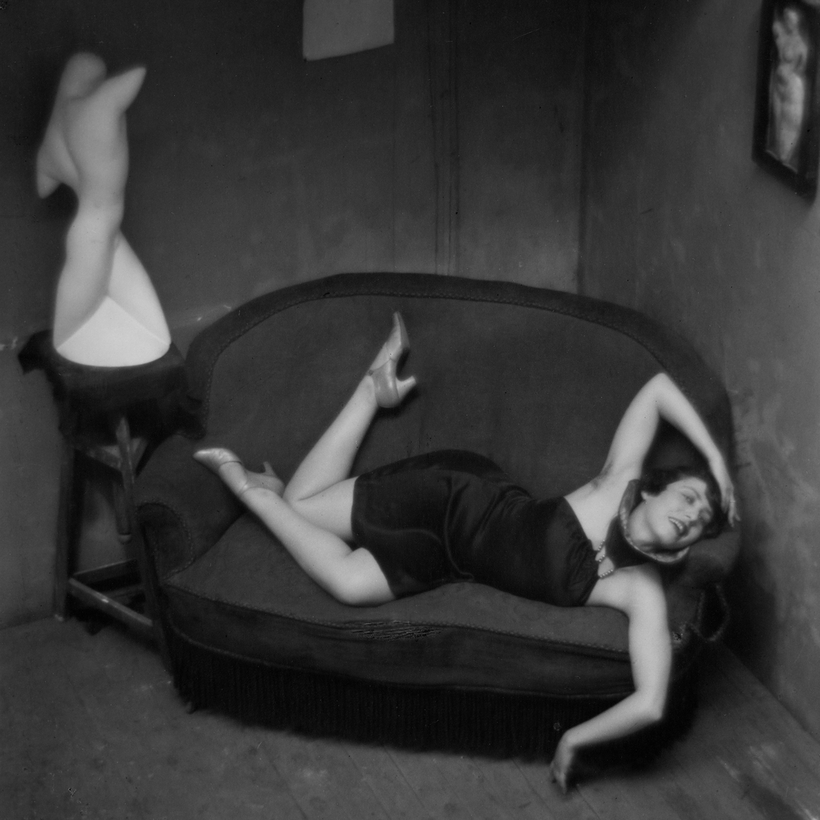
He moved to Paris in 1925 to do just that, changing his name from Andor to André and joining the city’s thriving expatriate scene. Paris was a breeding ground for every new “ism”—Surrealism, Constructivism, Purism—and Kertész borrowed freely from them all, but never aligned with any of them. In 1933, on assignment for Le Sourire, he photographed nude women reflected in fun-house mirrors, their distorted bodies recalling Dalí.

A photo taken by Kertész in Martinique in 1972.

In 1928, Kertész bought a Leica, the new handheld camera that used roll film instead of heavy glass plates. It was for Kertész what the electric guitar would later be for Chuck Berry and Muddy Waters—a thrilling new instrument that transformed his art. With it, he wandered Paris, catching split-second arrangements of light, shadow, and form. His design sense gave those photos backbone; his gift for nailing down “little happenings”—a bird in flight, a lone stroller—gave them a pulse.

After six years apart, during which time Kertész had a short-lived marriage with the French photographer Rosza Klein, Elizabeth and Kertész re-united in Paris. They married in 1933, though he was never able to divorce Rosza—and probably never told Elizabeth.

By then, Kertész was a rising figure in European photography, contributing photo essays to stylish French weeklies such as Vu. But by 1935, his income was dwindling. So when the American photo agency Keystone offered him a one-year contract with a guaranteed salary, he and Elizabeth moved to New York, assuming the stay would be temporary. However, the rise of Adolph Hitler and the start of World War II kept them in the U.S. for good.

Kertész quickly came to regret the move. New York was bustling and sharp-elbowed, with few of the charming quartiers of Paris. Worse, no one knew—or cared—who he was. Editors at Life and Look wanted bold, legible images, not subtle exercises in “poetic” sensibility. One editor told him his pictures “talk too much”—a put-down he never forgot.

The Leica was for Kertész what the electric guitar would later be for Chuck Berry and Muddy Waters.

Chronically under-employed, Kertész eventually ran out of money. Food was sometimes scarce. Once, when he and Elizabeth were locked out of their apartment for failing to pay rent, Kertész collapsed on the sidewalk. Albers puts his problem just so: “Being poor in Paris made you a poet. Being poor in New York made you a loser.”

In 1947, he reluctantly accepted an exclusive contract with the Condé Nast–owned House & Garden. For 13 years, he flattered the latest in coffee tables and bathroom sinks. The work was soul-crushing, but the salary—at least $10,000 a year, when the median annual income in the U.S. was $3,000—was life-changing. Combined with Elizabeth’s earnings from a perfume business she co-founded, by 1952, they could afford an apartment on Fifth Avenue overlooking Washington Square Park—an ideal perch for Kertész and his new zoom lenses.

Kertész still wanted more than a paycheck. He craved recognition.That finally came in the early 1960s, when he walked into the office of John Szarkowski, chief photo curator at the Museum of Modern Art, with a portfolio of his photographs. Szarkowski called Kertész back the next day to offer him a solo exhibition. Invitations followed, including the 1963 Venice Photography Biennale, where Kertész won a gold medal. By the early 1980s, portfolios of his work sold for tens of thousands of dollars.

Brassaï and Kertész, circa 1970.

Despite triumph after triumph, Kertész remained prone to self-pity, often complaining that “no one understands me.” Even Albers, generally a sympathetic biographer, notes that “many found Kertész’s rants tiresome.” New Yorker writer Brendan Gill once said of his friend: “The weather of his soul was charged with gloom, and he was determined to share that gloom with all the rest of us.”

“Being poor in Paris made you a poet. Being poor in New York made you a loser.”

In May 1985, months before his death, a major retrospective organized by the Art Institute of Chicago opened at the Metropolitan Museum of Art. I met Kertész at that opening, which I was reviewing for Time. He was charming, though a little hard to follow, beginning sentences in English, drifting into French, and ending in Hungarian—a private dialect his friends called “Kertészian.” (The title of Albers’s book nods to his fractured way of speaking.)

But what did it matter if his speech was a muddle? He always preferred to let his pictures do the talking. Which they still do, beautifully, and with none of the sour grapes.

Richard Lacayo is the former art-and-architecture critic at Time and the author of Last Light: How Six Great Artists Made Old Age a Time of Triumph