In the Post-Impressionist pantheon, the French painter Paul Cézanne is first among equals. Vincent van Gogh and Paul Gauguin certainly have more compelling biographies, and Georges Seurat—of Sunday in the Park with George fame—has been played on Broadway by the likes of Jake Gyllenhaal. But Cézanne’s newfangled fracturing of old-fashioned still lifes and landscapes became the very motor of modernism. Indispensable to figures as diverse as Pablo Picasso and Henri Matisse, not to mention Wassily Kandinsky and Piet Mondrian, Cézanne (1839–1906) can still reliably mesmerize. And with a substantial portion of his works in private hands, he can still surprise.

Switzerland’s Beyeler Foundation, blessed with a Renzo Piano–designed premises near Basel, made the case for Cézanne’s supreme position in the visual arts when it mounted “Cézanne and the Modern” back in 1999, giving a native son of Aix-en-Provence pride of place alongside Picasso, Matisse, and Alberto Giacometti. Tomorrow, the museum goes one step further by bumping him from top billing to solo performer. Of the 58 oil paintings and 21 works on paper featured in the exhibition “Cezanne,” around half are from private collections, while the rest are on loan from museums on both sides of the Atlantic.

Cézanne, photographed in his last studio by the painter Émile Bernard, Aix-en-Provence, 1904.

Paul Cézanne came into his own in the 1880s, when, after passing through a Paris-based Impressionist period, he returned to Provence. Here he managed to call the Impressionists’ bluff by going beyond their light-dappled distortions and using planes of color to all but break with linear perspective.

Emphasizing his final period, the Swiss show begins around 1890, with celebrated oil-on-canvas paintings such as The Card Players (1892–96), from London’s Courtauld Gallery, and unfinished landscape drawings, ghostly half-rendered in graphite and watercolor, from Switzerland’s Esther Grether Family Collection.

Les Joueurs de Cartes, 1893–96.

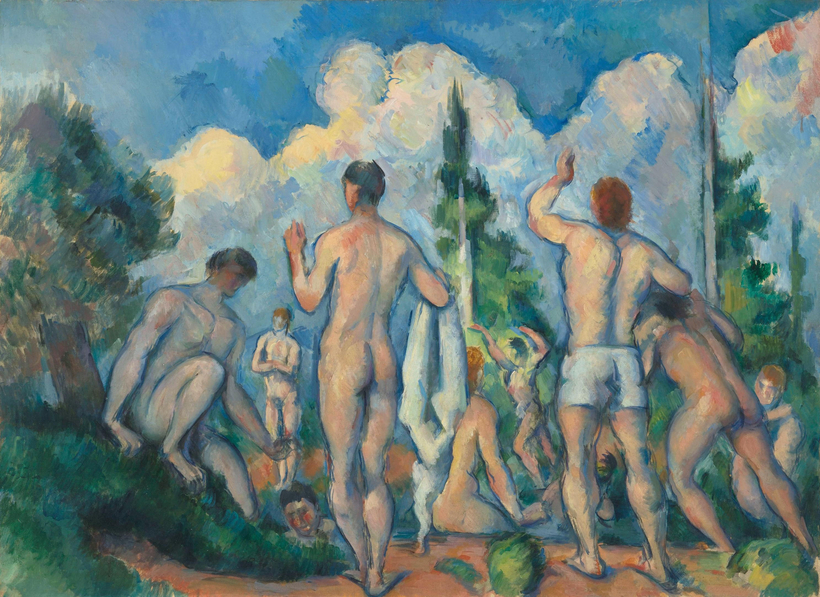
Some of the privately owned works haven’t been seen in public for decades. Indeed, one oil version of a sunny bathing scene—a favorite subject that Cézanne revisited dozens of times—has never before been shown in public. Painted between 1900 and 1906, but left unfinished, it has flesh-colored trees, a pale-blue sky, and eerie outlines of naked bodies. It’s as if the artist were looking through squinted eyes.

Writing in the catalogue, the distinguished Cézanne scholar Gottfried Boehm, a Swiss-based German art historian now in his 80s, argues that many of these apparently unfinished artworks, though fragmentary, can still be regarded as “complete.” And for Ulf Küster, the exhibition’s curator, it’s tempting to consider even the supposedly finished works, which almost invariably feature one of a handful of Cézanne’s recurring motifs—in this show, Provence’s Mont Sainte-Victoire, tables with fruit, and the bathing scenes—as part of a single, ongoing, never-quite-repeating series whose larger, open-ended endeavor is to re-invent painting.

La Montagne Sainte-Victoire Vue des Lauves, 1904–6.

By revising through repetition, and dispensing with perspective, Cézanne came to free himself from mere perception. He painted what he felt rather than what he saw. And in not depicting or reflecting reality but, rather, creating his own, Cézanne in this final phase helped install subjectivity as the core tenet of modern art.

The show will also do its bit to re-introduce the artist as “Paul Cezanne,” sans acute accent—the spelling preferred by the artist himself, who signed his paintings that way. Though now in limited use, the accentless version is on the march, says Küster, forecasting that in a decade or so “Paul Cézanne” may be gone for good.

“Cezanne” is on at the Fondation Beyeler, in Riehen, Switzerland, until May 25

J. S. Marcus writes about art and design for The Wall Street Journal and other publications