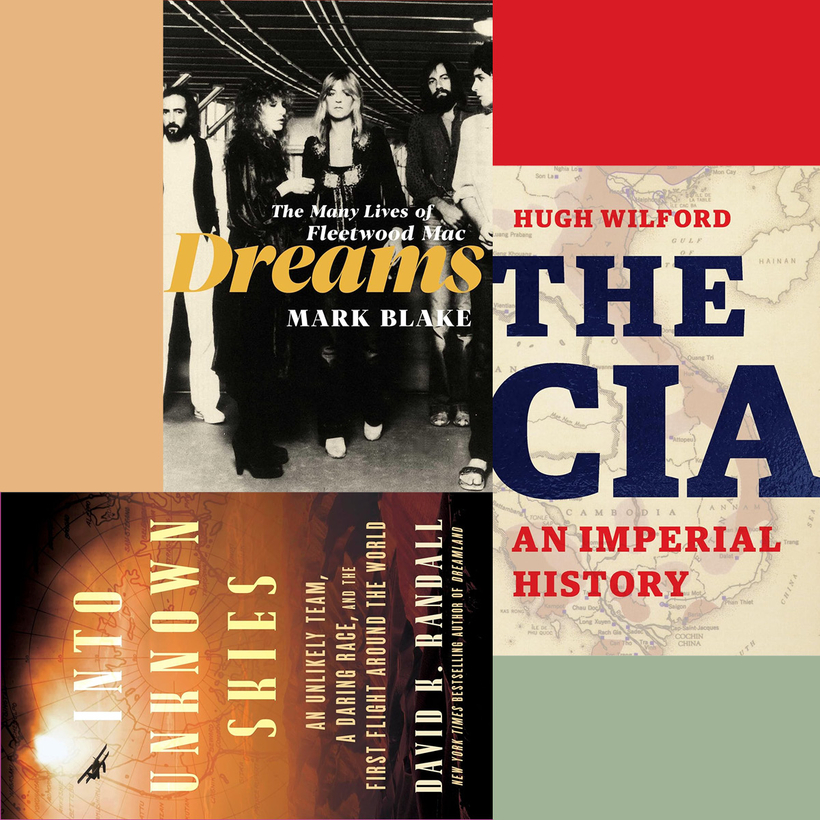
Even if you are not a Fleetwood Mac fan, at some point in your life you could not get “Don’t Stop” out of your brain, if only because it became the anthem of Bill Clinton’s 1992 presidential campaign. So it might interest you that the working title was “Yesterday’s Gone” and that Christine McVie’s goal in writing it—to help her estranged husband and fellow bandmate, John, move on with his life—went over his head. Affairs, of course, abound, the most famous being between Lindsey Buckingham and Stevie Nicks, and it is fair to say that tumult both produced memorable music and exploded the group. If you are a Fleetwood Mac fan, then Dreams will satisfy every ounce of your passion. And then go see Stereophonic on Broadway, and appreciate how claustrophobic it must have been to be in that band.
No one has ever claimed that there are not enough books about the Central Intelligence Agency, so kudos are due to Hugh Wilford, who has written not just a compelling history of the C.I.A. but one that places it in the context of previous colonial-era spying operations, especially those of the British Empire. From its founding in 1947 as a collector of information to its quick transition as a covert operation designed to overthrow regimes and eliminate enemies, the C.I.A. has attracted enough masterminds, wunderkinds, and screw-ups to populate several Slough Houses. Consequences intended and unintended are laid out in detail, including how in recent years the growing fog of conspiracy theories and “deep state” accusations has left the C.I.A. looking far more diabolical than facts show. The agency may have much to answer for, but after all these years the C.I.A. is still not and never will be behind the assassination of John F. Kennedy.