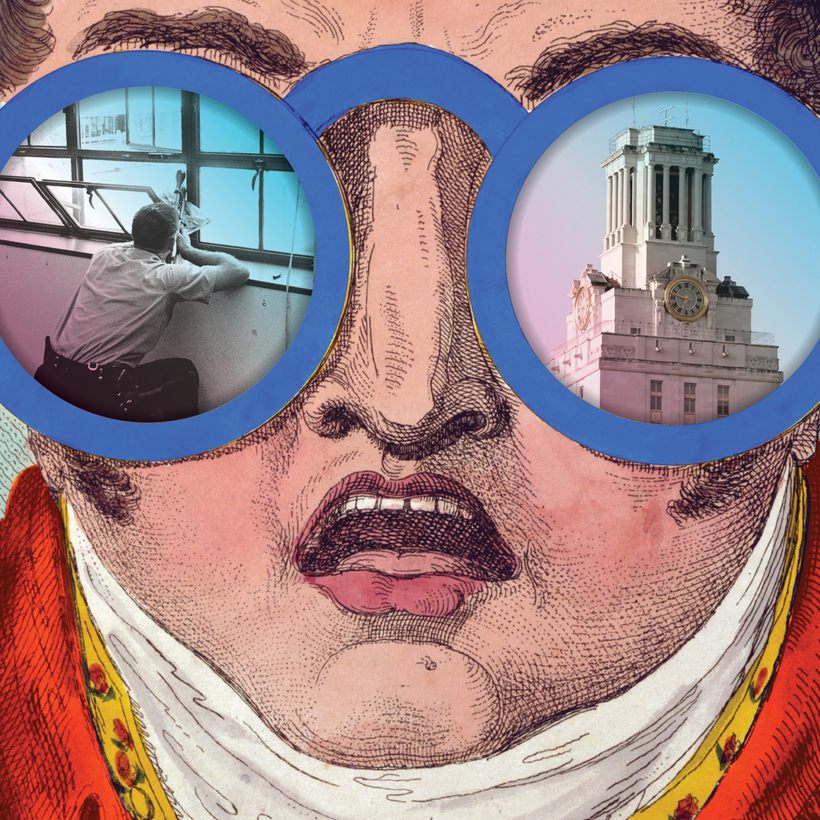
“No one could believe it. Who would do such a thing? Who would kill people he didn’t even know?” That was the ABC Radio News journalist Charles Osgood, channeling the nation’s shock and asking sincere, non-rhetorical questions during a grim “Special Report” on August 2, 1966. A day earlier, not long before noon, Charles Whitman, a 25-year-old engineering student at the University of Texas, had taken an elevator and then a staircase to the observation deck of the school’s 28-story bell tower. Dressed as a maintenance man, he brought with him two hunting rifles, a carbine rifle, a shotgun, three handguns, and a machete, stowed in a foot locker. He fired his first shot from the observation deck at 11:48 A.M. His last echoed across the campus some 96 minutes later. All told, he killed 15 people and wounded 31. That morning, he’d also stabbed and killed his wife and his mother.
At the time, this was the deadliest mass shooting in American history. Its toll wasn’t surpassed for nearly two decades, until 1984, when an unemployed welder killed 22 people at a McDonald’s in San Ysidro, California. The next four decades provided more competition: the U.T. shooting now ranks a measly 12th in terms of fatalities. For now, the 2017 shooting at a country-music festival on the Las Vegas Strip remains the deadliest, with 60 killed and more than 800 wounded or injured—a record one hopes will never fall. (Definitions of these crimes vary, but by the F.B.I.’s reckoning, the U.S. has averaged 21 “active shooter incidents” a year over the past quarter-century. This won’t matter to the victims, but the bureau’s definition would exclude the shooting last weekend at a Seattle food festival which left three dead and four wounded if, as seems likely, it proves to have been gang-related.)