
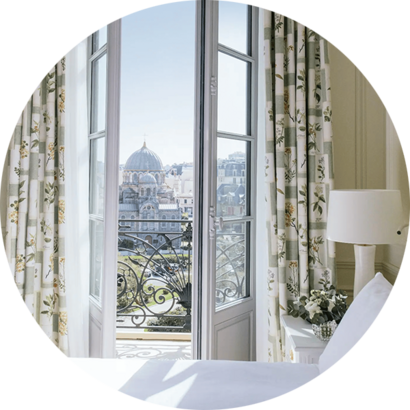
My heart sank when my cab stopped under the fanned glass porte cochère over the front door of the five-star Hôtel du Palais in Biarritz. An elegant red brick villa with beige stone trim and a boxy slate-clad mansard roof, the hotel was built by the French emperor Napoleon III in 1854 on a shelf of land overlooking the Bay of Biscay for Eugénie de Montijo, his Spanish-born wife. Over the course of many visits, I had grown oddly protective of this unique and very charming place, which is why it came as a terrible shock when it closed for a four-year renovation under the auspices of Hyatt Hotels, which was awarded a long-term lease on the property by the town of Biarritz, which owns it. Hyatt. Yes, Hyatt. There are some very good Hyatt hotels in the world, but I honestly didn’t hold out much hope. But upon my arrival, my spirits were lifted—current heat wave notwithstanding. The lobby looked unchanged, if perhaps a bit fresher, and as soon as I opened the windows in my room so that I could see and hear the sea, everything was not only perfect but better than ever—the Internet was fast and stable, the water pressure in the bath was potent, the beds were made up in taut white linens, everything was impeccable. And the unself-conscious fly-in-amber aristocratic ambience of the hotel came through the tumultuous modernization unscathed. “I think we’re good to go for another century now,” general manager Monsieur Poulingue tells me. I think so too. (hyatt.com) —Alexander Lobrano

read
Contrapposto
In his latest novel, Dave Eggers, founder of the literary journal McSweeney’s and author of the 2000 memoir A Heartbreaking Work of Staggering Genius, a finalist for the Pulitzer Prize, tells the story of the lifelong friendship between two art lovers: Cricket, a reserved but gifted artist, and Olympia, a slightly older, worldly art connoisseur. After leaving their small hometown in Indiana, Olympia becomes a high-end art consultant, while Cricket pinballs between odd jobs, working as a ship-breaker in Turkey and painting replicas of Impressionists in Cambodia. Over the decades, Cricket and Olympia teeter between friendship and love, their orbits colliding at New York galleries and Paris ateliers before painfully coming apart again. Though punctuated by tragedy and heartbreak, Contrapposto is decidedly optimistic about the power of art to endlessly delight, and the beauty of a lifelong friendship. ($32, penguinrandomhouse.com) —Paulina Prosnitz

see
“An American Beauty”
If, like me, you have the Grateful Dead as the soundtrack to your summer—and every other season—this exhibition might be a welcome companion. Curated by father-daughter photographer duo Ricki and Jay Blakesberg, “An American Beauty: Grateful Dead 1965-1995” features 20 large-scale prints and 13 smaller ones—several making their public debut. Moving between intimate moments and large-scale performances, the show centers on the rare access and trust of bona fide Grateful Dead photographers including Jay Blakesberg himself, and friends Adrian Boot, Suki Coughlin, Greg Gaar, Andy Leonard, Rosie McGee, Bob Minkin, Ron Rakow, Jon Sievert, Elizabeth Sunflower, and Kirk West. Now showing at the David Kordansky Gallery in Chelsea, it’s a must-see for Deadheads of all walks. (davidkordanskygallery.com) —Gracie Wiener
watch
Gidget
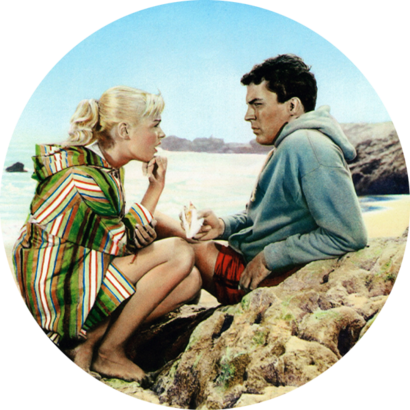
Gidget is not your ordinary coming-of-age flick. First in the Gidget canon, the 1959 film was adapted from Frederick Kohner’s book based on his daughter, Kathy, and her real-life adventures in the male-dominated surf culture in Malibu, California. Starring Sandra Dee, Gidget follows the independent and determined Franzie (Dee) over the summer before her senior year of high school as she learns to surf and navigates her first love. After an incident with her boy-crazy friends on the beach, Franzie is adopted by a clan of male surfers who christen her “Gidget” and become her second family. Uplifting and romantic, Gidget is more than the story of an empowered female protagonist; it also launched the beach-party film genre and catapulted surf culture into mainstream America. Complete with musical numbers and teenage drama, this late-50s cult classic is, in the words of Gidget, “honest to goodness, it’s the absolute ultimate.” (apple.com) —Eve Eismann

decorate
Victoria Hagan x High Camp Supply
Interior designer Victoria Hagan, of restrained East Coast elegance, has teamed up with High Camp Supply, the California floral brand known for its cut-to-order peonies and gardenias, on a limited-run summer capsule that feels tailor-made for a Nantucket hostess table. The collaboration includes a glossy navy vase—a first for High Camp—with a silver interior, plus a hand-painted gardenia palo-santo candle designed by Hagan to match, alongside the brand’s signature blooms, shipped overnight nationwide from California. Only 250 to 300 boxes will be released, which translates to: Don’t wait around. (from $275, highcampsupply.com) —Jennifer Noyes

read
Leaning Seaward
The Wall Street Journal recently announced the “dad book”—serious slabs of history, geopolitics, and biography—is dying. Leaning Seaward is a bracing rebuttal. Geoffrey F. Gresh’s fascinating study of Japan as a maritime power has all the old virtues of the form: maps, historical anecdotes, unashamed intellectual ballast. But it also shows why the category should not be consigned to the breaking yard. This is very much a book about the present: China’s rise, maritime bottlenecks, fraying supply chains, demographic anxiety, and the Indo-Pacific order that increasingly decides everyone’s future. Gresh depicts Japan as a harbinger state, facing first what other developed countries will face next. For anyone bored by the shallow thinking of podcasts, here are real depths. Dads of the world, dive in. ($65, yale.edu) —George Pendle