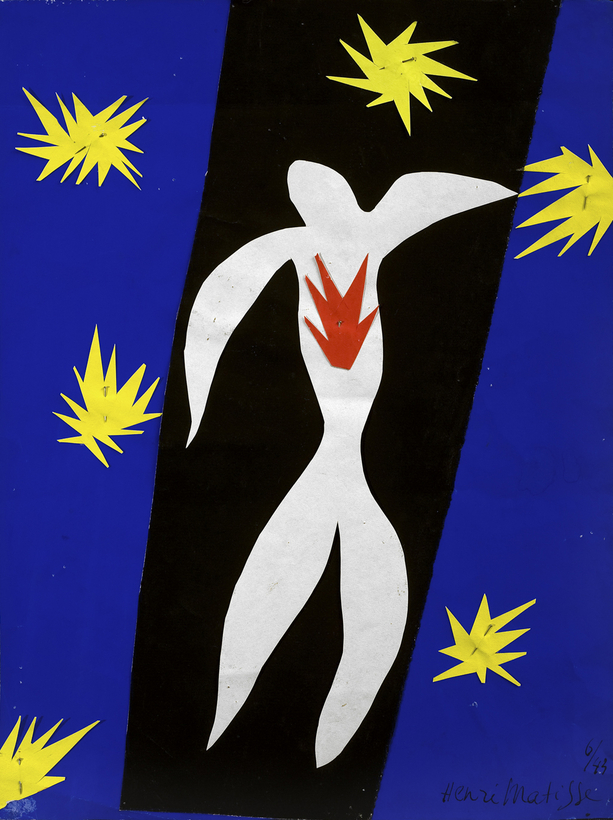

In one of the last self-portraits Rembrandt painted before he died, in 1668, he is laughing heartily. His humor suggests that the only way to face the ultimate is to be as alive as possible. Cézanne’s final version of The Card Players (1894–95) presents us with a moment in which mental concentration and human bodies, thought and matter, merge. In all of art history, however, there is no greater fusion of ethereality and immortality than in the work produced by Henri Matisse during the last 13 years of his life. The spirit of his colors and the forcefulness of his lines are boundless.

In 1941, when he turned 72, Matisse was diagnosed with duodenal cancer. Convalescing from arduous surgery in his house in Nice, where he was safely distant from his former home in Paris, now occupied by German troops, he was limited to either his bed or a wheelchair. Until his death, in 1954, Matisse was cared for by a group of nuns who were his neighbors. They devised a long stick that allowed him to draw on the walls, and equipped him with special scissors that enabled him to lie flat on his back and cut brightly colored paper—cosmic blues and greens, yellows as vibrant as sunlight, passionate reds—into forms that leap and bow.