Even in their incomplete and heavily redacted form, the three million pages of released Epstein files make for grim reading, torrentially upsetting from every conceivable angle. However, one under-discussed figure whose name comes up again and again is Peggy Siegal.
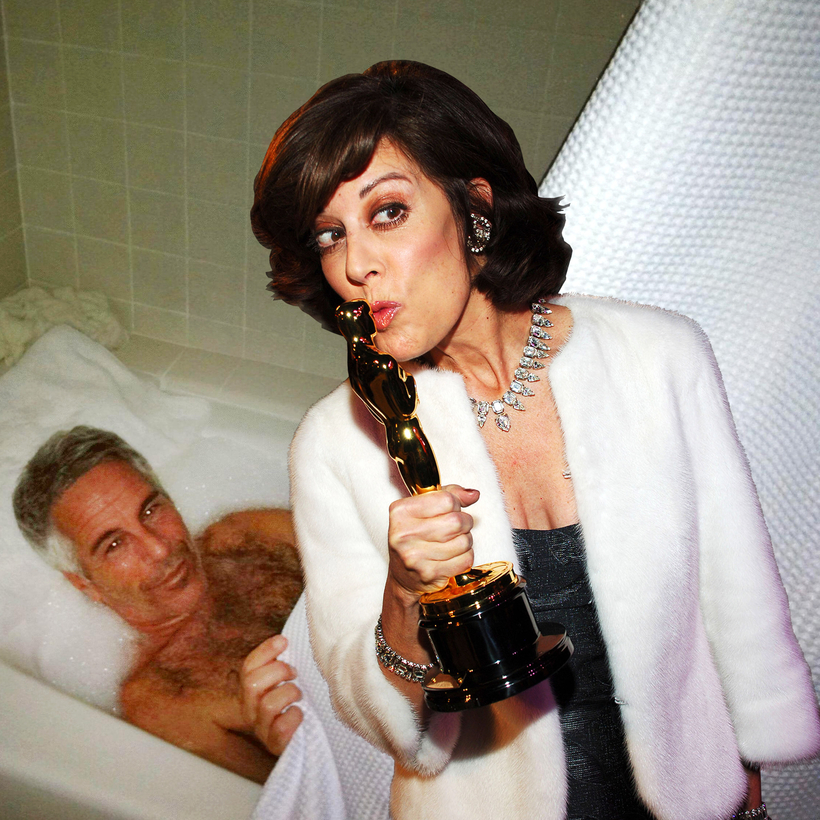
Siegal made her name as an entertainment publicist who specialized in organizing premieres and movie screenings attended by the rich and powerful. Pulling from her 30,000-strong contact list—organized by, among other things, nationality, number of children, and success level—she would flatter, cajole, and bully the great and good to attend. She was, by all accounts, extremely gifted at this. A Harper’s Bazaar profile from 2012 noted that she had attended every Oscars ceremony since the 1970s purely to schmooze with the stars; a year later, The Hollywood Reporter called her “New York’s top buzzmaker.”
Then it all came crashing down. In July 2019, a New York Times report on Jeffrey Epstein noted how warmly the A-list had welcomed him back into the fold after he served a jail sentence for procuring a girl below age 18 for prostitution. It printed names of those who had supported him, and Siegal was among them, with the piece calling her a “social guarantor” who could ease his way back to respectability.
Pulling from her 30,000-strong contact list—organized by, among other things, nationality, number of children, and success level—Peggy Siegal would flatter, cajole, and bully the great and good to attend.
Instantly, Siegal’s career cratered. A year later she told Vanity Fair that her work evaporated on the spot. Megan Ellison’s media company, Annapurna, dismissed her from working on the premiere of the film Where’d You Go, Bernadette. Word also quickly reached the trades that Netflix would be cutting ties with her, and FX told Variety that it was “highly unlikely” that it would use her services again. “If I had been in Nazi Germany, it could not have been worse,” she lamented to the magazine, denying that she had a particularly close relationship with Epstein. “He was a very minor aspect of the mix,” she said.
The files, as they stand, appear to dispute this. In 2010, just after Epstein was released from prison, Siegal agreed to oversee his Yom Kippur gathering, suggesting invitations for Charlie Rose (“Love him”) and Jane Fonda (“Nothing like an ex-Jew hater with a Jewish boyfriend to mix it up”). Siegal did not respond to Air Mail’s request for comment.
She certainly benefited financially from Epstein. In 2018, he gave her a “birthday gift” in the form of a $30,000 check. Six years earlier, Epstein had received an e-mail stating “Peggy Siegal’s office is calling again re payment…Peggy is starting to panic. The company keeps calling asking for payment for her travels … ,” to which Epstein shruggingly responded, “Doesn’t she have a credit card?”
They also now appear to have been closer than Siegal made out. Not only did Epstein help Siegal settle a legal issue with her brother over her inheritance (“You must have threatened [him] with in [sic] an inch of his life,” she said by way of thanks) but, in 2011, she asked him to be the executor of her will, something that isn’t traditionally requested of a minor aspect of your social mix.
It also seems as if she was aware of Epstein’s reputation. In 2012, ahead of a screening of the Will Ferrell comedy The Campaign, he received an e-mail stating that “Peggy says she does not want young girls with no last names at the screening … she requests ‘over 30.’” Less forgivably, there was also a 2009 e-mail where Siegal mentioned that she was traveling to Kenya. “Can bring a little baby back for you....or two,” she wrote. “Boys or girls? So Madonna.”
“If I had been in Nazi Germany, it could not have been worse.”
Then there is the worryingly large percentage of correspondence between Siegal and Epstein that takes the form of long e-mails in which Siegal just goes on and on about the parties she has attended. Sometimes she would write about the Oscars. Other times it would be Cannes. But perhaps the standout message is an e-mail, seemingly sent out of the blue “for a little fun and laughs,” about how she rang in 2014.
Entitled “Paul McCartney rings in New Year in St. Barths,” it features nearly 1,000 words of brags and name-drops, delivered in a sort of screwball rat-a-tat. “This was originally sent to my friends I have been playing tennis with for 15 years simply called, ‘The Tennis Girls,’” she tells Epstein (we would love to know which “girls” this group consists of), before going on to list every single person she encountered—and several she did not—on the island as well as on eight different yachts. These include, but are by no means limited to, David Geffen, Roman Abramovich, A-Rod, Robert Downey Jr., Larry Gagosian, Brian Grazer, and Mike Ovitz. In the e-mail, Siegal makes a point of explaining that her social currency in these encounters was mounds of DVDs of Philomena and The Butler that Harvey Weinstein had given her.
She goes on to mention that McCartney and his wife, Nancy Shevell, had lunch with real-estate developer Izak Senbahar, a “secret and very accomplished bongo player.” Later that evening, “Izak immediately pounded on the bongos hypnotically and Sir Paul shockingly followed on the drums. He was as good as Ringo.” According to Siegal, the evening peaked when “the DJ spun Paul’s Wings song ‘Goodnight Tonight’. Our favorite Beatle grabbed the mike and sang along. (I was standing inches away and fainting.) The rich and the richer went nuts.”
It’s hard to identify the purpose of these e-mails, since they aren’t exactly reciprocated. One of the signatures of Epstein’s correspondence is how one-sided it is, with long, multi-paragraph messages receiving terse and often misspelled replies. And so it was here, with Siegal’s epic poem of gratuitous celebrity spotting met with a joyless “great . now back to real life” from Epstein.
This feels like a microcosm of Jeffrey Epstein’s entire way of operating. Here is a man who spent his life collecting people purely for their use, only to discard them once he had wrung them dry. The fate of a chatty publicist is far from the most important thing contained within the Epstein files, but it nevertheless offers a telling glimpse into the social machinery that made him possible.
Stuart Heritage is a Writer at Large at AIR MAIL. He is the author of Bald: How I Slowly Learned to Not Hate Having No Hair (And You Can Too)
