

Garage owner and keen early automobilist Henry Frederick Stanley Morgan, the son of a rural English clergyman, built his first car, an eponymous prototype, in 1909. To the surprise of many, his concept of a tiny car with three wheels and a small, motorcycle-derived, two-cylinder engine succeeded, with the young garagist founding the Morgan Motor Company in Malvern, in Worcestershire’s hill country, and proceeding to build an improved production version in 1912.
When tax breaks for three-wheelers were curtailed, a 4/4 model—the name denoting its four wheels and four-cylinder engine—was launched. Retaining the three-wheeler’s unique sliding-pillar front suspension, the 4/4 was steadily, if modestly, updated through the years. It retained its rakishly handsome 1930s style and old-time construction method—hand-beaten metal body panels laid upon a frame made of ash wood, the lot then placed on top of a spindly, steel-ladder frame.
Incredibly, this vintage formula was enough to carry Morgan as a well-regarded low-volume manufacturer with a lovable, if antique and increasingly eccentric, offering into the 21st century.
To outward appearances, nothing’s changed at the Pickersleigh Lane Works, in Malvern. It’s the very same, startlingly unautomated Edwardian brick factory from which every Morgan has emerged since 1914, and something of a tourist destination for car enthusiasts. (They’ll even rent you a car.)
Except somewhere around the turn of the current century, the company and its then head, Charles Morgan (whose father, Peter, had taken the reins from H.F.S. in the 1930s), kicked off a slow-rolling effort to modernize, hoping to move a charming but truly antiquated product’s game into the present.
To look at, the new cars were unmistakably Morgan. But the up-to-the-minute bonded-aluminum chassis and modern suspensions serving beneath the handsome coachwork changed the game, the modernization effort gaining further momentum when the Italian private-equity firm Investindustrial acquired a controlling interest in 2019, infusing additional capital into the enterprise. The Morgan family carries on as minority shareholders, but what today’s buyers can rejoice in is that while the appealing vintage look remains, the mechanical bits of today’s Morgans are vastly improved, starting with the chassis.
However clever the sliding-pillar front suspension might have seemed in 1912, it was very much not that way by the 1950s, much less the 1990s, when I first experienced them. As much as I thought I loved Morgans, their connection to a distant automotive past quickly grew to be too much to bear, a fact underscored every time a road irregularity presented itself. The buckboard ride was permanently disqualifying, even for someone who has always been partial to British sports cars and obscure brands with cultish followings.
Touring England a few years back in a Morgan Plus Four (the 4/4’s lineal descendant), I discovered that the new chassis accounted for wild improvements in handling and ride quality. Straight-line performance was never wanting in Morgans of yore, their light weight making a variety of bought-in engines—from Triumph, English Ford, Fiat, and Rover—more than adequate to deliver acceleration on par with its maker’s major-manufacturer contemporaries.
But today’s BMW fuel-injected, turbocharged four- and six-cylinder engines (found in the Plus Four, Plus Six, and the new Supersport, which AIR MAIL has just driven), mated, in most cases, to an eight-speed automatic gearbox, set new standards for Morgan in accelerative capability (as fast as a Porsche 911) and refinement, complementing hugely improved road manners, courtesy of the new cars’ rigid chassis, all-independent suspension, and sympathetically calibrated shock absorbers.
Other mechanical niceties such as traction control, locking-differential and electronic-stability control, and additional safety essentials, like airbags and anti-lock brakes, plus amenities standard in most new cars—such as air-conditioning and a quality sound system (Sennheiser’s being audible up to around 50 m.p.h., which is more than any old sports car)—bring the new Morgans right up to, say, the turn of the 21st century, which ought to be close enough for those desiring a car that looks like something Bertie Wooster might drive.
Annoying infotainment screens and constant nannying—blind-spot alerts, parking assists, and low-grade autonomous drive—are not on the menu, and their absence is refreshing. For the purists, in place of door glass, removable side curtains with sliding plexiglass windows grace its low-cut doors, a link to automotive history, though easier to affix and more weathertight than before. Historically, side curtains encouraged water to enter the cabin in driving rainstorms rather than preventing it.
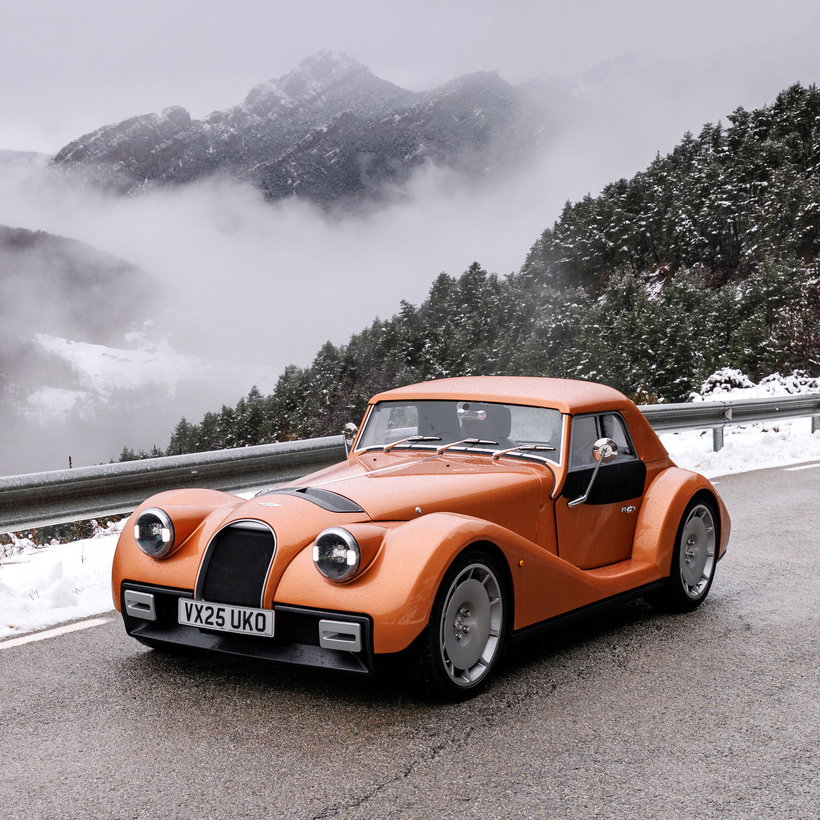
We drove a new Supersport model, a radically (for Morgan) re-styled take on its enduring original theme. Like its more traditionally styled Plus Six relation, the two-seater somehow manages to shoehorn BMW’s straight-six engine under its long, low hood. Cranking up a whopping 335 brake horsepower and 369 pounds per foot of torque, it allows the Supersport to reach 60 m.p.h. in less than four seconds, which, even in these crazy, horsepower-by-the-bushel days, remains very fast indeed, with 100 m.p.h. arriving in less than nine seconds.
Though the Supersport’s unique bodywork boasts improved aerodynamics over the Plus models, its fundamentally old-school shape discourages higher, triple speeds. In this regard and many others, it’s no 911.
Nice wooden veneers give the cabin an appealing, almost nautical feel, with leather, wood, and metal lending a class that reminds one of a slightly less polished, shrunken Rolls-Royce. The effectiveness of the impersonation act dissipates with a recalcitrant door release and a ride height that will allow those so inclined to drag their knuckles on the pavement. Fortunately, in such a low car, visibility with the carbon-composite top and its huge rear windscreen is superior. Also, behind driver and passenger resides a locking trunk of decent size, a Morgan first, with a big chunk of exposed structural wood inside it, looking fabulous.
The Supersport is not insanely expensive by current standards, at roughly $125,000. Alas, you can’t yet buy one in the United States. But as of only recently, you can again buy the classic formula and aesthetically awesome Morgan Plus Four. At $92,500, plus a 10 percent Trump tariff (down from 27 percent)—and with nearly all the same chassis improvements—it is a better value, even after having to make do with BMW’s two-liter, four-cylinder engine, turbocharged to produce 255 horsepower and 295 pounds per foot of torque. Weighing less than 2,400 pounds (lighter than a Mazda Miata), it’ll still reach 60 m.p.h. in 4.8 seconds and top out at 149 m.p.h., good enough for any foreseeable circumstance and too good for most others. It’s the one we’d want.
Parked by the sea in the English town of Hastings, not far from Brighton, the very striking copper Supersport attracted lots of attention, most all of it positive. Some recognized the car as a Morgan, radically updated with its sloping rear, while others had no idea, including many who actually knew what a Morgan was. A few commenters even thought the Supersport was futuristic.
The only critics were whoever pelted it with eggs (three, we’d conclude) in the middle of the night, leaving me to wipe the car clean the following morning. If only I’d been there to tell them that by today’s standards—and among the ranks of supercars that cost four times as much—the Morgan’s combination of performance and eyeball monopoly make it an affordable bargain. The hooligans might’ve beaten me up for saying so, but it’s true.
Jamie Kitman is a car columnist at AIR MAIL
