
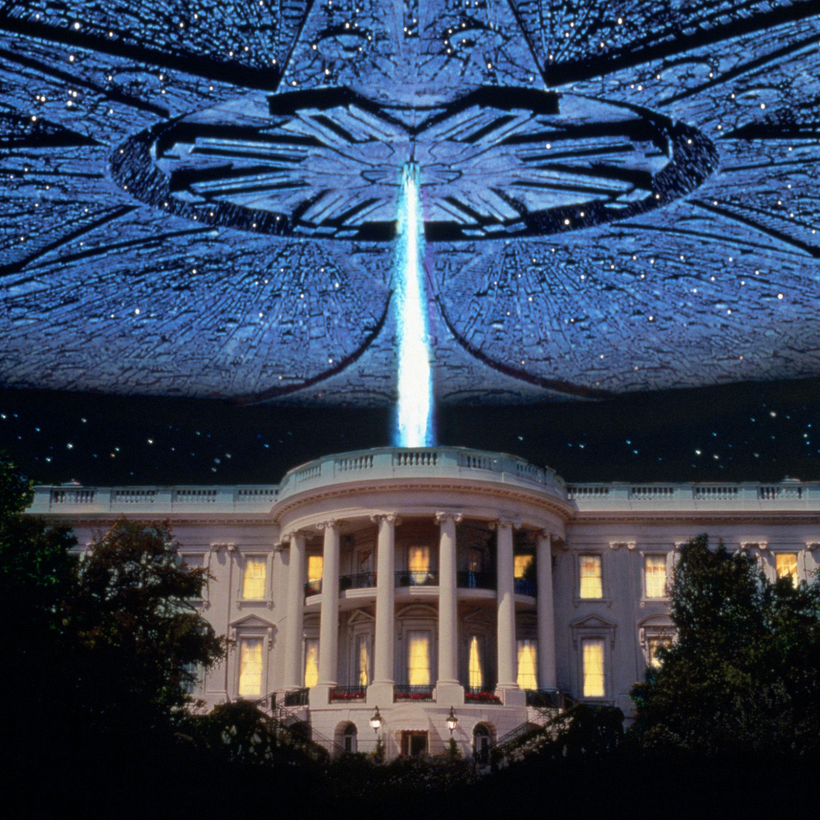

Nobody quite knew whether President Obama was joking when, at the tail end of a sober 50-minute podcast with Bryan Tyler Cohen last weekend, he appeared to say, with surprising matter-of-factness, that aliens exist. “They’re real,” he said, before adding, “but I haven’t seen them.”

Not to be outdone—especially by his hated predecessor—Donald Trump announced on Thursday that he was directing “the Secretary of War, and other relevant Departments and Agencies, to begin the process of identifying and releasing Government files related to alien and extraterrestrial life.”

With everything else going on in the news, one might wonder what in heaven is happening. But, if your social-media feed is anything like mine, the commotion makes perfect sense. On TikTok, Instagram, and Facebook, excitement has been building amongst the U.F.O.-curious that 2026 would be the year of “disclosure”—the moment the human race finally learns it is not alone in the universe.

The expectation hasn’t been confined to online forums. Last year, a former senior analyst at the Bank of England urged the bank’s governor to prepare for a financial crisis sparked by the proof of alien life. In early February, an exchange-traded fund with the ticker UFOD was launched to invest in companies that might benefit from “advanced or reverse-engineered alien technology.” Obama’s admission and Trump’s scene-stealing follow-up were seen as just the latest steps toward the most important revelation in human history.

In the Land of the Believers

I’m agnostic about aliens, but I’ve been orbiting the U.F.O. beat for decades, which may explain the skew of my social-media feed. I’m regarded as friendly to U.F.O. devotees despite a piece I wrote for Time some 30 years ago noting that spikes in flying-saucer sightings in Belgium coincided with economic downturns—suggesting the culprit might be less extraterrestrial than it is under-employed Belgians imbibing industrial-strength Trappist lager.

Despite this, the piece led to an invitation to meet an eminent C.I.A. veteran turned Ivy League–adjacent academic. He explained, at length, how he had inspected a crashed flying saucer made of an unknown metal, and also told me that the C.I.A. had once kept an injured alien in captivity. The being, he claimed, had gestured that it had some kind of problem with its elbows, and, although mouthless, got excited by the sight of strawberry ice cream.

Vertically modest, chromatically diverse, interplanetary persons—little green men—in 1957’s Invasion of the Saucer Men.

My source said he had briefed five presidents on U.F.O.’s but that only Obama had shown real curiosity—Jimmy Carter, who thought he once saw a U.F.O., later dismissed it as a military aircraft. Obama’s question, my source recalled, was simple: What would disclosure accomplish other than setting off a mass panic? (Tantalizing as all this was, my source insisted that I couldn’t quote him as the information was still classified. He has remained silent on the matter ever since.)

More recently, Congress has flirted with the same question. In 2023, the House Oversight Subcommittee on National Security heard testimony from former military and intelligence officers about secret U.A.P. programs (the government began referring to “unidentified anomalous phenomena” instead of “unidentified flying objects” in 2022) that were operating without congressional oversight, and often bypassing the Pentagon’s official U.A.P. office. The most high-profile witness was David Grusch, a former intelligence official with intense staring eyes, who attested under oath that the U.S. had recovered “intact and partially intact” vehicles of non-human origin.

There was, however, no physical evidence. I’ve always wondered why advanced beings capable of interstellar travel don’t simply land in Central Park and loudly demand to be taken to our leader. Stranger still, given the seemingly nonstop traffic of alien spacecraft, there isn’t a single clear photograph—despite the fact that nearly everyone now carries a high-quality camera in their pocket. Still, the sheer volume of congressional testimony has fueled demands for declassification—if there is anything to declassify.

Then came a twist. An internal Pentagon investigation, first reported by The Wall Street Journal, found that military personnel had intentionally spread stories and even fabricated materials about U.F.O.’s to divert attention from classified weapons programs. Yet, for true believers, this merely reinforced suspicion of the Pentagon. If the intention of the investigation had been to demystify the past, it seemed instead to reinforce the mystery.

A slew of recent documentaries has added fuel to the fire. The most persuasive among them, The Age of Disclosure, assembles 34 current and former government and military officials, including Marco Rubio, speaking before he became secretary of state. “We have people with very high jobs in the U.S. government that are either a) liars, b) crazy, or c) telling the truth,” Rubio said in the film, “and two of those three options are not good.” The Age of Disclosure was screened for a bipartisan group of congresspersons last year. (While many, including me, find the film quite convincing, not everyone does. The New York Times wrote that “anyone who sits through its nearly two hours of unprovable claims is a chump.”)

Hollywood will soon amplify the noise. With remarkably good timing, Steven Spielberg’s forthcoming Disclosure Day, a U.F.O./conspiracy thriller starring Emily Blunt, Josh O’Connor, and Colin Firth, is set to ramp up the U.F.O. conversation to ever more feverish levels. The cultural mood is primed. But what about the people who have spent decades actually searching for aliens?

Looking to the Skies

The SETI Institute, in Mountain View, sits in one of those sleepy business parks that abound in California. The Search for Extraterrestrial Intelligence is the world’s pre-eminent effort to detect technosignatures—radio signals, optical flashes, near-infrared lasers, unnatural thermal emissions—emanating from out of the universe.

I first visited in 2005, when NASA had cut its funding and private donors, among them Microsoft co-founder Paul Allen, had stepped up to keep the effort alive. Seth Shostak, then senior astronomer (and an adviser on the Jodie Foster film Contact), told me they had examined fewer than a thousand star systems, “which is nothing.” By 2025, he predicted they would reach a million. “That’s the number you have to look at if you’re going to find something. If it’s going to succeed, it’s going to succeed in the present generation.”

Twenty years on, I returned to see how that prophecy was faring. The short answer: not great. SETI now operates 42 radio dish antennas at Hat Creek, in Northern California, and processes torrents of data from partner observatories worldwide. A $200 million bequest from Qualcomm co-founder Franklin Antonio gave it a thousand times the capabilities it had in 2005. Yet the million-star-system milestone remains distant.

Bill Diamond, SETI’s C.E.O., tells me they have surveyed tens of thousands of systems, which is still quite a lot, although since there are probably 400 billion such systems in our little galaxy, and another two trillion galaxies in the observable universe, it’s barely skimming the surface of the surface.

Alien hunter–in–chief: Bill Diamond of the SETI Institute.

Nevertheless, had he found anything? “If we had,” Diamond says, “you would know. Because the whole world would know.” He says there have been six low-level alerts in the last 10 years, “but unfortunately no dramatic three a.m. excitement like in a movie.”

I ask him how SETI’s lack of success squared with the congressional hearings, the documentaries, the growing drumbeat of respected luminaries whose testimony suggests it should barely be possible to look out of a window without spotting a spaceship. Diamond is unmoved.

“A species advanced enough to travel to Earth but accidentally get ‘observed’ and detected by Earthlings?” he says. “Come on. Pure fantasy. Crashing in our deserts after traveling between stars? That’s laughable…. If some civilization has learned how to fold space and time, or somehow warp the fabric of space-time to travel to Earth, it’s hard to imagine they would simply present themselves as small little craft darting about our airspace.”

The problem, says Diamond, is that it “just doesn’t add up. None of it makes any sense. And just because people, including pilots and military, very occasionally observe things that appear to be moving in unexpected ways, or have strange shapes, does not justify concluding that they must be aliens.”

Diamond expects some form of biological life from elsewhere in the universe—perhaps a fossilized bacterium—to be found by 2030. And he believes the likelihood of other intelligent civilizations is almost 100 percent. But while he says detecting a burst of radio signal from aliens is still probable—although he pushes back the timeline to our grandchildren’s lifespan—seeing or meeting them is decidedly unlikely.

It’s not just that the chance of meeting intelligent alien beings we can vaguely relate to is far less than that of two people randomly walking across the Sahara bumping into one another. It’s that they are also likely to be unimaginably more evolved than we are. “If we find something, then, it would be a thousand, or ten thousand, or a million years older than us and at a totally different stage, and that would have profound implications.”

Diamond is a supremely articulate skeptic, but should we be skeptical about his skepticism? Aren’t we being a little anthropocentric by looking where and how our instruments allow us to look? We scan for radio waves and lasers because they are what we know how to detect, but it’s like searching for lost keys under a lamppost because the light is better there. Advanced intelligences might communicate through means we cannot imagine, by some biological technique, or using quantum effects beyond our detection.

In the early 19th century, meteorites were regarded as skeptically as U.F.O.’s are today. Scientists did not believe stones could fall from the sky, so reports of fireballs and “falling stones” were dismissed as folklore, peasant superstition, lightning, or other natural atmospheric phenomena. The French chemist Antoine Lavoisier reportedly investigated a fallen stone and concluded it must have been struck by lightning because rocks simply did not fall from space. The phenomenon was largely rejected because it failed to fit existing knowledge. And from this, it is fair to argue that, in the case of aliens from outer space, absence of evidence is not evidence of absence.

Tell the World, Not the Man

One thing has changed since my first visit: SETI now has a disclosure-day plan. In 2005, Shostak told me he had no idea what he’d do if he discovered alien life. He didn’t have a phone number for the White House and thought his best bet would be to call the mayor of Mountain View, although, as it turned out, the mayor didn’t know how to get hold of the White House, either.

Diamond has no such doubts. On the day SETI makes confirmed contact with an alien signal, he says, he will hold the mother of all press conferences. “We assume that once the news is out, everyone will then drop what they’re doing, whatever war or economic calamity they’re covering, and come here.” And the U.S. government? “No, we’re not telling them,” Diamond says. “Let them find out when everyone else does. They’re welcome to come to the press conference.”

In an age in which belief in government institutions is fragile, Diamond’s decision might be for the best. After all, if the Trump administration does reveal the existence of extraterrestrials later this year, would anyone believe a word of it? There’s a real possibility it would only entrench the conviction that there’s nothing out there at all. And I don’t envy whoever has to explain that to an impatient Zillon from the planet Tharg.

Based in London and New York, AIR MAIL’s tech columnist, Jonathan Margolis, spent more than two decades as a technology writer at the Financial Times. He is also the author of A Brief History of Tomorrow, a book on the history of futurology