
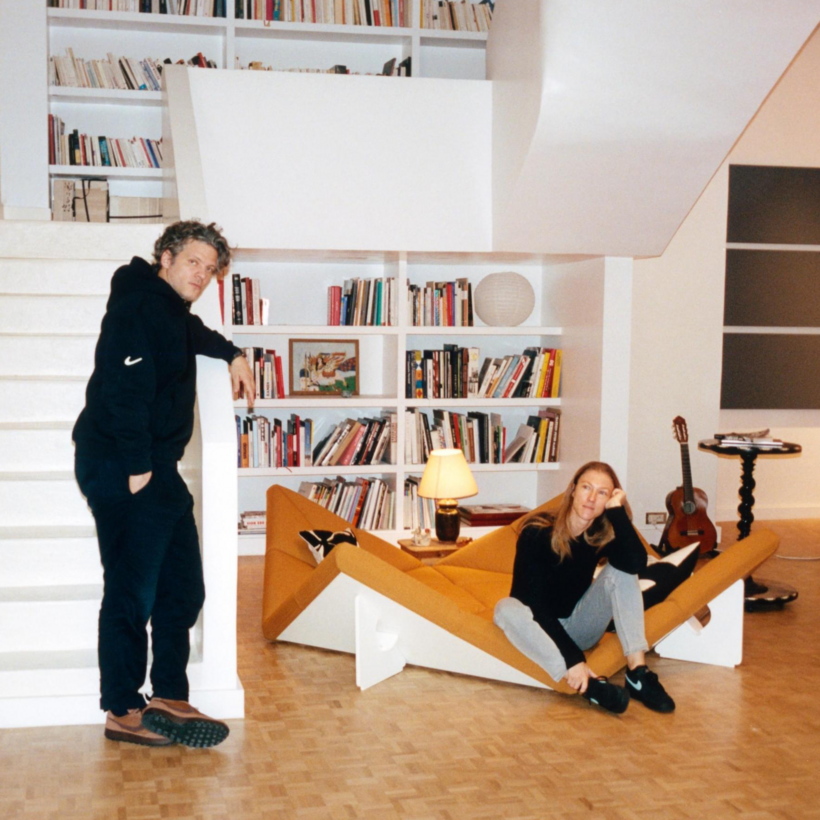
On any given evening in their modernist white house-cum-showroom in Paris’s 12th Arrondissement, Alice and Benjamin Paulin might be receiving a tour group from an American museum, 100 artists and creative leaders for cocktails, or a visiting musician who descends to their bespoke basement recording studio to lay down some tracks. The dynamic stewards of the legacy of Benjamin’s father, the visionary 20th-century designer and decorator Pierre Paulin, this nimble couple is devoted to sharing the inspiration that began in 2013, with the founding of their new company based on Pierre’s credo of finding comfort and poetry through functionality.
Born in 1927, Pierre dreamed of a career as a sculptor, but the dream was abruptly derailed by an arm injury. Instead, he began working in design in the 1950s. He went on to invent chairs such as the Groovy and the Tongue in the 60s, to reconceive the Denon wing of the Louvre, and, eventually, to redesign a suite of private rooms for President Georges Pompidou at the Élysée Palace in 1972, as well as the office of François Mitterrand, among other modernist civic, industrial, and installation projects. (The Élysée dining room and smoking room have recently been restored, and the smoking room will soon tour museums.)
“I felt the need to create a new dialogue with my father that was not a dialogue we had during his lifetime,” says Benjamin, 47, a high-school dropout who was obsessed with rap music early on. He never imagined he and his wife, Alice, 40, would one day oversee an ever expanding organic enterprise which now includes Paulin Paulin Paulin, the production arm for Pierre’s unrealized prototypes and the reissue of his celebrated furniture designs; Sounds Like Paulin, a recording studio, which will soon drop its first in-house record-label compilation; and an archive of more than 350 vintage Paulin pieces for a museum envisioned near the family home in Les Cévennes, in southern France. “Each strand informs the other,” says Alice.
The couple’s family narratives similarly intertwine. Alice grew up in the Maison à Bordeaux—the experimental home designed by Rem Koolhaas around the special needs of Alice’s father, the French newspaper publisher Jean-François Lemoine (now in MoMA’s architecture collection)—and once designed the artisanal fashion line Le Moine Tricote. Her mother, Hélène Lemoine, worked as Pierre’s studio colorist in her youth, but Benjamin did not meet Alice until she was 17, when they began dating.
“I felt the need to create a new dialogue with my father that was not a dialogue we had during his lifetime.”
In 2019, they mounted an installation of Paulin pieces in the Bordeaux house, a high point of the alliance of the two creative families for whom design has always been integral to their lives.
When Benjamin is not jamming with rap stars like Travis Scott or Theodora, he personally supervises the careful installation of Paulin pieces for their global clientele. Meanwhile, Alice is a whirlwind of activity, checking swatches and orders, Zooming with clients and fabricators, and organizing visits to the Paris house, or hopping on her bike to escort the couple’s three young daughters to school.
Last fall, at Design Miami.Paris, she was hands-on when it came to finishing the fair’s only bespoke booth with stained wood floors and walls, kitted out with an undulating Paulin Déclive sofa in chocolate-brown leather accompanied by a John Cage music-box sculpture playing a piece by Erik Satie. As fairgoers arrived, she demonstrated its adaptability by draping herself over the highest arch. A mere hour later, she was ready to receive guests at home in Dries Van Noten golden heels.
Downstairs, visitors mingled cozily in the Video Barnum, a giant upholstered Paulin floor piece with its own built-in speakers, as a Chaplin film unspooled on a movie screen. (Fair warning: once you relax onto a Pierre Paulin creation—intricate combinations of factory metal piping, Pirelli molded foam, and stretchy swimsuit fabric—you may never want to get up.) Upstairs, in the elegant living room featuring a Sol LeWitt mural and shelves of curated zines and books, others perched on a Paulin Big C sofa as the artist Koenraad Dedobbeleer began a spoken-word performance. Office staff descended from the mezzanine, which overlooks the open-air, central atrium, to lend a hand.
“We are not scientists or professors of design,” Alice says, “nor are we just a brand. Every time a big step happens, we say, ‘This is the new starting point.’” Now Pierre’s dream of discovery through functionality is in full flower. “We are intuitive, not strategic,” adds Benjamin. “We are re-inventing things. We feel this amazing energy from my father, but we use it for our own personal excitement. We are connected to the world of now, and to the future.”
Patricia Zohn has contributed to numerous publications, including Wallpaper, Artnet, the Huffington Post, The New York Times, and the Los Angeles Times
