

The club in Crans-Montana, Switzerland, was called Le Constellation. But the terrible events that took place in the early hours of New Year’s Day, when 40 people died and 119 were injured in a fire, were not written in the stars.

They were the result of a series of systemic failures. Fire controls had not been enforced by the canton since 2020. Soundproofing foam, soft and highly flammable, had been stretched across a low basement ceiling. A fire exit had been padlocked to avoid paying for an extra bouncer. The main staircase, once 10 feet wide, had been narrowed to 3 in 2015. And then there was the “golden sprinkler”: a pyrotechnic flare attached to a champagne bottle, lifted toward the ceiling by a woman in a biker helmet and, eerily, a man in a Guy Fawkes mask.

Videos flooded social media almost immediately, documenting the tragedy in real time. At 1:26 A.M., the ceiling ignites. Young people can be seen filming the foam as it melts above them. They didn’t have much time to plot their escape—within 120 seconds, the room reached a flashover.

The space turned orange as temperatures soared past 1,000 degrees Fahrenheit—heat so intense it incinerates not just objects but human airways. “There were 200 people trying to escape within 30 seconds through a single, narrow staircase,” a survivor later recalled. All the while, a sinister French rap song blared in the background. Just five minutes after it began, it was already the deadliest disaster in modern Swiss history.

A memorial to the victims of the Crans-Montana nightclub fire.

In the aftermath, public grief was quickly eclipsed by digital vitriol. On social media, users criticized the victims’ responses. “I’m glad I grew up in a time without a phone where I learned to run away from danger instead of pulling up my phone,” one Instagram video comment read. “Wow guys, the building is on fire, let’s just record and die,” another added. “No common sense.”

Some directed their anger at parents grieving children lost to the fire. “The duty of any parent is to put their children on guard against danger,” one user wrote. “The parents are disgusting for letting their children do whatever they want,” said another.

“There were 200 people trying to escape within 30 seconds through a single, narrow staircase.”

But there are biological reasons they didn’t run. Research by Stephanie Burnett and Sarah-Jayne Blakemore at University College London shows that risk-taking peaks around age 14. Teenagers are neurologically wired to prioritize social reward over threat. The D.J. kept playing, and as the ceiling melted, the pull of capturing the spectacle for peers likely overwhelmed survival instincts that were still maturing.

There is also the question of trust. In Europe, societies still place deep faith in institutions to keep people safe. That trust shapes how young people experience freedom. It may be why, in the United States, first beers and first kisses tend to happen at the homes of friends, while in Italy, France, and Switzerland, teenagers often have those same experiences in bars and clubs, often as young as 14 or 15.

Every February, during the settimana bianca in Milan, schools close and the more fortunate students decamp to friends’ houses in the mountains. In small Alpine towns, teenagers roam freely, testing independence, relationships, and alcohol. And for the affluent Milanese, including some of those who died in the fire, “the mountains” often means Switzerland: Crans-Montana, Saint-Moritz, Gstaad.

In these resorts, 70 to 80 percent of homes are second residences owned by foreigners. And in each of these towns, there is always “the bar”—the place where young teens mingle. In Gstaad, it’s GreenGo. My first flirtation happened in Saint-Moritz, at a pub called Bobby’s, the local equivalent of Le Constellation. Patrons 14 and 15 years old were allowed to smoke freely inside, packed into wooden rooms thick with cigarettes. You could buy a pack from a vending machine for nine francs.

I had my first vodka-lemon there. After my second, I threw up in the snow out back. I tried my first cigarette, too; I didn’t know how to use a lighter, so I lit mine from a friend’s. “You had to have your first experience somewhere,” a friend told me recently. “It might as well be there.” I’m told Saint-Moritz teens still go.

The unspoken consensus during weeks like the settimana bianca is parental leniency. Crime rates in these mountain towns are near zero, and homes are within walking distance of one another. “I went to Le Constellation with my friends,” a 40-year-old Crans-Montana regular tells me. “It’s where I had my first kiss.” Another regular says, “I sent my kids there because other parents sent their kids there. It sounds terrible, but it’s true.”

“I went to Le Constellation with my friends. It’s where I had my first kiss.”

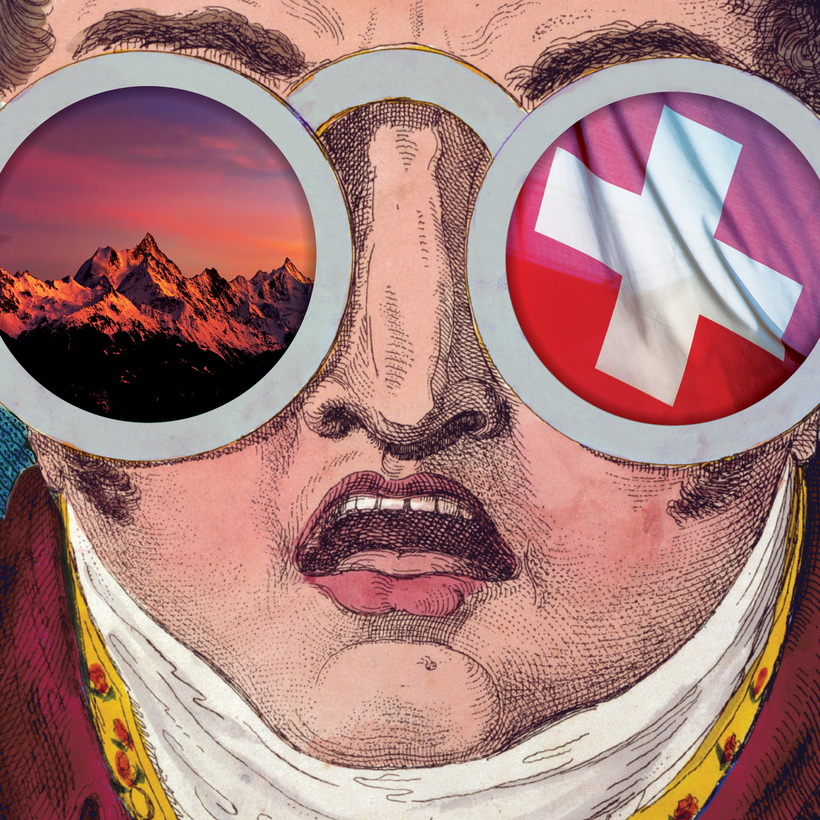
Another essential element in the Crans fire was trust in the Swiss brand. The white cross on a red background has long been as synonymous with safety as the Red Cross. Switzerland ranks fifth on the Global Peace Index. Driving five miles over the speed limit can result in fines exceeding 10,000 francs, calculated according to income. The country has 360,000 bunkers, enough to shelter nine million people in the event of war. Men keep military-issue guns in their homes to protect against an invasion that hasn’t happened since 1815.

But as this tragedy has shown, while the federal government in Bern projects total control, Switzerland’s highly decentralized cantonal system allows for a kind of regulatory “Wild West.” Exempt from many E.U.-wide rules, cantons can, it seems, place profit above safety. As the Neue Zürcher Zeitung and other Swiss media outlets have begun to ask: If the “Swiss seal of quality” cannot guarantee the well-being of teens in a mountain resort, why should the world continue to trust the nation with its gold and its secrets?

Before owner Jacques Moretti was detained on January 9, there had already been signs of evasiveness from the cantonal prosecutor, Beatrice Pilloud. A video from 2020 shows a club employee scolding a guest for playing with a sparkler on New Year’s Eve. “Careful with the foam,” she warns.

Public anger has since boiled over following reports that families struggled for weeks to obtain autopsy results, with Swiss authorities initially releasing bodies to Italian relatives without providing a formal cause of death. “We are not just grieving; we are fighting a ghost,” one father told an Italian broadcaster. “They told us our children died of smoke, but they wouldn’t show us the reports. They treat the truth like a state secret.” Silence has long been the Swiss modus operandi—but with stakes this high, they may have to come clean.

Outrage followed news that Moretti was freed from custody yesterday evening on $254,000 bail, posted by a close friend whose identity authorities have not disclosed—an outcome that, for critics, encapsulates Switzerland’s well-worn reliance on discretion and money. Moretti’s wife and business partner, Jessica, remains at home with their child. A trial date has not yet been set. “I have no words to comment on the release from custody in Switzerland of Jacques Moretti,” Foreign Minister Antonio Tajani told Il Corriere della Sera. “It is an act that represents a true affront to the sensibilities of the families who lost their children in Crans-Montana.”

On January 7, a funeral was held at Milan’s Sant’Ambrogio church for four teens whose futures were extinguished. The coffins arrived in black cars while people looked on in tears. One speaker, 14-year-old Elena Costanzo, addressed her dead sister. “I’m so angry that you left this world at 16,” she said, her voice echoing through the basilica, “just because you wanted to celebrate New Year’s.”

“What happened in Crans-Montana is not a misfortune,” Italy’s prime minister, Giorgia Meloni, said, “it is the result of too many people who did not do their job or who thought they could make easy money.”

In Milan, at least, we all remember, with painstaking clarity, what those early celebratory moments were and how sheltered we felt. “It touched so many people because it felt like a double violation,” one Crans-Montana regular says of the tragedy. “You are learning to trust the world. You are taking your first steps into adulthood. It was a betrayal of everything we were told to believe.”

Elena Clavarino is a Senior Editor at AIR MAIL