
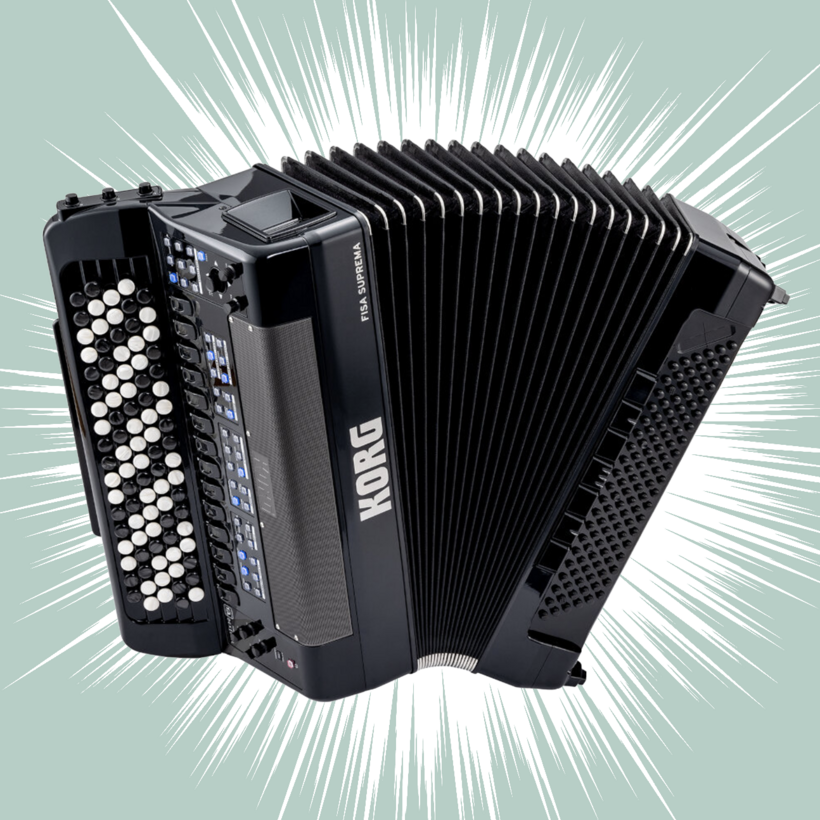

the Korg fisa Suprema

One of the most extraordinary musical instruments you’ve ever heard

“A gentleman is someone who knows how to play the accordion, but doesn’t,” Tom Waits has said. Or maybe Mark Twain. Or maybe Noël Coward. There can’t be too many quotes attributed to such an incongruous triumvirate, but then there are few instruments as polarizing as the squeeze-box.

Whatever, I hope it’s not too much of a shock for readers to know that these columns are produced in an accordion-filled home. The two in-house accordions—lately three, for reasons I will come to—are nothing to do with me. No, the accordionist is my art-historian partner, Sarah Jane Checkland, who has been playing for 25 years. And I have to admit, I do like hearing the sounds of Paris, Palermo, New Orleans, and so on wheezing in from the sitting room.

Those incoming sounds have been upgraded recently to something truly remarkable, because Sarah Jane is trying out a new and highly unusual digital accordion, a Japanese-Italian co-production called the Korg Fisa Suprema. And I have to report, it is one of the most extraordinary musical instruments either of us has ever heard.

It’s truly an accordion, not just a portable variation on a Korg electronic keyboard. So the bellows, which one could imagine is fake, provides the essential wind just like on a traditional machine. Korg describes its invention as an “aero digital instrument” to emphasize this. The electronics and the beautifully rich and vivid 112-watt internal amplification are, however, wholly digital. Accordingly, you can play through headphones, or through external amps, either wired or by Bluetooth.

The Fisa Suprema replicates 45 accordion types from around the world and enables you to personalize to a level I don’t pretend to understand but which I’m assured is extremely impressive. “Choose the type and combination of reeds, decide whether the reed is placed inside or outside the cassotto, select the type of growl and mechanical noises, decide your tuning, and configure the bass layout to your preference,” Korg says. You can even selectively age the sound of the instrument, or do that characteristically accordion thing of changing the sound by moving your body forward and to the side while playing; it achieves the latter using a two-axis accelerometer.

Where the Korg Fisa Suprema goes beyond the realm of your average accordion is when you start adding in more instruments and styles. The Fisa Suprema makes you not so much a one-man band as a one-man orchestra. If you’re thinking this sounds a bit cheesy, well, perhaps it is, but it’s seriously quality cheese. There are some great demos on the Korg Web site showing what the thing can actually do, but I also recommend looking up YouTube videos by a variety of accomplished performers to see the amazing diversity of the Korg Fisa Suprema. We particularly admire Richard Noel, a concert accordionist in Bakersfield, California, who also offers a range of downloadable alternative sounds for sale.

Whether Tom Waits, Noël Coward, or Mark Twain would have a change of heart because of the Korg, it’s hard to say. But we love it so much, we’re planning to buy one. On the practical side, it’s lighter than most accordions, although still hefty, and the battery lasts nine hours.

MONTBLANC DIGITAL PAPER

Montblanc Digital Paper, $905.

An impeccable digital writing pad from the virtuoso pen manufacturer

We’ve always been big fans on this page of the Norwegian-designed reMarkable range of paper-like writing pads. Now Montblanc, the renowned fountain-pen maker up in the north of Germany (far from the actual Mont Blanc, which stands where France, Italy, and Switzerland meet), has come up with what seems to be a super-deluxe and even better version of a reMarkable, the Montblanc Digital Paper. The Montblanc does look uncannily like the reMarkable, but neither company admits to any collaboration.

Montblanc achieves impeccable physical quality in all its products. It’s true they are even more into silly spin-offs than their compatriots at Leica—there’s even Montblanc aftershave—but they are serious regarding excellence.

Needless to say, the feel of the pen in the hand is a cut above, too. When you get to writing, the German product offers a tangible upgrade. It’s a superior experience altogether to the already excellent reMarkable. There’s a tad more friction to simulate paper, and there’s something indefinably sophisticated about the nib, which is hardly surprising, coming from such a virtuoso pen manufacturer.

My handwriting is horrible, and the more slippery screen of the reMarkable (which in turn is far superior to the iPad for handwriting) means when I use either of these, my scrawl becomes wholly indecipherable. However, with the Montblanc, I found it far easier to write legibly. Without any special effort, I adopted an almost elegant hand in which I could write for pages and pages.

The new features that have appeared recently on the reMarkable, from the (slightly underwhelming) colored-pen facility to a way the pad has of straightening indistinct lines if you’re into drawing diagrams, are not there on the Montblanc, but if you just want to write, spending the extra couple of hundred on the new offering is well worth it. The leather case is really fine for an extra $205, and there’s even leather worked into the tablet itself.

Paprika

Paprika 3, $4.99 for phones, $29.99 for Mac/P.C.

A handy recipe organizational app

We used to have a rather random method of buying groceries in our house, whereby everyone scribbled things we needed from the store on scraps of paper and the person shopping amalgamated them all, normally without conspicuous success.

Technology has now come to the rescue, however, in the form of the Paprika 3 app, developed in Hawaii, and it works across all our phones and laptops to unify our shopping lists in real time. So when you’re shopping, you have an up-to-the-minute list of everything the household is short or needs for a particular recipe.

Better still, albeit with some complication, Paprika can store all your favorite recipes and tell you exactly what you need even if you’re in the supermarket when you suddenly fancy cooking a particular dish. The cost of Paprika 3 is a one-off—there’s no subscription.

Lijiang Ancient Town

Lijiang Ancient Town construction kit, $109.99.

A perfectly relaxing construction kit

We have a lot of discussion about construction kits in this family. I have always loved building them, but my womenfolk can’t see the point of laboring hard to re-create someone else’s design.

To me, it’s a sort of mindfulness thing. When you’re concentrating on instructions, your mind goes into a Zen state. O.K., it comes right out of the Zen state when you’re occasionally fulminating at the idiot who wrote the manual, but on the whole it’s a restful and relaxing pastime. I spent three months during the coronavirus lockdowns soldering together an unbuilt Heathkit shortwave radio from 1975. Even though it didn’t quite work, I still look back benignly at what could be called a total waste of time.

Anavrin is a design studio in Salt Lake City that creates kits from which detailed miniature dioramas of historic houses and quaint stores in China, Japan, and Korea are yours to build. They typically take 10 to 12 hours to make—a perfect project for a few cold, dark winter evenings.

I chose their 605-piece Lijiang Ancient Town kit, a tiny bookshelf-height model of a section of street in Lijiang, a UNESCO World Heritage Site in southwest China with winding cobblestone streets going back 800 years. The diorama is lit by a string of L.E.D.’s, which rather charmingly replicate lanterns and windows. The electronics don’t plug into an outlet, but a couple of basic AA batteries keep it lit for weeks. Building the little scene was everything I’d hoped for, and no fulminating or manual throwing was required, just a tube of glue.

Based in London and New York, AIR MAIL’s tech columnist, Jonathan Margolis, spent more than two decades as a technology writer at the Financial Times. He is also the author of A Brief History of Tomorrow, a book on the history of futurology