He was studying writing; his betrothed was studying film. He’s a Syrian refugee; she had to flee the creeping authoritarianism of Russia. And yet they found each other. A breathless profile in The New York Times tells us that as love began to blossom between the young students, “make-out sessions began to occur spontaneously.” The couple, wed in 2022, were both students at Bard, the evergreen safety school for the disappointing children of our ruling class.
The Vows column is standard Style-section fluff, telling us which important figures and institutions these crazy kids are associated with to explain why we care they found love. But reading the profile of Mohamad Eisa and Yolka Gessen left me with a kind of dread, the kind that comes when a spin-off from a hit show spawns a spin-off of its own, promising/threatening hundreds of new hours of content to keep up with. In this specific case, it was the information that there’s a whole new branch of the Gould-Gessen family to pay attention to as the next generation comes of age and is ushered into cultural dominance.
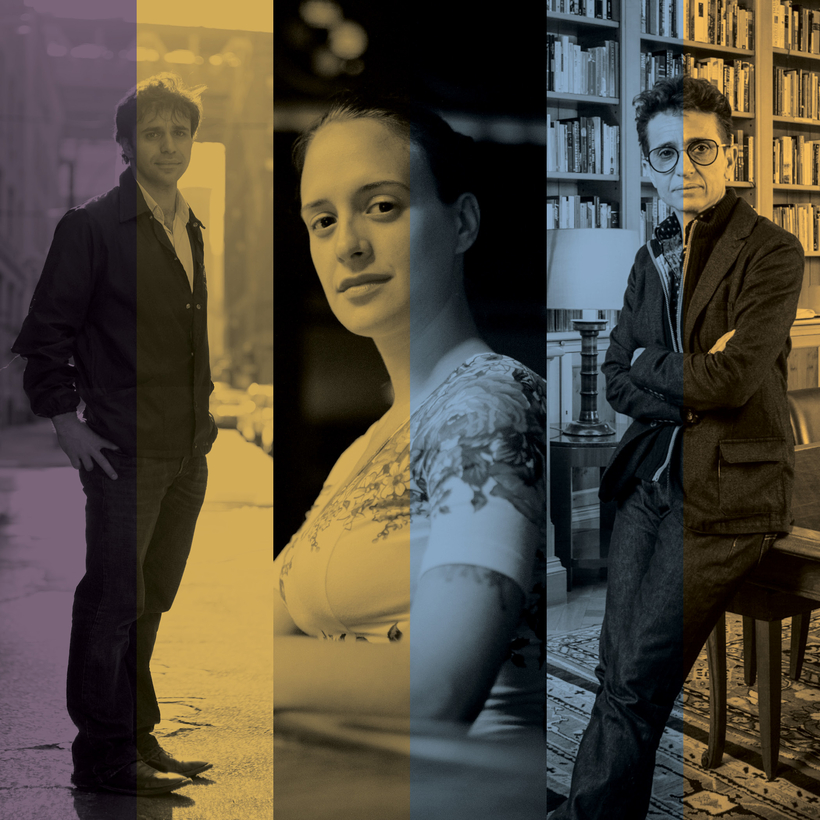
Emily Gould, Keith Gessen, and Yolka’s mom, M. (formerly Masha) Gessen, are a trio of publishing personalities who find themselves mysteriously, perpetually employable and at the center of media discourse. Emily is the personal essayist of the bunch, like Erma Bombeck on a psychopharmaceutical cocktail (which I mean as a compliment), whose every work sets off an internecine conflict between her hate readers and her defenders. She is married to Keith, the intellectual, whose Harvard degree and association with institutions such as Columbia University—where he teaches journalism—and The New Yorker give him an aura of greatness that his actual writing can’t manage to conjure. And his sibling M. is the queer dissident journalist, an omnipresent force on the New York Times Opinion pages and in The New Yorker, where she argued that presidential candidate Pete Buttigieg is “not gay enough.”
But Emily, Keith, and M.’s primary cultural contribution, more significant than any of their individual writings, is their personas. They present an image of the important artistic family, like the James siblings of Henry, William, and Alice in the 19th century, or of the fashionable, creatively productive marriages of the 20th century: Elizabeth Hardwick and Robert Lowell, Joan Didion and John Gregory Dunne, Sylvia Plath and Ted Hughes. And for decades now they’ve fed us lifestyle porn of a New York life of the mind, of cultural production, of eternal relevance, all wrapped up in cozy domesticity and a tightly interlocking professional circle.
Like the world’s least compelling reality series, The Brooklyn Intellectual Elites is now in its 20th season, broadcast directly into your media diet like one of those auto-playing videos that crash the page of the news story you were trying to read. And no amount of reloading, ctrl+alt+delete-ing, or slamming your laptop shut will keep you from absorbing the earworm jingle and the hyperbolic nature of its content.
In the show’s debut season, in the first decade of the millennium, Emily and Keith were introduced simultaneously but separately. Keith and his college friends launched the literary magazine n+1, which promised to be a new Partisan Review for twentysomethings who knew what Partisan Review was. Gould was a blogger at Gawker, the trashy but wildly influential New York gossip site that was like Page Six for media workers who didn’t know what Partisan Review was. He was the sad young literary man of his debut’s novel title; she was the mean-girl queen bee who had appeared on the cover of The New York Times Magazine supine on an unmade bed, with a sultry gaze and a sleeve of tattoos whose wearers were, in that time, still confused with being countercultural.
Their relationship was the subject of gossip and speculation spread through the comments sections of blogs, early-days social media, and young writers envious of their domination of both the high and low ends of New York media. It was all the more scandalous that n+1 published a takedown condemnation of Gawker and its practices, making Gould and Gessen the “will-they-won’t-they,” “love-you-hate-you” rom-com characters of media gossip, as well as (according to the rumors) being immortalized in Adelle Waldman’s hit novel The Love Affairs of Nathaniel P. And then their love was made official when Gould hinted that Gessen’s disapproval of her place of employment was the reason for her decision to leave Gawker behind in her publicly posted resignation announcement.
Soon the spotlight widened to include M. (then Masha), whose reporting from Russia—where the Gessens’ intellectual parents had immigrated from—was soon finding prominent placement at publications including The New Yorker and Vanity Fair. An out lesbian in Russia during a time when the state was threatening to strip gay couples of parental rights and was banning L.G.B.T. activist groups, M. found fame as an activist journalist and spokesperson. Their clashes with Putin, their family’s high-profile return to the United States, and their charge of spreading false information—for which they were tried and sentenced in absentia—only solidified their image as an important dissident voice, which was very useful for speaker bureaus and people who went to cultural festivals wondering, “Should we know more about what’s going on in Russia?”
The Gould-Gessen family continued to crank out books, but few people seemed as interested in their writing as they were in the drama of their lives. M. married and divorced, married and divorced, married and divorced, and married. Each ceremony gave them the opportunity to pontificate on the meaning of gay marriage and unconventional family constructions in major magazines. Keith found a renewed interest in his work once he stopped writing novels that were lovingly reviewed by his professional contacts but left no real mark on the culture and instead turned his attention to writing heartwarming accounts of raising a difficult child (who will, no doubt, grow up to write his own account of being written about by his professional-writer parents). The promotional media cycle allowed both Emily and Keith the opportunity to dish about the professional resentment that infuses a marriage with two ambitious people pursuing careers in the same industry.
Soon their marriage hit the gossip sites again, as word of a split came out, as well as Emily’s public attempt to crowd-fund money for her divorce, followed with an awkward announcement of reconciliation. And then Emily published an essay in New York detailing a manic episode, her descent into heavy drinking and wasteful spending, and time spent in a psychiatric hospital. It was during that spiral that she had decided to leave her husband, and during her recovery that she decided to stay. Her style of writing made it seem as if she were sitting across the table from you, digging in her purse for some tissues, dramatically explaining why she had been texting you at three a.m. in all caps, while you, slightly embarrassed, try to gauge if her raised voice is attracting attention from others in the diner. It’s addictive. Even people who seem to have given up on the show tuned back in once children showed up in the storyline.
The audience responded by doing what anyone reading about a celebrity divorce, or even a breakup of a loved one’s relationship when they are not around, does. They speculated on which person in the relationship was to blame and who won the breakup. This went on for ages on social media, like an exciting season finale that ends on a cliff-hanger. It was largely determined that Gould, who confessed to infidelity in the essay, was firmly in the wrong and that Keith’s decision to take her back was cuck behavior. But it’s inevitable that there will be more confessionals by and profiles of the couple to come, right around the time they have another book to promote, wherein they discuss healing the divide created by the betrayal and hint at just enough new sites of fracture to keep us coming back next season.
I once found myself attempting to explain the various strands of controversy and discourse around this essay to my husband, and an expression came over his face that I have only seen on him moments before he taps out when he’s caught in a choke hold at his jujitsu gym. But as the Gould and Gessen children start to discover new forms of self-expression and step into the limelight their parents created, and the audience perks up with “Oh yeah, that name sounds vaguely familiar, are they related to, oh yeah, hmm,” we’re promised decades more content to come.
And if the absence of a private life can be understood as a kind of trauma, the second generation of the Gould-Gessen clan will have plenty of material to work with: from Keith and Emily’s documentation of their son Raffi’s childhood to Emily’s revelation that Keith was the sperm donor for M. Gessen’s partner’s second pregnancy (Emily was “livid” that he didn’t consult her first), to the exposure of Yolka’s young, fragile love to the all-seeing eye of mass and social media in The New York Times’s Vows column. Why accrue therapy bills when you can get paid to process it all in public?
Jessa Crispin is the former editor of the literary blog Bookslut, the editor of the Substack the Culture We Deserve, and the author of the book What Is Wrong with Men