
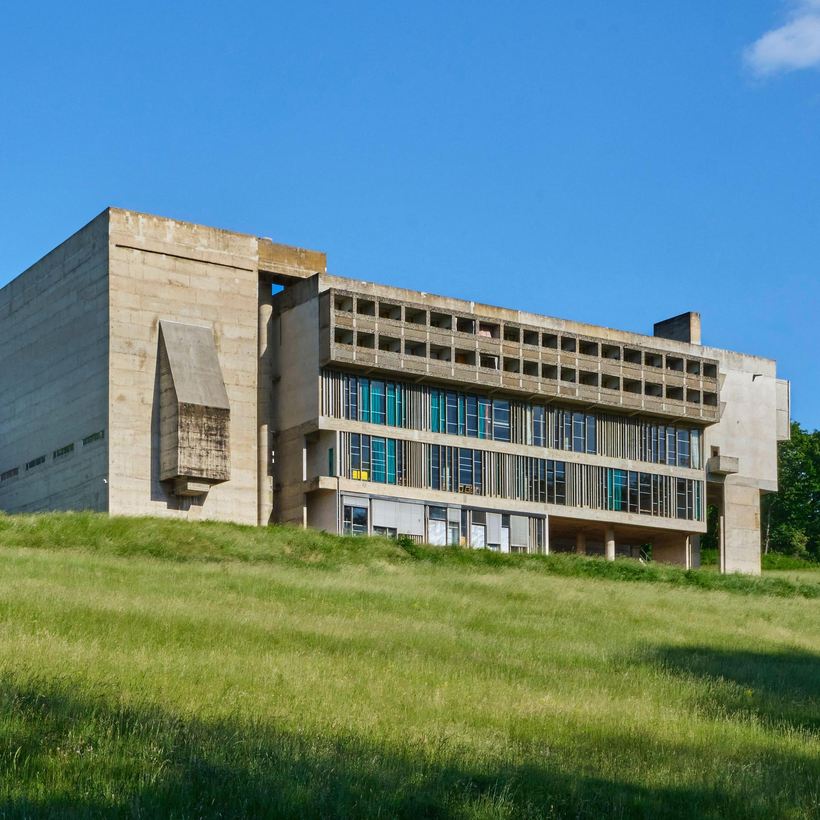
“Of course La Tourette is your favorite ‘Corb’ building,” a friend observed. “It is a city.” I had just returned from France, where I visited a chapel and a convent designed by 20th-century architect Le Corbusier: Chapelle Notre-Dame du Haut, completed in 1955 and colloquially known as “Ronchamp,” after its home village; and Couvent Sainte-Marie de la Tourette, completed in 1960 atop a verdant valley outside of Lyon.
Ronchamp is a kaleidoscopic jewel box in and of our earth, a luminous sanctuary visited by everyday souls in search of solace and redemption. By contrast, La Tourette is a city on a hill built for the Dominican order, who inhabit a silent life where chants become prayer and mortality is but a stepping stone. These two architectural masterworks are separated by two hours on the TGV, but the otherworldliness of La Tourette makes the trip interstellar.
Conceived in the ashes of World War II, the monastery resembles an earthbound space station formed by Le Corbusier’s signature raw concrete, le béton brut. The entry portal reveals but a glimpse into its dizzying courtyard, a brutalist collage reminiscent of both our earliest cave paintings and the etchings we would later place on Voyager. It is Guernica rendered in three dimensions, an homage to our ambitions and failings as a species.
Remarkably, for around $67, you get not just your own “cell,” complete with a sink, a minuscule bar of soap, a slightly larger towel, fresh bedding, and a monastic armoire suitable for a cabin bag, but also a crisp Beaujolais and a homey dinner served by a surly local, plus a Continental breakfast the morning after. Immaculate, gendered restrooms are down the hall—hot water from red pipes, cold from blue. Showering amid the rough-hewn concrete conjures a sense of exfoliation, but this is no spa.
The experience is about the beauty of austerity: no frills, many chills. Sleep arrives slowly in your single bed as footsteps echo in the hallway past your door. Fellow guests? Monks? Spirits? Each cell has a balcony. Outside, the wind and animals can be heard rustling in the woods. Night dims the lights. The Name of the Rose invades your dreams.
Hasselblad charged, I rose early to see the sun caress the concrete with first light. Monks, few but friendly, shuffled toward morning prayers in the chapel, a stark, timeless space. Unlike the brief tours offered to day-trippers, an overnight guest has free rein, other than the occasional locked room. But we guests know our place; we may observe but cannot join.
Hope pervades the melancholy of this enchanted vessel, a place that forces us to reflect upon our capacity for change. It is a world unto itself, a world away from our world, the creation of which is unthinkable in this moment, and perhaps any, other than the fleeting moment in which it is forever cast.
Vishaan Chakrabarti is the founder of Practice for Architecture and Urbanism