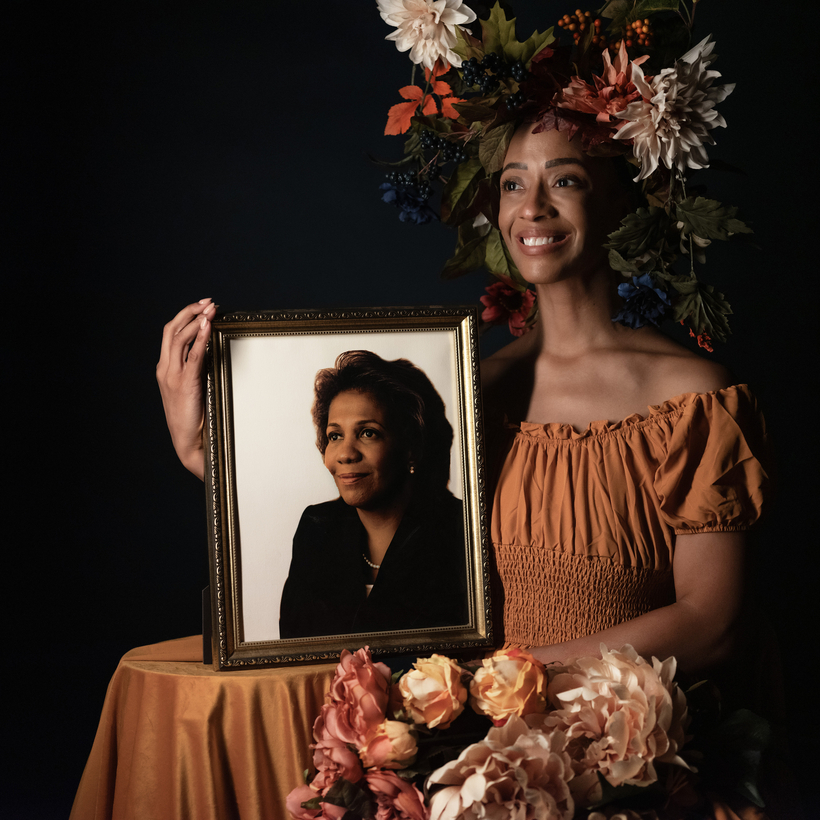

The Flower Bearers by Rachel Eliza Griffiths

Her wedding is at noon, but in the few hours that remain before the ceremony, Rachel Eliza Griffiths is more focused on bygone times—this explains the imaginary conversation she’s got going with her sharp-tongued, critical mother, who’s been dead now for almost 10 years—than she is on the future and its glittering possibilities.

“The hotel suite thrums with my past,” Griffiths, the author of several books of poetry and a novel, writes in her deeply felt memoir, The Flower Bearers. “Despite and beyond death, some mothers and daughters go back and forth this way. The elder tosses out a question that is less question than judgment. It may be posed as a question only to indicate that the daughter should have anticipated the other’s response. In this instance, the daughter—me—sometimes still needs her mother’s posthumous opinion even as she—I—protests that she is old enough to write and to live her own stories.” (Undoubtedly, many of the daughters reading this will relate.)

Fair to say that Griffiths is a woman of singular stories: she’s about to exchange vows “with a wondrous man, a man I’ve called my ‘boyfriend’ for the past four years,” she writes. “My ‘boyfriend’ is three decades older than me. My ‘boyfriend’ is older than my father. My ‘boyfriend’ is one of the greatest writers of the twentieth century.”

Her “boyfriend” is Salman Rushdie, lest we forget, the object of a 1989 fatwa issued by Iran’s Ayatollah Khomeini for blasphemy in his novel The Satanic Verses. The Ayatollah’s call for his assassination sparked threats of violence; Rushdie, who was knighted by Queen Elizabeth in 2007, went into hiding for several years.

Griffiths and Rushdie, who had briefly encountered each other at a reading in 2005, met again at a 2017 PEN event when Rushdie collided with a massive glass door that he mistakenly believed was open. Nose bloodied, glasses cracked, and head dinged, he thought it would be best to leave. Griffiths offered to see him home, where they talked for hours. “Time,” she writes, “spilled like water.”

Griffiths hilariously recalls the day she introduced her infamous beau to her adorably clueless father. “‘Now, Salman,’ my father began, mispronouncing his name so that it sounded like salmon. ‘I heard you mention that you’re a writer like my daughter. It’s good that you both do the same things. It’s good you have things in common.’”

When told that Rushdie had written books, Griffiths’s father eagerly probed for more information: “Where would I find some of these books you say you’ve written? Would they know your name at Barnes & Noble?”

Griffiths and Salman Rushdie at a 2023 Center for Fiction benefit, where Rushdie received the Lifetime of Excellence in Fiction Award.

For his part, Rushdie worried that his future father-in-law would not take kindly to the news that Rachel was involved with a 70-something-year-old. (He was born in 1947; she, in 1978.) “This seemed more important than all the other things,” Griffiths notes, “even a fatwa and four previous wives.”

The Flower Bearers—the title refers, in part, to a tradition of the southern Black funeral in which a woman carries flowers into the service—charts two singularly horrific events and their aftermath: the sudden and mysterious death of Griffiths’s longtime best friend, the poet Kamilah Aisha Moon, in 2021, and the stabbing attack that almost killed Rushdie the following year.

Griffiths and Moon met at Sarah Lawrence, where they were both graduate students. Working together on a poetry anthology, they quickly became inseparable—keepers of one another’s secrets, each other’s chief cheerleader, and the first call in times of trouble and triumph.

The two hung out together in New York City, going to jazz bars, dance clubs, and diners, slowly gathering the courage to read their poetry in public. “It was serious business to get up on that shoebox-sized stage and aim your mouth at the mic. Because it was your heart, your rage … your sex appeal, your accent … your lover, your city … your entire humanity at stake.”

Moon called Griffiths “chica”; Griffiths would serenade Moon with her own version of the Minnie Riperton song “Lovin’ You.” Being friends with you is all I wanna do …

Griffiths and Kamilah Aisha Moon.

Her anguished account of learning about Moon’s death on her wedding day (many of Griffiths’s friends and family members had gotten word that morning but kept it from her until after the ceremony) is tough to read: “I fight to pull what is left of me back into my flesh my body my voice howling so hard the skin stretches against my skull the diamonds on my ears and fingers cut my flesh…. They told me I kept saying, I can’t stay. I can’t stay.” The cause of Moon’s death at the age of 48 remains a mystery.

Less than a year later, Rushdie was about to give a lecture at the Chautauqua Institution in upstate New York when a knife-wielding man leapt onto the stage and stabbed him 15 times in the face, neck, arm, abdomen, and eye. Rushdie was left partially blind and with permanent nerve damage. (He chronicles the trauma in his 2024 memoir, Knife.)

For two years after the attack, Griffiths was crazed. She drank too much, ate too little, and was unable to sleep without pills. “I dislike the woman I am becoming,” she writes, “trapped between the grief for my friend and the trauma of my husband’s attempted murder.”

Griffiths writes with great candor and bravery about the mental-health challenges that have dogged her throughout her life—depression, a suicide attempt in her 20s, and dissociative identity disorder. But while one admires the put-it-all-out-there quality that infuses her work, things sometimes feel a bit overworked and overwritten. “They form an uncanny Janus coin that spins around on the silent bloodstained earth of my mind,” she notes of the loss of Moon and the near loss of Rushdie.

The final section of the novel, an account of Griffiths’s visit to Moon’s gravesite in Nashville and to a lake Moon referenced in one of her poems, strikes a hopeful, valedictory note. “The grief feels snuffed,” Griffiths writes. “In this moment, I know we are still inside a mirror world of water, trees, Aisha, sky.”

Joanne Kaufman is a New York–based journalist and critic