
For centuries in Britain, legitimate businesses, alongside sundry opportunists and hucksters, have been producing royal-themed souvenirs, keepsakes, and assorted jolly junk for monarchy fans and tourists alike.

The Museum of London has a Charles II commemorative mug made in 1660 to celebrate the restoration of the monarchy after a short-lived English republic. The mug, described explicitly by the museum as a “coronation souvenir,” features a crude half-length portrait of the new king, smiling if slightly cross-eyed and wonky.

But perhaps as a result of—or maybe in spite of—the current British royals’ being the world’s most celebrated dysfunctional family, Buckingham Palace now has, within 200 yards of the King’s own bedroom, four thriving, official gift shops stuffed with licensed royal merchandise.

One is in the King’s Gallery, part of the main palace building; one is a summer-only shop in the palace gardens; another is on the street alongside the palace; and the fourth, a year-round Christmas shop, is set in a mews within the main palace complex. There are also satellite stores at Windsor Castle and in Edinburgh, and online delivery is available worldwide—hurry, the final deadline for U.S. orders is December 15!

Crown Christmas-tree decorations ($22.50), and Buckingham Palace Guardsman Bears ($26).

The royal commercial enterprise extends to catering too. Almost wholly unknown to most Brits—as are the gift shops—there’s even a Buckingham Palace coffee shop, offering beverages alongside treats as varied as bagels and lox, strawberries and cream, coronation chicken sandwiches (see what they did there?), Queen of Puddings (they did it again), and a $37 afternoon-tea box.

Much of the trinketry on offer in the regal gift shops—which, thankfully, are not styled as “shoppes”—is made in China, and most are sternly marked as “Copyright His Majesty King Charles III 2025.”

Some of the memorabilia is tasteful and of high quality, some charming, some amusingly kitschy—and almost all expensive. For research, and Christmas-gift purposes, Air Mail confesses to buying from the tackier end of the range two Buckingham Palace “luxury shower caps” ($12 apiece) and a fridge magnet ($8).

In the lobby of the largest of the stores, the King’s Gallery outlet, customers are greeted by an impressive 25-foot Christmas tree decorated with 200 glass and fabric (“recyclable”!) crowns, which sell for $22.50 each and are “inspired by” the crown used by monarchs for their coronation.

Drink tea like a queen with the Queen Elizabeth II Centenary Collection.

Among products inside the store, at the higher end of the scale, you can get royal-branded Mappin & Webb carriage clocks for $5,295 each, a Balmoral brand 1978 single malt ($4,160 a bottle), a Launer Royal Blue Traviata Bag, as used by Queen Elizabeth II ($3,430), gold Buckingham Palace and Windsor Castle pocket watches ($1,950), and a set of six coffee cups and saucers “inspired by” Fabergé pieces in the King’s collection ($650).

On the jewelry counter (“Treat the lovely ladies in your life with something special from the home of official royal gifts”) under large, backlit photos of the King and Queen Camilla wearing matching crowns, and Catherine, Princess of Wales, modeling an extravagant diamond necklace (notably not on sale), the prices are more modest, from the made-in-China Gold Hematite and White Pearl Collar for $286, right down to rings and hair clips for $26.

Also in the more accessible merchandise, you can rummage among “God Save the King” cooking aprons ($26), Buckingham Palace guardsman bears ($26), honey from Balmoral ($11.65), and Crown-stamped wooden egg cups ($6.45).

While the “©His Majesty King Charles” labeling may look like a marketing ploy to make a hand towel or a throne-shaped Christmas-tree ornament appear more authentic and desirable—at which it rather succeeds—it’s a warning that the royal family can be dogged litigators. Since Queen Victoria’s day, citizens purveying goods to whom the royals take objection on copyright grounds have been pursued legally. Letters from the Palace’s lawyers have been described by recipients as “terrifyingly firm.” The cases never make it to court, though, as wrongdoers inevitably back down.

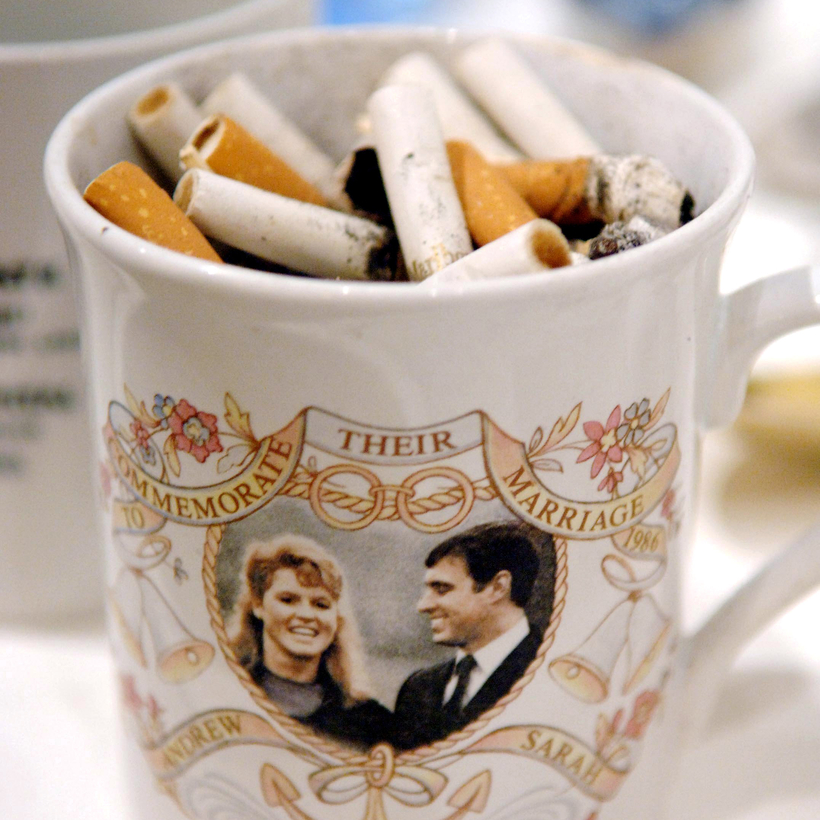
One thing your reporter couldn’t help noticing among the piles of royal matter for sale is that not a molecule of it celebrates the family’s outliers—Princess Diana, “the Prince Formerly Known as Andrew” (as Brits increasingly call the former Duke of York), Sarah Ferguson, Prince Harry, and Meghan Markle are permanently out-of-stock in souvenir land.

Asked if there were any Prince Andrew mementos, perhaps reduced, a young Italian employee said with admirable directness, “He no work here no more.” Princess Diana? “No, sorry. Maybe try Kensington Palace, where she lived.”

It made one think the stores could bring in some extra money if they had an official doghouse, where collector’s items depicting no-longer-in-favor royals could be sold. Just suggesting, Your Majesties.

Welsh-made socks from the royals’ in-house brand, Corgi.

For the modern British royals, making money is nothing new. In 1990, when he was still Prince Charles, the King started a line of organic foods, Duchy Originals. Now that he can’t be too involved for reasons of state, it’s been rebranded as Duchy Organic (all profits go to charity), its eggs-to-pasta-to-steaks produce sold through the tony Waitrose supermarket chain.

And at the King’s country pile, Highgrove in Gloucestershire, there’s yet another royal enterprise selling a range of Charles products, from signed lithographs of H.R.H.’s paintings ($4,500) to jars of mustard ($7.35).

The royal family’s commercial ventures, it’s only fair to say, are not used to keep the family in tweeds and tiaras. All profits are donated to various charities and good causes. The royals’ last annual report reveals half of their $117 million income was given away.

On the other hand, when you’ve seen lines of Chinese tourists waiting to buy Chinese-made British-royal knickknacks to take home to China, it becomes clear that the P.R. value of keeping “the Firm,” as the royals often call themselves, in business is priceless.

Based in London and New York, AIR MAIL’s tech columnist, Jonathan Margolis, spent more than two decades as a technology writer at the Financial Times. He is also the author of A Brief History of Tomorrow, a book on the history of futurology