
In the most stylish enclaves of New York City, it’s not easy to turn 50 without becoming a nipped-and-tucked facsimile of one’s younger self. This applies even to restaurants—unless, that is, they are appropriated by new New Yorkers who overly romanticize the past.

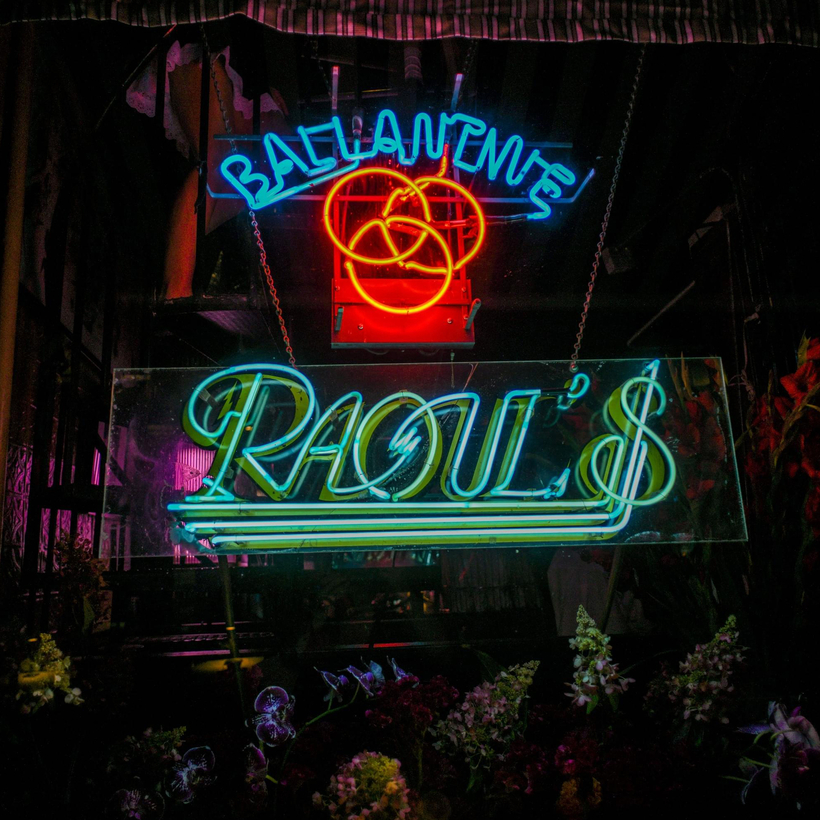
Raoul’s, on Prince Street, still appears as it did on opening night in 1975, but fortunately it’s attracted a new crowd while retaining many of its original regulars.

At Raoul’s, everyone has always been welcome—70s artists, 80s-era supermodels and photographers, the indie-film stars of the mid-90s, the Wall Streeters of the turn of the millennium, and everyone and their mother of today. Somehow, despite its enduring appeal, the restaurant has evaded both popularity and irrelevance.

For a certain kind of creative expense-account type, be it a fashion designer, artist, actor, or art director, there’s no better place to celebrate a project or take a date. (Or find one.) Many of them also frequent Omen, around the corner, for a quiet work dinner or low-calorie catch-up, but Raoul’s is where you go when you want the night to have repercussions.

Katie Holmes and Chloë Sevigny at a Madewell fashion show and dinner, held at Raoul’s in 2023.

Actor Chloë Sevigny’s arc fits the mold. “I discovered Raoul’s in the 90s through friends in the art world,” she says. “It was and remains a favorite for that crowd, with its Larry Clark and Bruce Nauman, amongst others, adorning the walls. I was immediately taken with the restaurant, the endless gladiolus, the fish tank, and the tarot-card reader upstairs. I spent countless nights walking through the kitchen to the old back room or cozy in a booth celebrating birthdays with their famous caramelized dome dessert, eating oysters and artichokes to my heart’s content with friends and lovers. I brought my husband there on our first date for their coveted burger only served at the bar between certain hours. Years later, we would return with our child to my favorite room in Manhattan.”

From its inception, celebrations have been foundational. The building was a Portuguese dance hall in the 1800s and housed a string of Italian restaurants until the French brothers Serge and Guy Raoul bought it for $15,000 from the owner of Luizzi’s on the condition that her husband and their cat, Inky, could stay.

Serge, a correspondent for France 2, wanted his brother to serve the classics they’d grown up eating at their parents’ restaurant, in Alsace. After launching Raoul’s, he intended to return to his filmmaking career. (That never happened.)

The brothers opened with such anemic funds that Guy cooked with the food that had been left in the walk-in, improvising Italian dishes for two weeks. Serge invited European television journalists who were reporting on the artists transforming SoHo. In turn, they brought those artists and dealers, who were happy to have a late-night restaurant in the neighborhood.

Clockwise from top: the restaurant today; Serge and Guy Raoul; maître d’hôtel Rob Jones, who performed nightly as Dusty Springfield.

An under-the-radar hot spot was born—a venue for a spontaneous Saturday Night Live cast party where one might spot the likes of Robert De Niro at the bar. (Perhaps watching women wind their way up the perilous spiral staircase to the bathroom.)

They didn’t exclusively come for the food. “We’re not trying to re-invent the wheel,” says Karim Raoul. The son of Serge as well as a filmmaker himself, Raoul grew up at Raoul’s and stepped in after his father’s stroke in 2010. The classics—artichoke vinaigrette, oysters, frisée salad, steak (tartare and au poivre), and profiteroles—are the touchstones. Whenever he’s tried to remove such a dish, says Raoul, “people were visibly upset.” The tepid reviews they’ve received over the years don’t really matter: “Either you get it or you don’t.”

In 2014, Raoul put a dish on the viral food map: He convinced the (reluctant) chef, David Honeysett, to make a bar burger. Honeysett came up with a play on their steak au poivre and limited it to 12, based on the number of buns in a package. The late Esquire journalist Josh Ozersky named it the best burger in America, creating a line that formed at 4:30 for the 5 o’clock opening and hasn’t shortened since.

The French brothers Serge and Guy Raoul bought the restaurant for $15,000.

The restaurant’s energy and conviviality still make it feel like a private party every night. That’s the work of long-standing employees such as maître d’ Eddie Hudson, who’s been there since 1978 and who gives the restaurant what Raoul calls its “Cheers factor.” The glossy-black pressed-tin ceiling and booths, pink neon, and framed nudes hanging throughout the dim room culminate “into one big feeling.”

That feeling is timelessness. “When you walk into that space, you feel completely disconnected from the world,” explains Raoul. “It could be 1980, or it could be Paris, or it could be New York in 2025.” In that sense, he says, “celebrities feel comfortable there.” The staff ensures that every guest feels welcome: “No matter who you are, once you’re in, everyone is the same.”

But sometimes a presence is so big it can’t be ignored—Diana Ross, who came after a 1983 concert in Central Park, was the first to stun the dining room into silence. The same goes for Bill Clinton, who visited in 2000 and shook hands with the entire staff. (The dishwasher was nervous because he thought the president was there to deport him.)

Urban legend has the model for the nude painting on the left as Sarah Ferguson. (It’s not.)

Today, Raoul’s is an institution based on a version of New York that few remember. Raoul tells the story of a tourist in her early 20s who described her love of the restaurant as “so old-school New York.” When pressed, she couldn’t quite explain why, or what “old-school New York” was actually like. Ultimately, she told Raoul, “it doesn’t matter what the reality is.”

It holds true even for octogenarians who remark, “The steak au poivre tastes exactly like it did in 1985.” Raoul laughs and says, “I’m like, ‘If I give you the steak au poivre of 1985, you would send it back.’” Today’s version is much more appealing. Over the past 50 years, it seems, even Raoul’s has learned a thing or two.

Christine Muhlke, a former editor at The New York Times and Bon Appétit, is a co-author of Wine Simple and Wine Simple: Perfect Pairings with Le Bernardin’s Aldo Sohm. She is also the founder of culinary consultancy Bureau X and the creator of the Xtine newsletter