
An essentially illiterate man, someone who’d never read a novel or even a newspaper article all the way through without difficulty, helps resurrect and then extend the career of one of America’s foremost novelists. More than that, he becomes one of that novelist’s closest friends, caring for him until the day he dies, and then tends tirelessly to his legacy. Together, they form one of literature’s oddest couples and surely its most improbable and successful collaborations. On their first joint venture, they end up loathing one another and vowing never to work together again. But they—Norman Mailer and Lawrence Schiller—simply can’t stay apart, and only a few years later they’re back at it, with a book that wins the Pulitzer Prize: The Executioner’s Song.
Mailer I never managed to meet. But Schiller I’ve known for almost 30 years, going back to the O. J. Simpson trial. A couple of years ago, I was shocked when publishers passed on his proposed memoir, which I was helping him write; after all, for most of his nearly 90 picaresque years, years of nonstop energy, ingenuity, guile, and hustle, Schiller has been able to sell just about anything. True, his life story might have been a fact-checker’s, and maybe a lawyer’s, worst nightmare, but in my very subjective judgment at least, it would also have become a classic, for never has there been a life like his, nor—in a time when personalities have flattened, and shadows shortened—will there ever be again.
Along with entanglements with everyone from Lee Harvey Oswald to Marilyn Monroe to Timothy Leary to Patty Hearst to O. J. Simpson to Yuri Andropov, Schiller claims innumerable firsts: first to document photographically the culture of L.S.D.; first to get pubic hair past the postal inspectors and into Playboy; first to show the Jackson 5 what an ocean looked like. But his complex bond with Mailer would have provided the longest, most important, and spiciest section in the book.
Mailer’s first biographer, Peter Manso, once calculated that Mailer’s collaborations with Schiller over 35 years constituted “more than one-third of Mailer’s total career output.” Notwithstanding Mailer’s multiple wives and mistresses, Manso added, “for sheer longevity none had hooked him like his marriage to Schiller.”
And it continued long after Mailer’s death, in 2007. By establishing a writers’ colony at Mailer’s home in Provincetown, holding an annual gala for it in New York, and repackaging his books, Schiller helped fend off the inevitable posthumous dip in Mailer’s reputation. “I remember Gay Talese coming to me and saying, ‘I want a Larry Schiller for my legacy,’” Mailer’s youngest son, John Buffalo, tells me.
To this day, the dyslexic Schiller, now 88, has never really read much of what Mailer wrote with or without him. Even The Executioner’s Song, Mailer’s best-selling “true-life novel” fashioned almost entirely from Schiller’s interviews and reportage, Schiller read only very laboriously, hopping on a transatlantic jet, regardless of the destination, where he could shut out the rest of the world, to do it. Bizarre as that might sound, to Schiller, failing to read the work of his best friend was no big deal; why, he once asked me, did he have to read Mailer, when he’d had the privilege of knowing him for 40-odd (and 40 odd) years?
No one has ever been able to describe who or what Larry Schiller actually is or does, and, for all his narrative and analytical skills, that included Mailer. “There’s nobody like Larry,” he once said. “He’s unique, absolutely unique. Don’t pretend that you understand the man, or know where he’s going.” When, testifying at the trial of Charles Manson, Schiller described himself as a “communicator,” it prompted a raised eyebrow from the judge, and laughter from the gallery. It wasn’t exactly wrong, but nor was it very clarifying.
Schiller has made a career of ubiquity, a profession of proximity. For decades—as a photographer, researcher, reporter, writer, packager, director, producer, publisher, fixer—he materialized wherever and whenever events happened, then pushed, maneuvered, or burrowed his way to their lucrative core, often becoming a player in the process. Perhaps the best terms for him are “insinuator” and “ingratiator.” He hasn’t slowed down, but he has showed signs of becoming slightly less outlandish.
In the early 1960s, he wormed his way into Marilyn Monroe’s confidence, then her dressing room, then the movie set where she skinny-dipped for him (Hugh Hefner paid Schiller a then record $25,000 for those pictures), then her Thunderbird when it was parked outside Schwab’s drugstore, then her house in Brentwood, then her garden on the last day of her life, then her funeral.
A year later, he reached Dallas only hours after John F. Kennedy had been assassinated, in time to photograph a glowering Lee Harvey Oswald in the corridors of police headquarters, and, in one of his most indelible images from those dark days, Lieutenant J. C. “Carl” Day, of the Dallas Police Department, holding high above his head the shooter’s Mannlicher-Carcano rifle. A couple years after that (by which point he’d befriended Marguerite and Marina Oswald, the assassin’s mother and wife), he recorded Jack Ruby’s last words on the Uher reel-to-reel tape recorder he’d somehow smuggled into Ruby’s hospital room in Dallas.
Through F. Lee Bailey, Schiller got Time an exclusive jailhouse interview with Patty Hearst and a cover photograph of her for himself. In early 1977, on the eve of America’s first execution in a decade, he was the only journalist to hear Gary Gilmore’s dying declaration, then witness a firing squad finish him off. Two decades later, thanks to his friendship with Robert Kardashian, he became a key adviser to (and bankroller of) the “Dream Team” defending O. J. Simpson. When an overzealous bureaucrat stripped Schiller of his seat in the courtroom, Johnnie Cochran pleaded to Judge Ito, “You can’t do that, he’s paying our bills!” (His seat was quickly restored.)
It was Schiller who, unbeknownst to Cochran and Robert Shapiro, spent 16 hours interviewing their client in the county jail before his trial, from which he cobbled together I Want to Tell You, the best-selling collection of Simpson’s prison ruminations, which put more than $1 million into the defense’s coffers.
Various other Schiller-engineered projects, such as supermarket-tabloid exclusives, kicked in at least $1 million more—minus Schiller’s own cut, of course. It was also he who helped re-stage Simpson’s house shortly before the (mostly Black) jury stopped by, replacing the picture of the (white) model Paula Barbieri on his nightstand with one of Simpson’s elderly and infirm mother. And it was Schiller who’d made the muffled, incendiary racist rants of Detective Mark Fuhrman intelligible enough for all to hear.
The Simpson case was probably Schiller’s supreme coup, showcasing all of his skills—personal, technical, strategic, and literary. It was during that trial, which I covered for The New York Times, that I first beheld Schiller, a portly man in a baggy brown safari suit, chain-chomping peanut M&M’s in the corridor, and became only the latest in a long line of reporters and competitors to sell him egregiously short. Which Schiller, who thrived on being misunderstood and underestimated, only encouraged. He resurfaced sporadically and unpredictably, leaving successive generations of suckers to crack his code anew.
Schiller undoubtedly holds the world record for bad first impressions. “The Ziegfeld of grim reaping,” one naysayer called him. When, 13 years after the original production, the Dallas city fathers let Schiller re-stage the Kennedy assassination on Dealey Plaza for a TV movie (something even Oliver Stone didn’t get to do), Tom Shales, of The Washington Post, dubbed him “the Dino de Laurentiis of the graveyard.” When one of Schiller’s chroniclers fished for a fresh metaphor with which to malign him, Schiller graciously came up with one: “carrion bird.” More than any other, it stuck.
Folks like me went through the same serial stages with Schiller, from puzzlement to revulsion to wariness to skepticism to frustration to condescension to amusement to acceptance to admiration and even to affection, though rarely without reversals en route, and almost never to the promised land of total trust.
Where one lands with Schiller depends in part on how long one lingers. Mailer followed that same path, though with bigger bumps. “I’ve known some hustlers in my day,” he once told Schiller, “but when it comes to hustling—there ain’t too many … ” And then words failed even him. But as Mailer told Playboy in 1997, Schiller “worked hard to purify himself. He has changed more than any person I know. He is now very much a man of substance.”
A Hustler with Substance
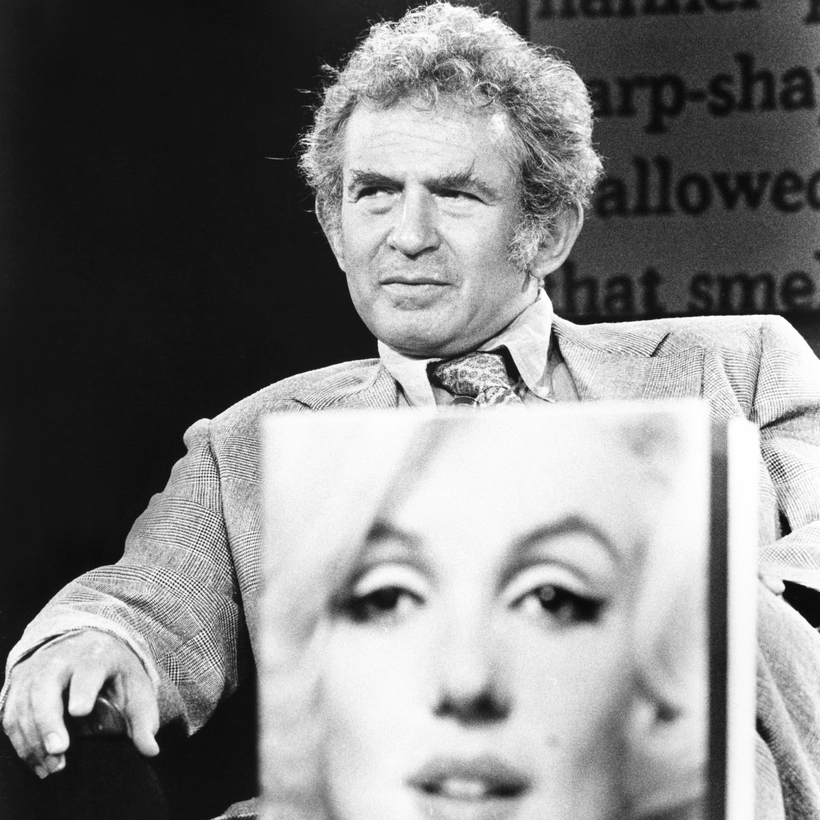
They’d begun in 1972 by collaborating on a book about Marilyn Monroe, for which Schiller assembled the pictures (including several of his own), then recruited Mailer to write the text. It was “a shotgun marriage,” Mailer recalled, “a shidduch made in Hell,” using the Yiddish word for an arranged match. Schiller’s very appearance, before a black beard gave him a patina of wisdom and maturity, offended Mailer: he looked like a wheeler-dealer. Marilyn: A Biography, as their book was called, sold more copies than anything Mailer ever wrote, but by the time it was published, the two men were barely speaking. As far as Mailer was concerned, they would never speak again. But Mailer’s endless financial woes and the sheer power of Schiller’s Gilmore materials enticed Mailer back.
So it was that a man unable to string together a few respectable sentences, who didn’t know “there” from “their” or vowels from consonants, who routinely misused some words (e.g., “garnish” publicity) and invented others (“obliviate”), rescued Mailer from bankruptcy and gave him security, prosperity, and companionship in his final years. Schiller became Mailer’s advance man and agent, champion and protector, anticipating his misbehavior, cleaning up his messes, inserting himself into the line of fire. And, more than anyone else, Schiller helped Mailer achieve greatness.
All of which Mailer was loath to admit. Complimenting Schiller too effusively or publicly seemed to pain him; describing the boon he’d been to him, the eloquent Mailer suddenly went inarticulate. (Schiller, he once said, was “someone who gave, um, uh, sustenance to my economic life.”) His very dependence on Schiller seemed to make him meaner to him. “He’s able to get a lot of great things done,” Mailer once told his son John Buffalo. “But you have to watch him like a hawk.”
People who’d thought Schiller a rube and a pushover were amazed at how he took Mailer on. “The problem with you is that you never fucked Marilyn Monroe!,” Schiller would taunt him. “If I’d known I’d have to kiss your ass, I would never have shaved,” was how Mailer launched one of their periodic reconciliations. Working on the Monroe book, they’d nearly come to blows once in a United Airlines Friendship Lounge.
After re-uniting a decade later to retrace Oswald’s pre-assassination life in Minsk, the two wrestled their way down a dank stairwell. But whatever his frustrations with Schiller, Mailer kept coming back for more. “Norman was not always happy to hear from Larry, but he never refused a call,” said Mailer’s longtime friend and biographer, J. Michael Lennon. And, craving the respect and respectability that Mailer was uniquely able to confer, Schiller never stopped calling.
So it was that a man unable to string together a few respectable sentences rescued Norman Mailer from bankruptcy and gave him security, prosperity, and companionship in his final years.
Slowly and begrudgingly, Mailer came to realize that in his own very irregular way, Schiller, too, was a genius, with an “infallible instinct for a good story” and an uncanny ability to get people to open up. “He’s got antennae all over the place, and sees possibilities where others don’t,” Mailer said. “He senses possibilities in all the little fissures of history, and enters them.”
“You walk in on every fucking thing that goes on,” he told Schiller once. “We’re always making history in the place you are.” Then there was Schiller’s knack—despite his insistence he was merely a sponge, absorbing everything he saw—to alter whatever he witnessed. “You have much more effect on your immediate environment than almost anyone I know,” Mailer told him. “Once you get the picture, the picture’s never the same.”
Mailer came to enjoy the very improbability of their bond; for someone ensconced and forever embattled in catty literary circles, hanging out with someone so admiring, before whom he didn’t have to strut or put on the usual tough-guy shtick, must have been a relief. Schiller elicited from Mailer a tenderness and solicitude he rarely displayed in public. It was Mailer who, while cooking up some spaghetti for themselves in their Belarusian kitchen, first diagnosed Schiller’s dyslexia, another of those five-dollar words Mailer used that Schiller hadn’t heard before.
“We’re always making history in the place you are.”
For their own reasons, each kept their relationship mostly under wraps. Schiller feared his sketchy reputation would besmirch Mailer. Even after Mailer’s death, he took care to hide his fingerprints; though he donated half a million dollars to the writers’ colony in Provincetown, he kept these facts almost entirely to himself. Mailer, too, remained mum, either for fear that too much enthusiasm for someone so unconventional, disdained, and untutored would either raise eyebrows with his fancy friends or give ammunition to his detractors. Hadn’t Tom Wolfe, eager to take him down a few pegs, once described how Mailer’s career had floundered until “a remarkable Santa Claus named Lawrence Schiller” came along with his “reportorial gold mine” on Gilmore?
Read the acknowledgments and you’ll see that the first person Mailer thanks for The Executioner’s Song isn’t Larry Schiller but Gilmore’s girlfriend, Nicole Baker, and that when he finally gets around to Schiller, he shortchanges him. “Without Schiller, it would not have been feasible to attempt the second half of the book,” he writes, failing to note that without Schiller the first half would have been equally impossible.
“To Larry, a true collaborator, genius, kid brother, maniac, monologist, prick, and general factotum, cheers,” he once inscribed a photograph of the two of them. Mailer kept his greatest praise for Schiller private. “To Larry, because he is in the warp and woof of this book and so much of it is his,” was how he inscribed Schiller’s personal copy of The Executioner’s Song. But Schiller was too blinded by love and gratitude to see such slights; to this day, he feels he got the better of the bargain.
With Mailer and everyone else, Schiller’s needs were modest. “Beneath the fat, behind the bark, Lawrence Schiller wants to be recognized as a functioning person in the company of other functioning creatures,” Art Seidenbaum, of the Los Angeles Times, wrote about him—in 1966. Mailer gave Schiller the two things he craved most, things even his own wiles couldn’t supply: confidence and credibility. The bar Mailer surmounted with him was low, but few others in Schiller’s life had ever even tried.
“I do not think of myself as a generous man,” Mailer once observed. But he became the elementary-school English teacher Schiller never had, or might have had but hadn’t listened to, or wouldn’t have understood even if he had. Mailer heard Schiller out and intuited what, with his impoverished vocabulary, he was trying to say. (When someone, clearly oblivious to what made Larry tick, once called him an “egomaniac,” Larry had to ask the guy what it meant.)
Mailer brought schlubby Schiller into his world—places he’d never imagined entering, like the Polo Lounge of the Beverly Hills Hotel, where he’d find himself having drinks with Truman Capote or lunch with Joan Didion. And with The Executioner’s Song, he’d given Schiller a second crack at a great book, after Schiller had let the one on the Manson case slip through his fingers, with Vincent Bugliosi writing it instead.
A “writer without hands,” Schiller called himself, but like everything involving language, he mangled the metaphor: he was really a writer without words. Mailer gave him those words. It all started during a walk one night from Mailer’s home in Brooklyn Heights to the Chinese restaurant down Montague Street, when Schiller asked Mailer, in the middle of one of his interminable sentences, what a particular term meant. And Mailer told him, then told him why he’d used it, and then kept on walking, as if nothing unusual had happened. But for Schiller, it had: he now knew he could ask such a question, and not feel stupid for it.
A “writer without hands,” Lawrence Schiller called himself, but like everything involving language, he mangled the metaphor: he was really a writer without words. Mailer gave him those words.
It was on that foundation, Schiller said, that Mailer became his “blood brother.” And “second father.” And “closest friend.” And “rabbi”—someone for whom, he once said matter-of-factly, he’d have been willing to die. Inscribing a book of his photographs for Mailer, Schiller summoned a grace and eloquence Mailer had never summoned for him. “To the man who changed my life forever,” he wrote.
Mailer paid Schiller a different sort of tribute, which was to deem him sufficiently interesting and consequential to try to understand. It was partly out of necessity: Larry the character was the glue that held the second half of The Executioner’s Song together. His descriptions of Schiller, both there and elsewhere, are keen: how his obesity gave him “one more layer of asbestos against the flames”; how he “tells you what his motives are, so he can move on to other motives”; how he would like to be “the most accurate storyteller in the world” but simply can’t, because “it gets in the way of too many other things.” “That’s his worst vice,” Mailer said of Schiller’s nonstop tall tales. “I’m immensely fond of the guy, and I owe him a lot, but the way he mis-tells a story drives me up the wall.”
Schiller’s deceptions go way back, take many forms, and have multiple explanations: survival, insecurity, convenience, profit, self-protection, self-promotion, instinct, habit, carelessness, naughtiness, the scrambled circuitry of his brain. Punch lines leapfrog from one anecdote to another, stories shift locales or decades, numbers shoot up and down, weeks become days or months; Marilyn Monroe had come on to him, or she hadn’t; he’d taken an illicit pre-execution picture of Gilmore, or he hadn’t; he’d sat in on O.J.’s defense meetings, or he hadn’t.
Schiller cops to peddling “Schiller legends,” as he calls them, some for so long he’s forgotten what parts of them, if any, are true. He insists it’s something he’s outgrown, like a childhood case of asthma, but certain canards—like his claim to have photographed Ernest Hemingway’s funeral, in Idaho, for Paris Match—have endured for decades. “There may be several slight versions of this story that I’ve given in public,” he told one interviewer about another of his tales. “I’ll try to remember the reality version now.”
To Schiller, lies aren’t lies so much as “errors” or “mistakes,” things to be revised or edited as circumstances warrant, and at least in some instances, more to be relished than regretted. The director John Huston once advised Schiller that when somebody’s dead, you can dramatize his or her life any way you like. But when it came to his own life, Schiller couldn’t wait. If it ever appears, his story, like Mailer’s version of Gilmore’s, should probably be labeled a “true-life novel” and, if it wins its own Pulitzer, perhaps it would have to be, like The Executioner’s Song, for fiction.
David Margolick, a longtime reporter for The New York Times and Vanity Fair, is the author of several books, most recently When Caesar Was King: How Sid Caesar Reinvented American Comedy. He is currently completing a biography of Jonas Salk
