It has been well over a decade since Nicolas Sarkozy left the Élysée Palace in defeat, and his multiple legal battles could now provide work for an army of lawyers. However, the former French president is a hero to Yveline Renaud, and the hundreds of other people who were queuing patiently last week in front of a bookshop in Menton in the winter sun to buy a signed copy of his new book, in which he describes his recent spell in jail.

“I really wish he were back in charge,” said Renaud, 67, who put up posters in Dijon for Sarkozy during the 2007 campaign that brought him to power. “He is really able and a true politician who would be able to run France better.” Clothilde Vidal, 63, next to her in the queue, added: “I’ve been a fan since the early days. He loves France.”

The two women had both bought two copies of Le journal d’un prisonnier (“The Diary of a Prisoner”), which, even before it was released last Wednesday, had topped the best-seller list on pre-orders alone, achieving the near impossible feat of knocking Asterix in Lusitania into second place.

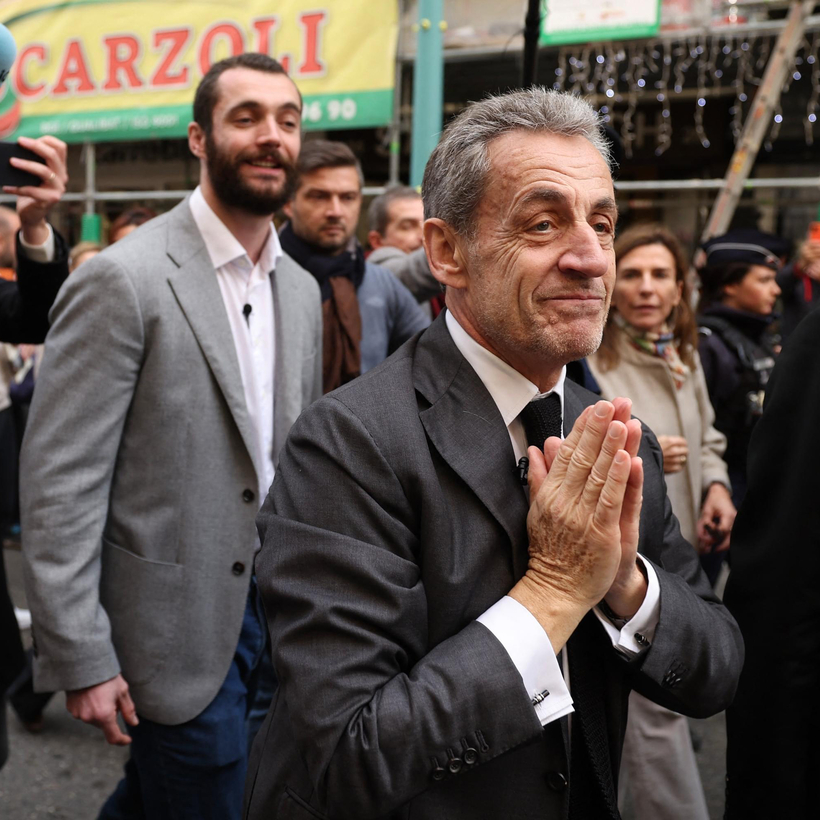
Sarko-mania! Sarkozy meets his adoring public.

Isabelle Dague, 56, had bought five copies — one of them for her three dogs, Ruby, Romance and Anouchka, which Sarkozy, 70, happily dedicated, too. “I told him we support him and miss him a lot,” she said. “And he thanked me. He was so nice.” In three hours he signed 1,000 copies.

Menton, on the French Riviera, may seem an unlikely stop on a book tour that began in grand style at a bookshop in Paris’s swanky 16th arrondissement. However, the resort town of 30,000, sandwiched between Monaco and Italy, may represent the next chapter in the Sarkozy family’s political history: Louis, his third and youngest son, has been campaigning to become the local mayor in elections in March.

At 28, he is the same age as his father was when took the helm of the Parisian suburb of Neuilly-sur-Seine in 1983, where the former president continued his tour last Saturday. “It is Sarkomania,” Louis agreed, when I walked with him through Menton’s Christmas market after the signing, where he greeted residents and sampled nougat from a stand. “And it’s very simple to explain: firstly, the political class is seen as not very effective; secondly he has always been incredibly popular since he stopped being president and always sold a lot of books. And thirdly, he just lived a hugely unjust and historic moment. Combine those three things and you have this explosion. And it is an explosion.”

Isabelle Dague, 56, had bought five copies — one of them for her three dogs, Ruby, Romance and Anouchka, which Sarkozy, 70, happily dedicated, too.

The announcement that Sarkozy senior was writing a book about his recent imprisonment was ridiculed by his critics, largely because he managed to spin more than 200 pages out of his mere 20 days of confinement in La Santé jail in Paris.

Prisoner of the Fifth Republic: Sarkozy and his son Louis greet the crowds in Menton at a book signing.

A judge released him on November 10, pending the result of his appeal hearing, which will begin in March. If he loses, he could be sent back to serve the remainder of the five-year term he was given in September for conspiring to accept millions in pounds of laundered cash from Muammar Gaddafi, the late Libyan dictator, for his 2007 campaign. Sarkozy denies the charges.

Critics mocked the former president’s horror at the soggy baguettes, plastic-feeling pillows and the inmate of a neighboring cell in the prison who spent “part of the time singing The Lion King, the other part pounding on the bars of his cell with a spoon”. The last laugh was on them, however, as the book, which was written, edited and published within a month of his release, has been flying off the shelves. Fayard, its publisher, declined to reveal how many copies had been sold.

Le journal d’un prisonnier (“The Diary of a Prisoner”), topped the best-seller list on pre-orders, achieving the near impossible feat of knocking Asterix in Lusitania into second place.

The Lamartine bookshop in Paris where the tour kicked off is true Sarkozy country. Several hours before he arrived, the queue already stretched hundreds of yards along the road past Petrossian, an upmarket grocery, and around the corner of the block.

Sebastien Chalot, 37, who regularly visits prisons through his work as a psychosocial support worker, said: “Twenty days is not nothing. I invite anyone who has never been to a prison to spend even just one day there, to see how it is.”

A heavy police presence kept protesters away — save two militant topless female protesters from the Ukrainian women’s rights group Femen, who shouted: “You should be in prison.” A cheer went up when they were bundled into a police van and taken away.

At a bookshop in a shopping center in Marseilles, on the second stop of the tour, was Angelique, 48, an English teacher, who had spent her time in the queue reading the book and had already reached page 104. Her verdict? “It’s simple — but in the positive sense, very honest and very raw. I wasn’t expecting something complicated and deep, but it was nice to read.”

“Twenty days is not nothing. I invite anyone who has never been to a prison to spend even just one day there, to see how it is.”

The single note of dissent was sounded by a bald-headed man named Axel Joly, 31, who carried a slogan that read: “Volume 2, four years, 346 days, 19,866 pages”, in reference to the number of pages he calculated Sarkozy would need to cover his stay if he is sent back in March to serve the remainder of his term.

Inside Nicolas Sarkozy: the former president’s best-selling memoir, Le Journal d’un Prisonnier.

“He has the right to write a book, but I have the right to criticize him,” said Joly. “He shouldn’t be able to monetize this and create a narrative where he’s a victim.” Were the numbers correct? “Of course, I’m a math teacher,” he said.

The book appeared to be part of a carefully orchestrated campaign by Sarkozy to win over public opinion before his appeal. He also uses its pages to bemoan the crisis into which France has sunk after eight years of President Macron’s presidency and, more controversially, to extend an olive branch to Marine Le Pen’s far-right National Rally (RN) — hitherto a foe of his mainstream conservatism.

Louis said: “National Rally voters used to be ours, they were also my father’s not so long ago. The truth is, when my father calls for a ‘union of the right’, he’s not calling for an alliance with the National Rally. He’s calling for a union of right-wing voters behind a single candidacy.”

Louis’s main opponent in the mayoral contest is Alexandra Masson, a National Rally member who has been Menton’s MP since 2022 and has no intention of stepping aside in his favor. “The RN is very strong here, but not because of her. She’s surfing a wave,” he said.

Louis spent much of his time growing up in America with Cécilia Attias, his father’s second wife, and only returned to France about a year ago, where he made his name as a political commentator on television. He and his wife, Natali Husić, 33, moved to Menton in the summer — allowing foes to accuse him of having been parachuted in.

Louis accepts he has no strong links to the town. “I am here because I chose to live here,” he said. He nevertheless has a vision for modernizing Menton and to encourage more young people to move to the town, long a haven for retirees. This would include tighter restrictions on Airbnbs and other short-term rentals that make living there unaffordable for the residents.

He claimed he was, like any son, merely basking in the pleasure of showing his father around his adoptive hometown. “I wanted to show him what we’re trying to build here, where I live, where his grandson lives,” Louis said. “Of course it has a political impact, I’m not naive, but the real priority of this day was first and foremost a personal one.”

Peter Conradi is the Europe editor at The Sunday Times of London