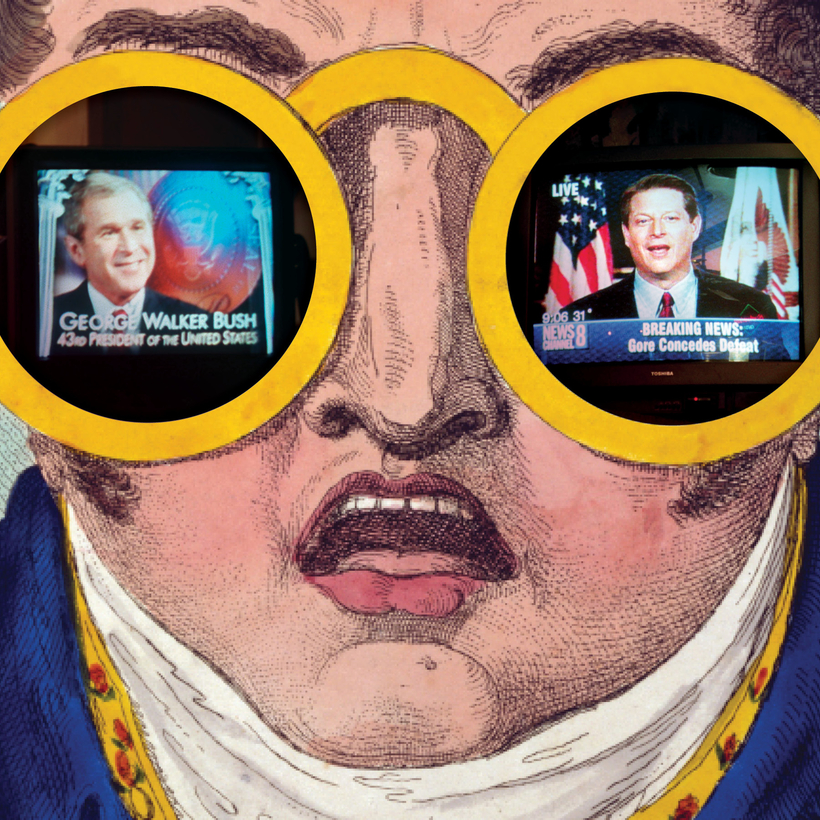

“Just moments ago,” Vice President Al Gore said in a speech to the nation exactly 25 years ago today, “I spoke with George W. Bush and congratulated him on becoming the 43rd president of the United States.” On the previous day, December 12, 2000, the Supreme Court decided the epic case of Bush v. Gore, which, by a vote of five to four, ended the presidential recount in Florida. Throughout the 36-day battle to decide the election, Gore behaved with the same kind of restraint and dignity that he displayed in his concession. Who knew, in that more innocent time, that there was a very different way for a losing presidential candidate to behave?

After his defeat, Gore retreated from politics, focusing instead on his work on climate change, which earned him a share of the Nobel Peace Prize in 2007. His relatively low profile, along with his refusal to re-litigate the 2000 election, has served to obscure what a good case he had that he actually won. He did win the popular vote by more than 500,000 votes, and though Florida was ultimately awarded to Bush by 537 votes, and with it the Electoral College by a tally of 271 to 270, we’ll never know what the full recount would have revealed, because the Supreme Court shut it down.

I was in Florida for the duration of the fight, and there was an unmistakable difference between the Democratic and Republican forces. The Gore team, led initially by former secretary of state Warren Christopher, treated the process as a legal dispute, one that could and should be resolved with a level of decorum as high as the stakes. The Republicans, led throughout by James Baker, also a former secretary of state, saw the fight as political as much as legal, and they deployed crowds, not just lawyers, to make their case. “Get out of Cheney’s house!” they chanted outside the vice-presidential mansion in Washington. When Jesse Jackson wanted to hold a rally in Tallahassee, the Gore hierarchy told him to stand down. The stylistic differences between the parties have only grown greater with time.

From today’s perspective, the most significant moment in the recount may have been the “Brooks Brothers riot,” when a group of Republican staffers staged a violent demonstration in the building where the recount was going to take place in Miami-Dade County. By screaming at the county employees, banging on office windows, and generally causing chaos, the Republicans managed to halt the recount in Miami-Dade. Gore had the chance to harvest a lot of votes in a recount of that Democratic-leaning county, but the gangsterish tactics of his opponents made sure that didn’t happen. There’s a clear line from that event, on November 22, 2000, to the one on January 6, 2021, at the Capitol.

“We’re going to the Capitol,” Trump told his supporters on January 6, 2021. “And we fight. We fight like hell.”

Indeed, it’s almost as if Donald Trump studied Al Gore’s behavior in 2000 and decided to do the opposite after he lost to Joe Biden in 2020. (And Trump did lose—by seven million votes in the popular vote, and 303 to 232 in the Electoral College.) Like Gore, Trump went to court in the aftermath of the election, but instead of eminences like David Boies and Laurence Tribe, who represented the vice president, Trump trotted out crackpots like Rudy Giuliani and John Eastman. For his efforts, Boies nearly got a majority on the Supreme Court; for theirs, Giuliani and Eastman got disbarred. Notably, too, the Gore forces sought and received recounts in Florida, because the election was close enough for recounts to matter; Trump didn’t have a single recount in any state because he lost them all by so much.

But the most important difference between Gore and Trump involves violence. At the infamous rally on the Ellipse on January 6, Giuliani called for “trial by combat,” and Trump told the throng, “We’re going to the Capitol. And we fight. We fight like hell. And if you don’t fight like hell, you’re not going to have a country anymore.” Since then, more than 1,500 of Trump’s fighters have been arrested. Two weeks later, Joe Biden took office, but Trump (unlike Gore) failed to attend the victor’s inauguration and persisted in the lie that the election had been stolen from him.

Instead of the oblivion that Trump deserved, his belligerence won him continuing political relevance and, ultimately, the presidency once more in 2024. (Gore’s decency earned him irrelevance.) On the first day of Trump’s return to the White House, there were pardons for those criminals who answered his summons to violence at the Capitol. In all, the diverging fates of Gore and Trump offer grim lessons about the country they both sought to lead. Violence pays. Lying works. Grace is for suckers. “This is America,” Gore said in his concession speech. “Just as we fight hard when the stakes are high, we close ranks and come together when the contest is done.” No, alas; look who’s president now. This is America.

Jeffrey Toobin is the author of several books, including Too Close to Call: The Thirty-Six-Day Battle to Decide the 2000 Election