
Blaze Bernstein had been a “popular, smart-alecky kid with wide-ranging interests” in his artsy California high school. After graduating, in 2016, he went on to the University of Pennsylvania, where he studied psychology and was named managing editor of the student foodie magazine, Penn Appetit. Home on winter break during his sophomore year, he delighted in cooking his family an entire Thanksgiving meal, having stayed east for the actual holiday.
Sam Woodward, a high-school classmate of Bernstein’s, could not have been more opposite—brooding, angry, and fond of racist postings on social media.

They lived in bucolic Orange County, the wealthy and historically conservative enclave south of Los Angeles whose residents basked in “the rolling hills, the lush green landscaping, and the glimmer of the Pacific Ocean in the distance.”
But everyone had secrets.
Bernstein was Jewish and gay. Woodward was a neo-Nazi—or nascent neo-Nazi. And their beautiful county was home to a festering nest of young, white racists such as Woodward. Their rage, initially stoked by hardcore skinhead bands with names like Definite Hate, Blue Eyed Devils, and Jewsslaughter, was now nourished by the pitch-black corners of the Web and the unapologetically racist rhetoric spewing from the Trump White House.
One balmy night that January, Bernstein got into Woodward’s car—and was never seen alive again. And soon, Woodward’s and Orange County’s darkest secrets would be revealed for all the world to see.
This painfully tragic encounter, its run-up, and its aftermath, form the through line of Eric Lichtblau’s American Reich: A Murder in Orange County, Neo-Nazis, and a New Age of Hate. Oscillating between alarming and infuriating, American Reich takes readers on a cross-country journey to examine how racial hatred slithered, like tentacles, out of Orange County and into the rest of the country.

It’s all here in clean, unflinching prose. Lichtblau, a Pulitzer Prize–winning journalist for The New York Times, traces the history of racism in America, with a special focus on the more recent hate crimes perpetrated in the years before and after Bernstein’s murder, such as the 2018 Tree of Life–synagogue shooting, in Pittsburgh. Another jarring example is from 2017, when 17-year-old neo-Nazi Nicholas Giampa shot and killed his girlfriend’s mother and stepfather in their home outside Washington, D.C., after they barred her from seeing him. He later killed himself in prison.
There is a certain sameness to the young, white, male perpetrators. Often raised by racist parents, they tend to be loners, with little ambition, poor grades, and substance-abuse issues. They crave a sense of belonging. Most are likely too immature to fully grasp the Nazi ideology they espouse.
But they are not all the same. Nineteen-year-old John Earnest, for example, was an over-achiever who swam for his high-school team and earned top grades. On April 27, 2019, he published a 4,000-word manifesto claiming Jews were orchestrating a “meticulously planned genocide of the European race,” drove to a synagogue near his home in San Diego County, and opened fire during a Passover service—killing one and earning a life sentence.
The book explodes with pulse-pounding tension as the police zero in on Woodward and unearth his crime. Eight days after Bernstein was reported missing, Bernstein’s body is found in a shallow grave in a park near his house. He had been stabbed 28 times. Bernstein’s parents, police, and friends eventually connect the dots when they find messages with Woodward on his phone.

Woodward had told those he knew that he delighted in fake flirting with gay young men before humiliating them. He was sentenced to life in prison for the killing, which was found to be an anti-gay hate crime. Bernstein’s grieving parents are left to grapple with their tremendous loss under a public microscope.
In time, some heroes emerge. A. C. Thompson, an investigative reporter for ProPublica, broke key details of the Bernstein murder—discovering before the authorities did that Woodward was a member of the Atomwaffen Division, a neo-Nazi terrorist network with whom he’d trained at a “hate camp” in Texas. Thompson was tormented by other Neo-Nazis for his efforts, including having his home “swatted”—a form of harassment that involves tricking law enforcement into sending an emergency response team to someone’s location. But Thompson doggedly continued his investigation.
Later, an Orange County woman named Layla Parks is so outraged when a Chinese-American family in the neighborhood is repeatedly tormented by local teens that she forms a neighborhood watch, and dozens join—so many, in fact, that there aren’t enough shifts to go around.

Lichtblau’s reporting is rock solid, but he could have used more real numbers rather than percentages to demonstrate the rise and spread of neo-Nazism, both within and beyond Orange County’s borders.
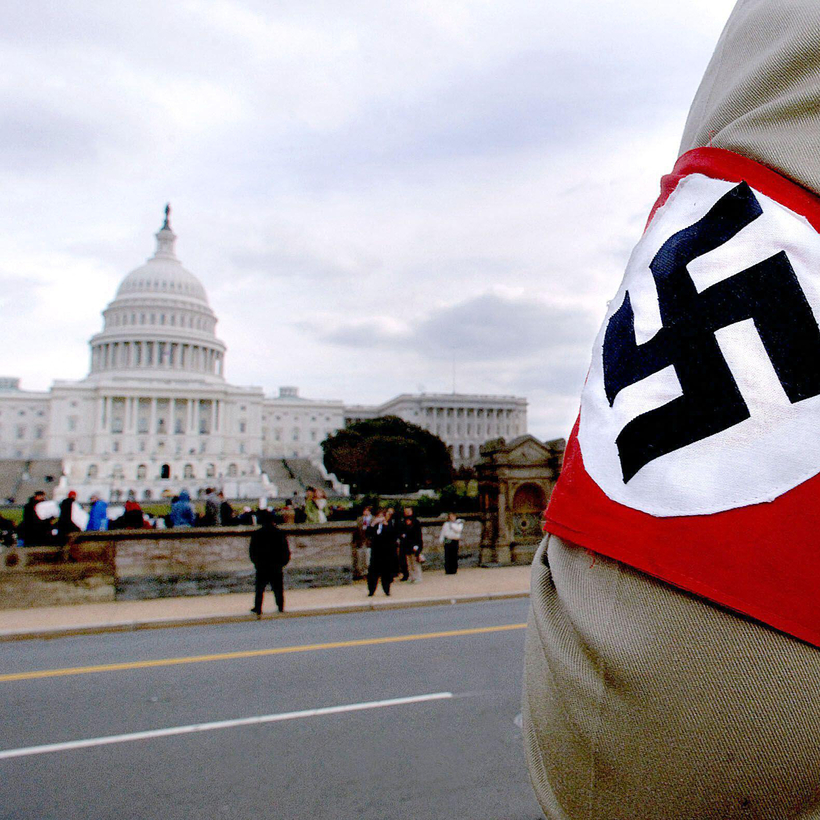
The author’s argument about the rising undercurrents of hate in America comes to a head with the January 6, 2021, riot, at the Capitol, where white-supremacist ideology was on full display.
Almost five years later, with last month’s slaughter in Bondi Beach, Australia, we are reminded that the United States does not have a monopoly on hate. Far from it—hate is everywhere. And for some, that might be reason enough to avoid this book—delving too deeply in the hate is too wearying, too relentlessly infuriating and heartbreaking. But to bring light to the darkness we must first understand it, and then, perhaps, we can do a little good, as A. C. Thompson, Layla Parks, and, yes, Eric Lichtblau, have done here.
Wendell Jamieson, a former Metro editor at The New York Times, is a co-author, with Joshua A. Miele, of Connecting Dots: A Blind Life
