
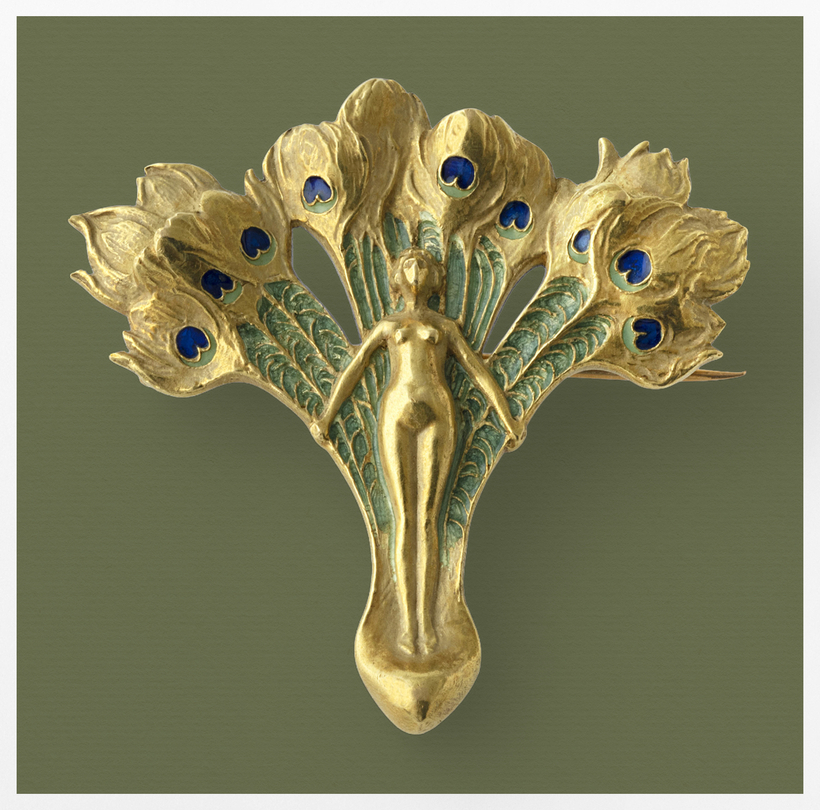

As movements in jewelry go, the Art Nouveau, dating from around 1895 to 1910, was brief. But what it achieved was seismic, thanks to the protean skills and imagination of René Lalique. Today, an exhibition of jewelry and glassworks by Lalique is always cause for celebration. Last month, the newly renovated Lalique Museum, in Doesburg, the Netherlands, opened “Magnificent Jewels! Art Nouveau & Art Deco Jewelry by René Lalique and Contemporaries.” Nearly 130 pieces by the designer, drawn from the museum’s large collection of 3,000 works as well as from private collections, form the heart of the show.
Lalique was born in 1860 in Aÿ, France, and as a young man he went to Paris to pursue an interest in jewelry. There, he apprenticed for Louis Aucoc for two years while also attending the École des Arts Décoratifs; in 1878, he went to London, where he studied at the Sydenham School of Art. Two years later, Lalique was making designs for houses such as Boucheron and Cartier. In 1890, he opened his own shop near the Paris Opera. From that point forward, until his death in 1945, René Lalique achieved mastery in jewelry as well as in glass, creating glorious vases, fountains, and decorative panels for doors and windows. He remains a virtuoso of enduring importance.