
Everyone loves an underdog story. Erin Brockovich vs. PG&E. Seabiscuit vs. War Admiral. Elle Woods vs. that snooty and dense ex-boyfriend of hers. Now another such saga is unfolding in real time as Dogue—a canine-fashion magazine run single-handedly by a Beverly Hills dog-mom—prepares to take on Vogue, via its parent company, Condé Nast.
It all started on December 5 at the U.S. District Court for the Central District of California, in Los Angeles, when Condé Nast filed a federal lawsuit against Dogue’s publisher, Tasty Work LLC, alleging trademark infringement, trademark dilution, and unfair competition. The complaint claims that Dogue’s “deliberate” use of a title “nearly identical” to Vogue was “obviously” intended to mislead consumers about any affiliation between the publications. It goes on to say that Vogue has suffered damage to “its business reputation and goodwill” as a result of Dogue’s existence, and that, “unless restrained,” Dogue would cause “irreparable damage” to Condé Nast.
If Condé Nast prevails, Dogue will have to cancel their trademark application (which remains pending before the Trademark Trial and Appeal Board), recall and destroy all infringing materials, hand over any profits tied to the infringement, and pay for damages, legal fees, and any other additional compensation the court deems “just and proper.”
“My company is a one-person L.L.C. and not currently profitable, which makes it extremely challenging to defend against this kind of litigation,” Olga Portnaya, the founder and editor of Dogue, who writes under the pseudonym “Oli Port,” tells me. Condé Nast did not respond to a request for comment from Air Mail.
Portnaya is a 41-year-old self-published author, freelance photographer and graphic designer, but her full-time job is running Coverdogs—an app that turns photos of pets into magazine-style covers, along with its corresponding Instagram account—and Dogue, both under the same L.L.C. “Dogs are my inspiration and the reason behind my work,” she says.
Portnaya’s all-things-canine career began in 2013, when she opened an Instagram account for her childhood pet, Boss, a Dogue de Bordeaux (also known as a French mastiff), whose breed she says helped inspire the name for Dogue. At the time, the world of petfluencers—social-media influencers who are, indeed, pets—was just beginning to take shape. According to a 2025 survey, there are now 3.5 million active petfluencer accounts, with some personalities (see: Jiff Pom, Doug the Pug, Nala Cat) boasting millions of followers each. “He was truly a pioneer,” Portnaya says of Boss.
By 2016—the year Portnaya adopted a Pomeranian called Mimi Bear and “naturally” dedicated an Instagram account to her, @mimibearpom (which, at a mere 4.9K, has more followers than most AIR MAIL editors)—the online dog-verse “had blossomed into a vibrant, creative community,” says Portnaya, “and I wanted to contribute something meaningful to that world.” In 2019, she launched Coverdogs. Dogue quickly followed suit.
“Dogs are my inspiration and the reason behind my work.”
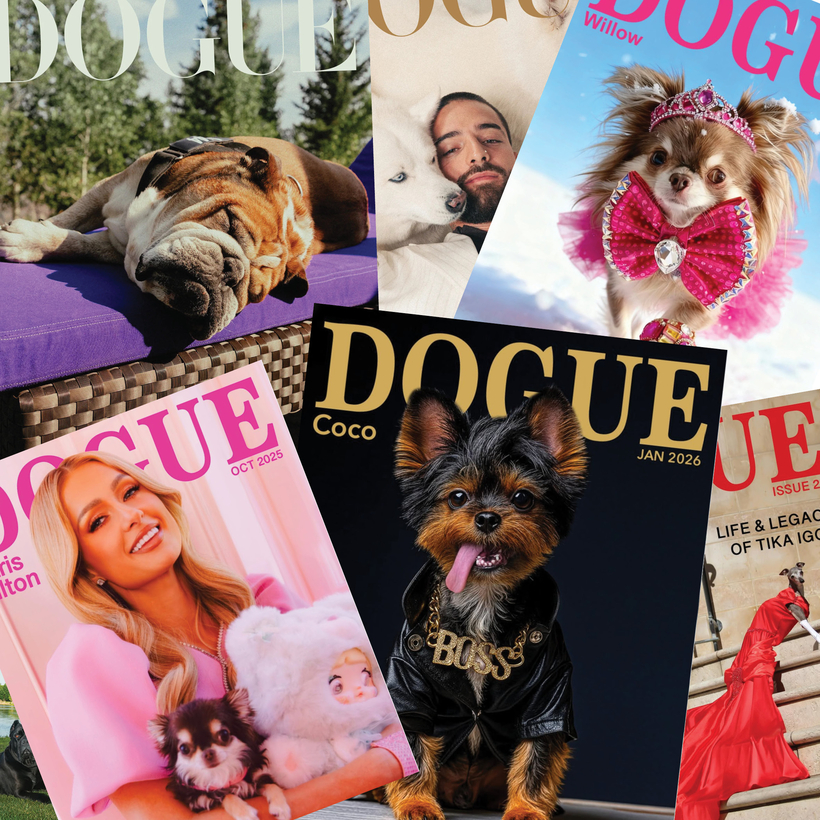
Dogue’s Web site is vast and intricate, but it reveals no signs of being a largely one-woman show. A glance through its masthead finds Portnaya’s new Pomeranian, Maui (Mimi died in 2024), listed as the “Chief Inspiration Pawfficer” and other dogs, like a Frenchie called Gucci, a Cavalier King Charles spaniel called Queen Elizabeth, and an Hermès-clad Shih Tzu called Mia, as “Chief Style Pawfficer,” “Pack Relations Manager,” and “Fashion Barkitect,” respectively. Padding the full-spread fashion shoots of dogs dressed in “Chewnel” and “Fursace” are stories like “Doodlemania: The Boom and the Billion Dollar Empire” and a conversation on bereavement with pet medium and best-selling author Karen Anderson. The site’s “About” page used to cite Vogue as a guiding influence but no longer does.
Beyond its digital presence, Dogue has produced 24 print issues since 2021, with a new issue publishing roughly every season. It covers operating costs with revenue from Patreon, where members pay between $5 and $50 a month for access to virtual events, monthly blogs, and chances for their dogs to be featured on a digital cover of Dogue.
The magazine seemingly found its stride in the last couple of years with cameos from Hollywood types like Kevin Costner (in December 2024, photographed with his Labrador retriever, Bobby) and Don Johnson (in May 2025, photographed with his German shepherd, Rufus, and Jack Russell, Thunder). An issue of Dogue featuring Paris Hilton with her teacup Chihuahua, Iconic, was published in October, just two months before the Condé Nast lawsuit.
Currently, there are four successfully registered Dogue trademarks under the United States Patent and Trademark Office (U.S.P.T.O.): two for a canine-cuisine company, one for a pet-photography business, and another for a dog-accessories company. There are also three pending applications. Two belong to Portnaya (she initiated a second application in August after Condé Nast moved to block her first one), and the third belongs to the aforementioned dog-accessories company, which is looking to expand into grooming. None belong to Vogue.
This despite Vogue launching its own annual version of Dogue—a digital issue called “Dogue Days of Summer,” featuring nepo-dogs from Tim Walz’s rescue Labrador, Scout, to Sydney Sweeney’s pit-bull mix, Tank—in 2024, five years after Portnaya’s first edition of Dogue was published. “At the time, some friends messaged me in a panic saying Vogue was trying to steal Dogue, and I honestly laughed,” says Portnaya. Amanda Ferrazi, a Massachusetts dog-mom to a Pekingese named Mia and a fan of Dogue and Coverdogs, tells me she was “devastated” after seeing Vogue’s campaign, saying that their “copying” of Dogue was “hostile” and felt like a “gut punch.”
Hair of the Dog
This isn’t Condé Nast’s first dogfight. In a case dating back to 2004, Simone Kingston, the Australian owner of a small dog-accessories boutique in Woollahra, a suburb of Sydney, found herself in a similar battle over the name of her mom-and-paw shop, Dogue. She had applied to trademark the name in 1999, and Condé Nast quickly moved to block it. “It was ridiculous,” Kingston told The Sydney Morning Herald at the time. In the end, Kingston won her case by default after the media behemoth failed to oppose the pending trademark before the cutoff time. (Kingston is no longer the owner of Dogue and declined to comment for this story.)
Similarly, this past October, two months after the U.S.P.T.O. published Portnaya’s original trademark—first filed in 2022—in the Official Gazette, a weekly online bulletin used to announce pending trademarks and give third parties an opportunity to protest a trademark’s registration, Condé Nast, after securing an extension to the standard 30-day opposition window, formally opposed the pending trademark and issued a cease-and-desist letter demanding that Dogue discontinue the use of the name. When this was unsuccessful, they pursued litigation, initiating the formal trademark-infringement-and-dilution action.
“Having to defend our trademark—and, frankly, our right to exist—has been surreal and difficult to process,” Portnaya tells me. “I still can’t believe this is happening.”
Does Portnaya’s Dogue stand a chance? “I think Vogue has a winner of a case here,” says Jeanne Fromer, vice dean and professor of intellectual-property law at New York University School of Law, citing a 2023 Supreme Court case involving whiskey brand Jack Daniel’s and a parody squeaky bottle-shaped dog toy called “Bad Spaniels.” The Court ruled in favor of Jack Daniel’s, concluding that a legal standard called “likelihood of confusion”—the probability that consumers mistake two similar products as being from the same source—takes precedence over the free-speech protections previously extended to parody. “Even though Dogue is obviously a parody, I think there’s a good chance consumers are likely to be confused,” Fromer says. “That being said, I’d love to see Dogue have a fighting chance. I think we take ourselves too seriously. I think Vogue and Dogue can coexist in peace.” (As of the time of writing, a trial date for their dispute has not been set.)
For the past four years, Dogue has been sold exclusively at the Beverly Hills Newsstand, between South Beverly Drive and Charleville Boulevard, where its print issues tend to be nestled between issues of Vogue—something Condé Nast noted in their lawsuit: “Dispelling any doubt as to its intent, [Dogue] proudly displays photographs on its website of [its issue] next to and surrounded by Vogue magazine.”
However, the newsstand’s manager, Glenn Martin, tells me Portnaya has no say in the placement of her product. “We just determined that it should be by the fashion [magazines],” he notes. Martin also says the magazines are curated by popularity, with the best-sellers getting “front-row status.” Dogue “usually flies off the shelf pretty quickly.” Portnaya donates the profits from the print issues, which sell for $25 each, to the American Society for the Prevention of Cruelty to Animals.
“Beverly Hills people love dogs,” Martin says. “They see the magazine and they just are taken to it. And at this point, there are people that know about it and ask, ‘Hey, when’s the next issue coming in?’” Martin also admires Portnaya’s “determination to start [Dogue] basically from scratch, and to just continue to do what is necessary, always at the grind, whatever it takes.”
“Having to defend our trademark—and, frankly, our right to exist—has been surreal and difficult to process. I still can’t believe this is happening.”
That focus has seemingly been unwavering. Since being sued, Dogue has published two new issues. One of them is an in-memoriam feature on the life and legacy of Tika, an Italian greyhound with gay parents who has 1.6 million followers on Instagram, including designer Cynthia Rowley and Saturday Night Live’s Chloe Fineman.
“Dogue remains focused on dogs, fashion, and community,” Portnaya tells me. “This is a disagreement about creative expression. We respect the legal process and are confident that the facts will speak for themselves.”
Carolina de Armas is an Associate Editor at AIR MAIL
