
The wonder of it is that Wuthering Heights, which was declared to be “unquestionably and irredeemably monstrous” upon publication, exists at all, its creative origins forever obscured by the brief and enigmatic life of its author. The novel, published in 1847 under a male pen name (Ellis Bell), was written by Emily Brontë, a 27-year-old virgin so reclusive she makes Emily Dickinson seem positively sociable, who lived in a parsonage together with her gifted sisters and alcoholic brother in the tiny village of Haworth in Yorkshire, England.

The parsonage abutted the moors, where Brontë liked to wander, and the wild, bleak landscape of which is described in the novel, acting as a symbol for the untamed nature of the romance at its center. Emily, who died a year after her book came out, somehow managed to call forth from her vivid, anarchic imagination one of the darkest love stories in Victorian (or any other) literature, creating an unprecedented Demon Lover in the portrait of Heathcliff and an obsessed madwoman in that of Catherine Earnshaw. Its erotic undertones are unmistakable and all the more powerful for being suppressed.

For all its heaving drama, the plot of Wuthering Heights is remarkably simple, even primitive. It is the age-old one of a soured romance, of childhood sweethearts who are foiled by the adult reality they grow into. Boy meets girl; boy falls in love with girl; boy loses girl. And then, if the boy in question happens to be Heathcliff, with his “satanic nimbus,” as one writer put it—the romantic antihero par excellence—all hell breaks loose.

Robbie’s acting chops are in full view.

As I have discovered by way of many re-readings over the years, Wuthering Heights never loses its ability to send a chill through one while at the same time making one breathe faster. It is sexy; that is, in a diabolical way—there is nothing sweet or homespun about its intentions. I suppose there is an argument to be made that the novel is akin to contemporary vampire love stories, except that it is far less melodramatic and all too human, and the violence is mostly psychological. It speaks, I think, to anyone who has ever felt a wish to be inseparable from a love object who is not retrievable, and for whom being in a state of yearning is second nature.

Filmmakers and TV producers have been continually trying to translate this elusive work into a visual medium ever since it was made into a movie in 1939 starring Laurence Olivier and Merle Oberon. While watching the latest film adaptation, I kept wondering what Brontë would have made of this version of her stark, doomed story, with its graphic scenes of masturbation, B.D.S.M., and doggy-style penetration. Would she have recognized her novel at all? And what about Cathy’s outlandish, anachronistic wardrobe, replete with a red latex gown, German milkmaid corsets, and Elton John sunglasses?

This is a movie with its sights firmly fixed on Gen Z.

But maybe these are not the right questions to ask. This movie, written and directed by the controversial Emerald Fennell (Promising Young Woman, Saltburn), is characterized as “loosely inspired” by the novel—ergo, at liberty to take liberties. The story begins as young Cathy Earnshaw (Charlotte Mellington) meets a young Heathcliff (Owen Cooper), the mysterious swarthy boy her father brings home from one of his trips. The lonely girl and boy form the closest of bonds as playmates and promise to be each other’s forever.

As the years pass, however, their relationship changes; Heathcliff’s lowly, servant status in the ramshackle Earnshaw household, in which Cathy’s father (wonderfully played by Martin Clunes) drinks himself into a stupor every night, becomes ever clearer, and his beloved Cathy treats him with condescension while secretly continuing to adore him. The housekeeper, Nelly Dean (Hong Chau), meanwhile keeps vigilant watch over the two, harboring unknown plans of her own.

What would Emily Brontë have made of Emerald Fennell’s film? Would she have recognized her novel at all?

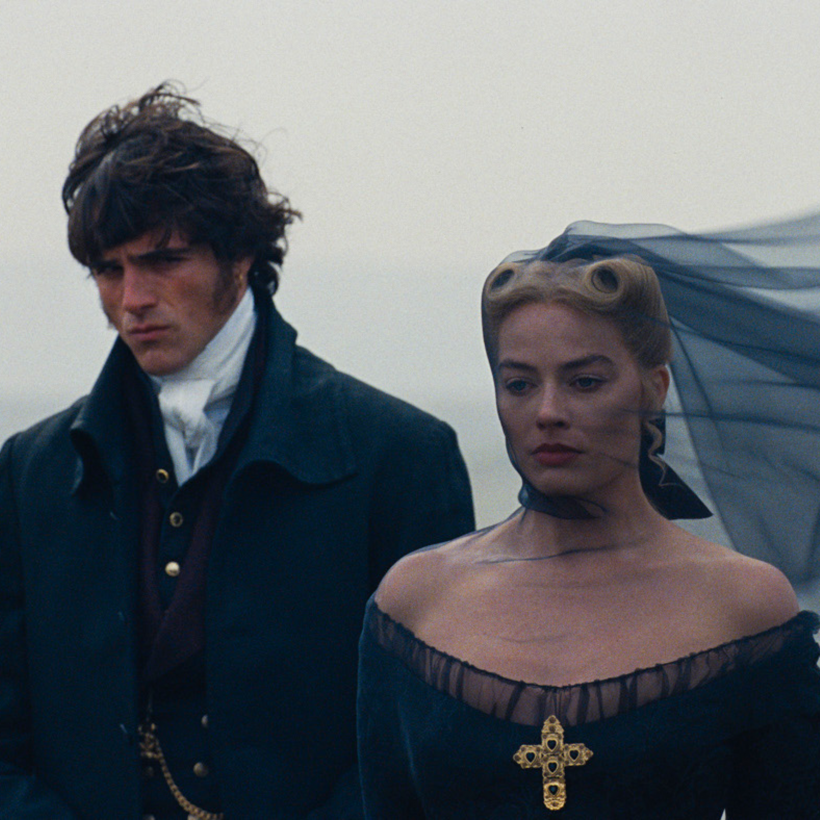
The adult Cathy, whom I had always imagined to be dark-haired and frail, is played by the blonde, blue-eyed Margot Robbie, whose acting chops are in full view once again. Heathcliff is played by Jacob Elordi, whose unkempt locks are quickly reshaped into the chic-est of Sally Hershberger haircuts when he reappears, newly rich but destructive as ever, after fleeing in the wake of Cathy’s abrupt decision to marry Edgar Linton, a simpering but wealthy neighbor.

Laurence Olivier and Merle Oberon in the 1939 film.

Although Elordi’s face and physique seem a bit delicately honed for the character, he captures Heathcliff’s brutality, his fiery lust, and, most important of all, his wounded pride. As Linton’s wife, Cathy is introduced to a world of luxury she has never imagined: banquets and frocks galore, a bedroom decorated to match her blushing cheeks, high tea in the garden with uniformed servants standing by. Linton (Shazad Latif) attends to her with syrupy affection and even manages to get it up with some degree of regularity, but her only real companion is her sister-in-law, Isabella, an odd little cloistered creature, played by the gifted Alison Oliver. In an act of revenge, Heathcliff marries the adoring and masochistic Isabella, whom he treats with undeviating savagery, tying her up on a leash and commanding her to bark like a dog.

Much of the film is shot in unrelenting close-up, which seems to be the cinematic flavor of the moment, allowing us countless views of Robbie’s poreless complexion and Elordi’s sinewy, whip-lashed back. It captures some of the novel’s heat—Robbie and Elordi work up a genuine-seeming froth—but by featuring endless sex scenes between Heathcliff and Cathy after she has married Linton, the film undercuts the thwarted, pristine longing that fuels Brontë’s vision, the unconsummated, just-out-of-reachness of the couple’s passion. The soundtrack, Charlie XCX’s contribution notwithstanding, is terrible and left me pining for Kate Bush’s eerie, tinkling requiem. Linton’s Barbie–meets–Marie Antoinette estate, with its lacquered floors and luridly painted walls, seems jarring from the get-go.

Influenced by the aesthetics of soft porn and high fashion, this is a movie with its sights firmly fixed on Gen Z. It works, in its edgy stylistic way, and it should sell heaps of tickets. But by simplifying the arc of the original story, ending the narrative with Cathy’s death and leaving out her ghostly haunting of Heathcliff, and by making explicit what was implicit, this Wuthering Heights is, curiously, a less subversive and radical rendering of the otherworldly, inexorable desire that Emily Brontë captured almost two centuries ago.

Wuthering Heights will be released on February 13

Daphne Merkin is a Writer at Large at AIR MAIL and the author of numerous books, including the memoir This Close to Happy: A Reckoning with Depression and the novels Enchantment and 22 Minutes of Unconditional Love. She is currently working on a book about her experiences in psychoanalysis