
This year is only a little more than a month old, but the relentless flow of appalling news has already sparked an urgent desire to escape for a few days. The perfect place to do so has just opened in the Swiss village of Sils Maria, just over seven miles from plutocratic Saint-Moritz, in the Engadin Valley.

Artfarm, the art-and-hospitality company founded in 2014 by Iwan and Manuela Wirth—the founders of Hauser & Wirth—is behind Chesa Marchetta, a 13-room hotel created from a 16th-century farmhouse. The celebrated Zurich-based gallerists have 19 art spaces in Switzerland, London, Los Angeles, New York, and Minorca, as well as hotels in Scotland and Somerset.

Arriving in the heart of the village, you’ll find a dictum engraved on one of the hotel’s walls. It’s written in Romansh, the local dialect and one of Switzerland’s four official languages: “Mountains and valleys stand alone, but people meet.” The quote feels fitting. As Iwan and Manuela Wirth explain it, the hotel is a reflection of their “raison d’être of cultivating community, conversation, and connections between people in the places where we work around the world.”

Top, a charming bedroom at Chesa Marchetta; above, a frescoed corner of the hotel.

There was a snowstorm on the dove-gray winter morning when I arrived, and a fire crackled in the lounge beneath a soaring wood-beamed ceiling. The guests greeted each other on their way to breakfast or settled into one of the big leather armchairs near the fire with a book and a coffee before going out for a morning walk.

Here, as at the Wirths’ Fife Arms hotel in Braemar, Scotland, art is everywhere. I contentedly waited for the elevator on the second floor, where I was staying, grateful for the pause—it gave me time to study a slender blue-and-white Louise Bourgeois statue by the window. Works by Daniel Spoerri, Nicolas Party, and Jason Rhoades also dot the walls.

The pleasure of traditional Alpine hospitality—defined by comforts like chevron-patterned throws of soft Swiss wool by Manufactura-Tessanda, one of the last handweaving mills in Switzerland; hand-sawn wood-plank floors; and arven (Swiss stone pine) antiques that release a subtle, bracing perfume—made me want to curl into the chair with a book rather than go out. There are window doilies knitted by nuns in a nearby convent; heather-scented, Scottish-made Albamhor bath amenities; and thick cotton towels on heated chrome racks. A glass canister of delicious homemade spice cookies sits next to the espresso machine and tea kettle on an antique chest of drawers.

But I went on a walk, curious to see how Sils Maria and the surrounding valley have attracted some of the world’s greatest writers, artists, and musicians. Just next door to Chesa Marchetta, the German philosopher Friedrich Nietzsche stayed at what is now known as the Nietzsche House from 1883 to 1888, after falling in love with the village in the summer of 1881. Writing to a friend, he called Sils “the loveliest corner of the earth,” adding, “I have never been in more peaceful surroundings.”

He wasn’t the only one drawn to the area. Rainer Maria Rilke, Marcel Proust, Hermann Hesse, Thomas Mann, Pablo Neruda, Boris Pasternak, and William Faulkner came to Sils on holiday and to write. Max Liebermann, Oskar Kokoschka, Emil Nolde, Max Ernst, and Marc Chagall arrived with their oils and brushes, and Chagall painted Chesa Marchetta when it was still an auberge. Charlie Chaplin and Albert Einstein also stopped in.

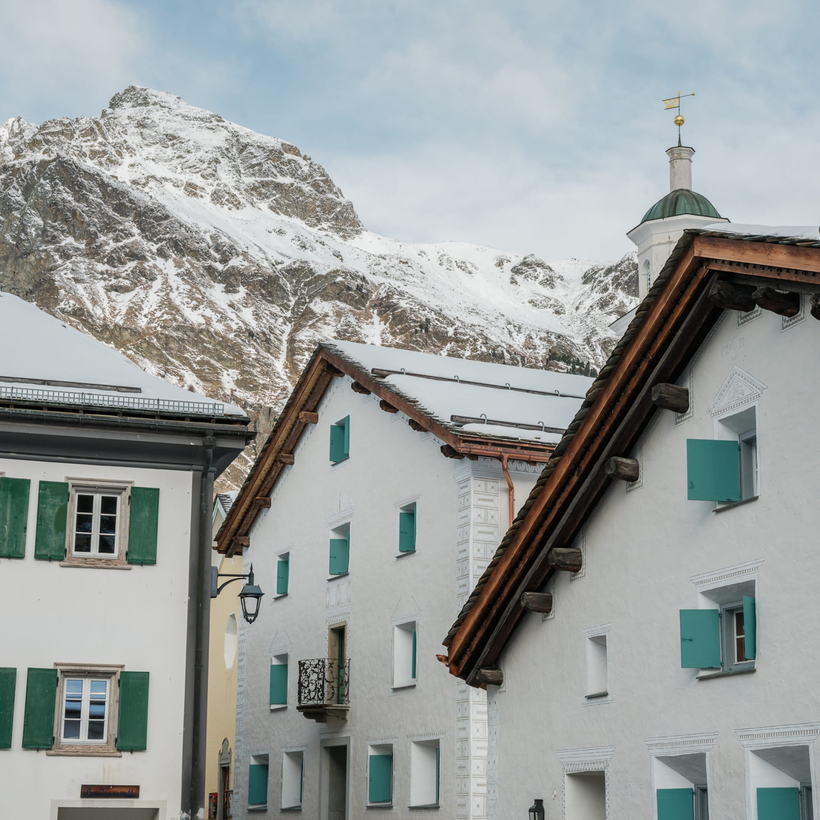
As I walked down the Via da Marias, the village’s main street, I noted the sgraffito designs on the façades of many of the village’s houses. And the enormity of the mountain that rears up at the very end of the road stopped me in my tracks.

Top, one of the hotel’s cozy salons; above, a window dressed with lace doilies knitted by nuns from a nearby convent.

The tiresome trope of hotels wanting their guests to feel at home rarely works for me, because a hotel room usually still feels like a public space. But at Chesa Marchetta, the stiff formality of a hotel stay has been swept away in favor of unscripted, friendly interactions with the staff, including the Italian chef Davide Degiovanni, whom I fell into conversation with when I sat down at the bar for a drink before dinner.

He suggested that I try an Alpine Juniper, a tequila cocktail mixed with a botanical cordial made with Alpine plants. It was delicious. Degiovanni told me that he’d moved to Sils after 23 years in London, including a stint working under Gordon Ramsay. “It’s changed me to live here,” he said. “I see my suppliers all the time, and this is how I write my menus. The goal of everything I do is to enhance and show off the natural flavors of the best local seasonal produce.” That night, the elegant simplicity of the veal tartare under a canopy of grated black truffle, and the delicate gnocchi in brown butter with sage he learned to make from his grandmother, proved his point.

After breakfast the following morning, I took a horse-drawn sleigh up to the Bergkirche Fex Crasta, a whitewashed 15th-century chapel perched on a hill above Sils, to see the frescoes painted by itinerant artists from Pavia. Then I decided to walk back to Chesa Marchetta.

Outside, the sun had burned through the fog that had cloaked the village in the early morning, making the snowdrifts on the slopes above the village sparkle. Finally, I understood the deep allure of Sils and the Engadin—where the enormity of the mountains induces a humility that stills the mind. Suffice it to say, it was a brutal shock for me when the time came to pack up and leave both Chesa Marchetta and Sils, places I immediately yearned to return to.

The writer was a guest of Chesa Marchetta, where accommodations begin at $515 per night

Alexander Lobrano is a Writer at Large at AIR MAIL. His latest book is the gastronomic coming-of-age story My Place at the Table: A Recipe for a Delicious Life in Paris