
Straight plays, grand opera—it’s all theater, right? To a point, yes, and directors cross back and forth all the time. For the gang onstage, it’s a different story. In plays, imagination, empathy, and a sixth sense for subtext will see an actor of genius through any part. The singing actors in opera do well to use that tool kit, too—but their sine qua non is the voice.

Luca Micheletti, 40, has been playacting since his father, an actor, took him out there at age four in Giovanni Verga’s morose, verismo epic I Vinti (The Defeated). “We are heirs of a long tradition,” he says of his family, touching on their four-generation history in the theater, “but no one is carrying it forward.” His grandfather still barnstormed the countryside like the strolling players in the Leoncavallo’s Pagliacci, not to forget Shakespeare’s Hamlet. But his father settled down in “a proper theater, with walls.”

“The time has been that, when the brains were out, the man would die.” Macbeth quails before Banquo’s ghost.

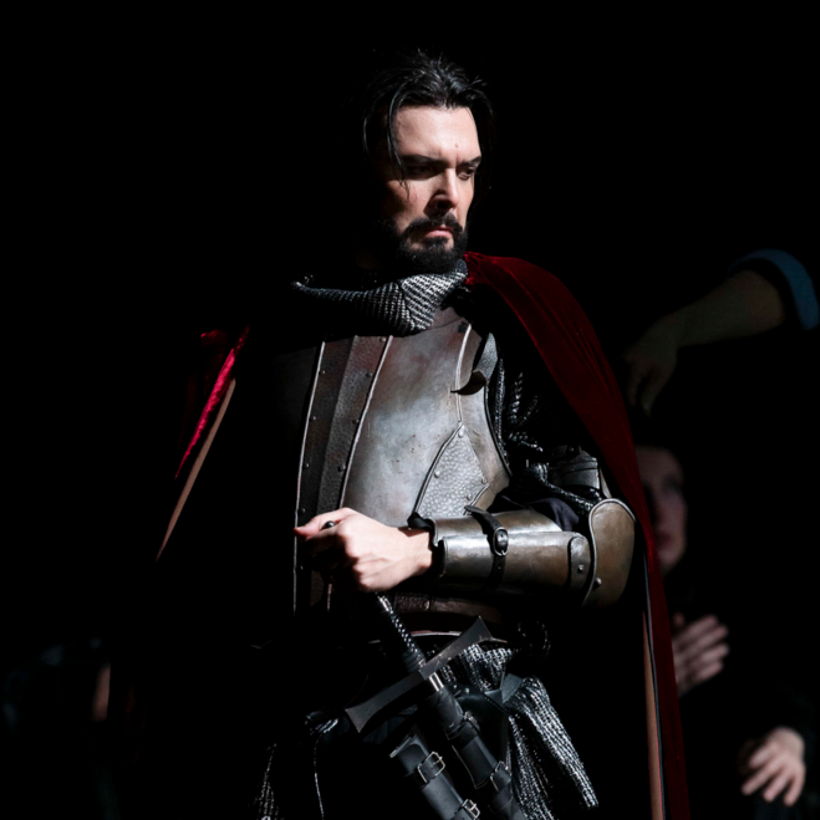
In the lifetime since his precocious debut, Micheletti has immersed himself in world theater from antiquity to the present day, and not just as an actor. He also directs, translates, and adapts plays as well as writing new ones. On top of all that, for going on a decade now, he’s been folding grand opera into his portfolio, with special attention to the crowning baritone parts of Mozart and Verdi. Beginning on February 24, he portrays the latter’s Macbeth at the Teatro Regio, Turin, for six performances through March 7. Micheletti’s early champion Riccardo Muti, the nonpareil authority in the Mozart and Verdi repertory, conducts.

“I always loved music,” Micheletti told me a year ago in the Metropolitan Opera press room, on the eve of a hit-and-run midseason house debut in Puccini’s La Bohème. “I studied piano as a child, and I played saxophone. But I sang like an actor who can’t sing, not like a proper opera singer.”

The turning point came a decade ago, when the filmmaker Marco Bellocchio cast Micheletti in Pagliacci, an 18-minute cinematic deconstruction of the Leoncavallo warhorse. The script included some operatic bits, and the international tenor Mario Malagnini came in to coach him. “Sing!,” Malagnini told Micheletti once he heard him, meaning: Sing opera in opera houses! “Why not? You can do this if you want to.” Together, they got down to work.

“Your face is as a book where men may read strange matters.” Lidia Fridman as Lady Macbeth in Chiara Muti’s staging of Verdi’s opera.

Pagliacci was released in 2016. In 2018, Micheletti tested his wings in Cagliari, the capital of Sardinia. As Bizet’s bullfighter Escamillo, in Carmen, he made his entrance with the treacherous Top 40 “Toreador Song,” which demands the brilliance of a high baritone but also the punch of a no-nonsense bass. And presto, the newly minted opera star was on his way, swiftly advancing from gateway houses to the grand shrines in Milan, Rome, and London, with plum gigs as far afield as Tokyo and Sydney.

Blessed with the jawline and physicality (and the mane) that Marvel Studios spins to gold in action franchises, Micheletti, as we hear him today, has transformed himself into a musician in the Apollonian mold, sculpting noble phrases, never seeming to need to reach for notes, never wobbling or crunching gears. Within his dark, burnished timbre lies a wealth of expressive shadings, artfully and economically applied. Like the Renaissance worthies who gave birth to opera, he has steeped himself in the form’s many constituent arts, going back to the ancients.

In fact, it’s Sophocles, Micheletti says, who is his lodestar. In the summer of 2024, he threw himself body and soul into Ajax, drawn from the mythology of the Trojan War. The silent part of the doomed hero’s little son Eurysaces fell to Micheletti’s daughter, Arianna, all of 18 months old at the time. The even more searing Philoctetes is on Micheletti’s drawing board for a future season.

Contemporary geopolitics being what they are, who knows when America might properly discover Micheletti. Happily, his tantalizing YouTube clipography covers the waterfront. A spiritually charged excerpt from Haydn’s Mass in Time of War exemplifies his poised vocalism at its purest. Dantean terribilità reigns in Donizetti’s 20-minute solo cantata Il Conte Ugolino, set to lines of the Inferno at its most harrowing and uttered in tones of ashen restraint. For a lark, catch Micheletti spilling out of a limo in top hat and tails for a number from Lehár’s Merry Widow or snapping his suspenders in Leonard Bernstein’s Trouble in Tahiti. Have I mentioned his signature Mozart and Verdi? There’s lots to choose from.

Macbeth opens at the Teatro Regio, in Turin, on February 24, with performances through March 7

Matthew Gurewitsch writes about opera and classical music for AIR MAIL. He lives in Hawaii