
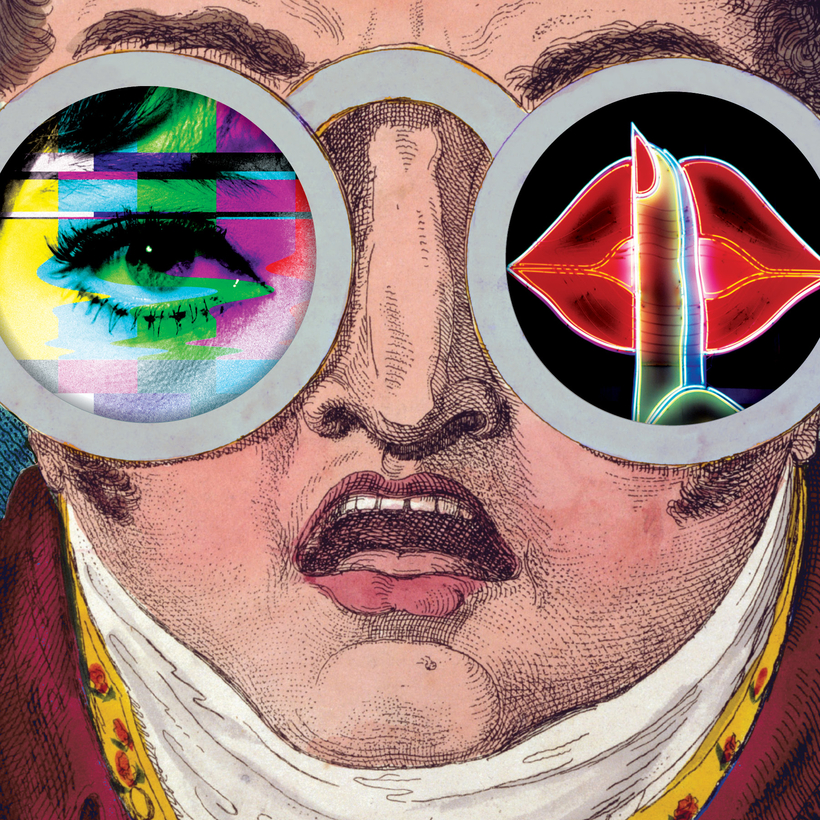

Last fall, Harper’s magazine published a much-discussed dispatch about an online cult of porn obsessives. These self-described “gooners” fashion elaborate “gooncaves”—lined with screens and stocked with every convenience—so that they can withdraw from the world in their pursuit of perpetual stimulation.

“What are these gooners actually doing?” the writer, Daniel Kolitz, asked. “Wasting hours each day consuming short-form video content. Chasing intensities of sensation across platforms … abjuring connective, other-directed pleasures for the comfort of staring at screens alone. Does any of this sound familiar?”

It would have to David Foster Wallace, the late Gen X novelist. Wallace often worried about the pull (and perils) of entertainment. His great, prescient 1996 novel, Infinite Jest, which turned 30 this month, is about a near-future North America pleasuring itself to death.

Lauded on its initial release, the 1,079-page book has drawn the de rigueur backlash in recent years: too showy, too maximalist, too male. But dare to crack the nearly three-inch-wide spine and you’ll find a novel that’s as readable—and relevant—as ever.

David Foster Wallace, seen here in 1997, believed that serious art should “force you to work hard to access its pleasures.”

Wallace saw where we were heading: a world paralyzed by screens. Consider the minor character (and ur-scroller) Erdedy, here struggling to muster the attention span needed to watch something on his “teleputer,” or TP: “He sat on the edge of his bed with his elbows on his knees and scanned the stack of cartridges. Each cartridge in the dock dropped on command and began to engage the drive with an insectile click and whir, and he scanned it. But he was unable to distract himself with the TP because he was unable to stay with any one entertainment cartridge for more than a few seconds.”

A company called InterLace (a proto-TikTok) mails these cartridges (what we now call “content”) directly to the denizens of Wallace’s future. There’s even something like streaming, for those willing to pay extra: another character’s “lavish TP receives … the spontaneous disseminations of the InterLace Subscription Pulse-Matrix.” A “complexly molded dinner tray” fits onto this character’s shoulders so that “he may enjoy his hot dinner without having to remove his eyes from whatever entertainment is up and playing.”

The title, which borrows a phrase from Hamlet, refers to a film: a cartridge so compelling it renders viewers immobile until they eventually expire. Multiple groups, including wheelchair-bound French-Canadian terrorists, are in hot pursuit of this weaponizable entertainment. As in our world, addictions are rampant, U.S.-Canadian relations are complicated, and the president, one Johnny Gentle, is a former entertainer. “Our very own Johnny Gentle has been reelected,” observes Michelle Zauner in the foreword to the new anniversary edition.

The first chapter of Infinite Jest takes place a year after the events of the novel proper and makes a passing reference to the book’s two main characters, a tennis prodigy and a recovering addict, digging up the head of the prodigy’s father. But the first-time reader doesn’t yet know that these are the main characters and that the father is the director of the dangerously addictive film. Making matters worse, these characters never intersect again in the text. Readers with long memories (or the stamina to start over) will wonder: Why are these characters exhuming the father’s head? Is the film buried with (or in) the head? Is the novel’s true climax buried in plain sight?

Wallace’s novel leaves much dangling; he isn’t interested in contriving a conventionally satisfying ending. But then you don’t read Infinite Jest for the payoffs and reassurances of a beach read. You read it for the dazzling similes and metaphors (“My chest bumps like a dryer with shoes in it,” the “sad tiny distant-champagne-cork sounds of scores of balls being hit down at the East Courts”), the virtuoso set pieces, the meditations on addiction that beat any self-help book, and the startlingly well-observed moments.

Wallace, who died by suicide in 2008, noted in a 1993 interview that “TV and popular film and most kinds of ‘low’ art—which just means art whose primary aim is to make money—is lucrative precisely because it recognizes that audiences prefer 100 percent pleasure to the reality that tends to be 49 percent pleasure and 51 percent pain. Whereas ‘serious’ art, which is not primarily about getting money out of you, is more apt to make you uncomfortable, or to force you to work hard to access its pleasures, the same way that in real life true pleasure is usually a by-product of hard work and discomfort.”

The book’s forbidding page count and mice-type endnotes (sometimes barnacled with their own notes) are not gimmicks, as some killjoys will claim. By demanding a lot from the reader, while dispensing pellets of wit and style on every page, Wallace offers an alternative to the grim timeline we now find ourselves in. The antidote to the book’s terminally enjoyable film is the novel itself. The counterpoison to our world of screens is a work of fiction. That’s entertainment.

Jason Guriel is the author of several books, including Fan Mail: A Guide to What We Love, Loathe, and Mourn, On Browsing, and The Full-Moon Whaling Chronicles