
Margherita Ragona, a former competitive Alpine skier turned instructor, spent three winters teaching at her local ski school at Sestriere, a ski resort in the Italian Alps, before making her way to Courchevel this season—where she was struck by a profound sense of jamais vu when she encountered what she calls her “first influencer.”

It was during a pre-paid, half-day private lesson last month. Twenty minutes in, after French-frying up the magic carpet and pizza-ing down the bunny slope, Ragona’s student suddenly stopped in her tracks, handed Ragona her phone, and said, “O.K.! Time for pictures!” What followed was a three-hour photo shoot where Ragona was either taking pictures of her student or standing watch as a professional resort photographer clicked away.

The student, who turned out to be a Brazilian influencer, would throw handfuls of snow up in the air, smile, and ask Ragona what pose would make her “look like a professional skier.” Ragona started by telling her how to correctly hold her skis. Ragona would go on to experience this six more times with different content creators over the course of the season, which is, by the way, far from over.

Rhode founder Hailey Bieber poses on a snowmobile.

The bunny slopes across the pond look no different. As skiing and snowboarding grow ever more popular—with three of the five busiest seasons on record occurring since the pandemic, according to preliminary data from the National Ski Areas Association, and the 2024–25 season ranking as the second-busiest ever—locals and old hands increasingly find themselves sharing mountains with people who are less in love with the sport itself than they are with its aesthetic.

“O.K.! Time for pictures!”

Raised in Aspen, Madelyne Leibinger has been skiing since she was two years old, often taking odd jobs as a ski instructor—including, at one point, teaching Kim Kardashian’s children. “Since 2020, it’s changed so much,” she says. “The runs that I used to love going down have become infested.” Every year, more and more people come to Aspen to “ski,” she says using air quotes, “but really it’s just to go shopping at Kemo Sabe [a high-end Western-wear store frequented by the likes of Jeff Bezos, Rihanna, and Kevin Costner], or to take the gondola up and pose in front of the mountains…. It feels inauthentic. People are losing the reality of skiing as a sport. It’s becoming skiing for show.”

A ski instructor who has been teaching at Jackson Hole, in Wyoming, since 2021, tells me he’s noticed a similar trend as Leibinger. Referring to the Aerial Tram, a 100-person gondola that takes passengers from the base of the resort to the peak of Rendezvous Mountain, he says, “It used to be packed with skiers and just a handful of non-skiers. [But] this year, I’ve seen the biggest uptick in scenic riders. The lines are longer.”

But the real bottleneck, he says, is at Corbet’s Cabin, a once quaint café at the top of the tram that serves “absolutely delicious” waffles.”I see more photo shoots there than I ever have,” he says. The waffle/social-media tourism has caused further delays for skiers trying to get a quick snack between runs. “It’s no longer just a grab-and-go, but that’s what it was built for!”

“The runs that I used to love going down have become infested.”

So, who’s to blame for this new subgenre of snow bunny, dubbed “Ski Girlies”? A lot of people would point their HotHands-warmed fingers at the resorts themselves, arguing that they’re trying to offset rising snowmaking costs (a result of global warming) by drawing bigger—and more social-media savvy—crowds. Just two weeks ago, Vail Resorts hosted an all-inclusive “intimate group trip” for influencers to Park City, Utah. The trip included an Epic Pass for the season, roundtrip flights, hosted accommodations, food and beverage experiences, ski rentals, destination activities, and more.

The Aspen Chamber Resort Association (ACRA)—a hybrid chamber-of-commerce-and-destination-marketing organization—even has an “Influencer Application,” offering complimentary or discounted experiences in return for coverage on influencers’ social-media accounts. Influencers are “thoroughly vetted” by the ACRA team and must meet several requirements, including a follower count exceeding 40,000 on Instagram, TikTok, or YouTube and an average engagement rate at or above 2 percent.

But there are other forces drawing Ski Girlies to the mountains. For one, skin-care brands have recently made more of a concerted effort to establish a presence on the slopes this season. Earlier this month, Hailey Bieber’s Rhode hosted a “Rhode Snow Club” at Big Sky Resort, in Montana, selling limited-edition caffeine-reset masks, peptide lip balms, and headbands from a colossal teal, R-shaped kiosk perched at 8,800 feet.

Photos show fur-clad influencers posing atop a teal snowmobile and riding the lifts—sans skis—to reach the Everett’s 8800 Deck, a restaurant at the top of Big Sky’s Andesite Mountain, where the spectacle took place. Also this season, other “ski care” heavyweights have formed unlikely partnerships, such as Supergoop cementing a deal with Ikon Pass as its first official sunscreen, and Kiehl’s staging a “resort takeover” at five destinations, including Jackson Hole.

Brazilian influencer Julia Norremose Ferreira at Bagatelle, one of the more popular après-ski spots in Courchevel.

Then there’s the après factor. In Courchevel, Ragona says “normal people” go to pubs at the bottom of the gondola. But Ski Girlies go to Bagatelle, the ritzy club with locations spanning from St. Barth’s to Dubai, where Eurotrash and tech bros dance on dinner tables to Fred Again. “They usually don’t stay until close, though, like real après-skiers, because they have other photo shoots to go to, like dogsledding,” says Ragona.

In Aspen, the Ski Girlies magnet is Cloud Nine, a restaurant atop the Aspen Highlands ski resort. “You’ll see people who will take the lift up, go to the restaurant to take pictures spraying champagne, and then become a liability to ski down because they really just don’t know how,” says Leibinger, adding that locals sometimes make an evening out of watching the drunken influencers attempt to make their way to the base. In Jackson Hole, it’s the Million Dollar Cowboy Bar, a Western-style watering hole in the town square. “People buy more expensive hats and boots to wear one night at the Cowboy Bar than most people who work a lifetime at dude ranches,” says the Wyoming instructor. “They’ll spend $2,000 to $3,000 on their outfit to feel Western and take pictures on saddle chairs.”

Add to that the hundreds of form-fitting ski looks available now, from high-end brands such as Prada and Goldbergh (which offers one-piece ski suits for up to $2,500) to new arrivals like Skims and Halfdays (where ski suits are closer to $700), and you begin to understand why so many influencers are eager to share their fits in “Get Ready with Me to Go Skiing” videos, inviting viewers to watch them get dressed as if they were courtiers at a grand lever.

As a result, Ski Girlies are easy to spot a mile away. If you “see someone with skinny, super-tight clothes with fur, then that is 100 percent an influencer,” says Ragona. “Extra points if they don’t have a helmet and instead wear a headband with a fresh blowout and sunnies.” If that visual isn’t vivid enough, think of the Audrey Hepburn–inspired ski look worn by Lily Collins in Season Four of Emily in Paris. Spoiler alert: Emily’s a first-time skier who has to be carried down the mountain (albeit by a sexy Italian man).

In the fourth season of the hit Netflix show, Emily (Lily Collins) travels to the French ski resort of Megève.

Mount Everest recently banned amateur mountaineers from its perilous slopes to deter influencers. Should ski resorts—which can also be dangerous places, as this week’s tragic avalanches in Lake Tahoe and the Italian Alps demonstrated in stark terms—do the same?

There are a few valid reasons to do so—besides the utter annoyance factor—and safety is one of them. “They usually go down really fast because they don’t know how to ski, but they want to look professional,” says Ragona. “It’s a miracle if they don’t hit someone.” Another is their lack of ski etiquette, like the aforementioned clogging of on-mountain dining or even bartering for services. “I got a lot of ski-instructor friends where their client asks if, instead of paying for the class, maybe they can tag them in some stories or post saying they are the best instructor in Courchevel,” adds Ragona. “But it doesn’t work like that here.”

Nonetheless, the real battleground for the Ski Girlies debate isn’t on the slopes—it’s on the Internet. On TikTok, user Rachel Day gave voice to one side of the argument: “Please stop starting unnecessary ski clothing businesses [where] the brand messaging is just casual après alcoholism or crying on the ski slopes.” On the other are fashion influencers like Blake Rayfield, who recently said on Instagram, “If you plan on showing up to Aspen in some old, mismatched Patagonia ski layers, don’t even book the flight.”

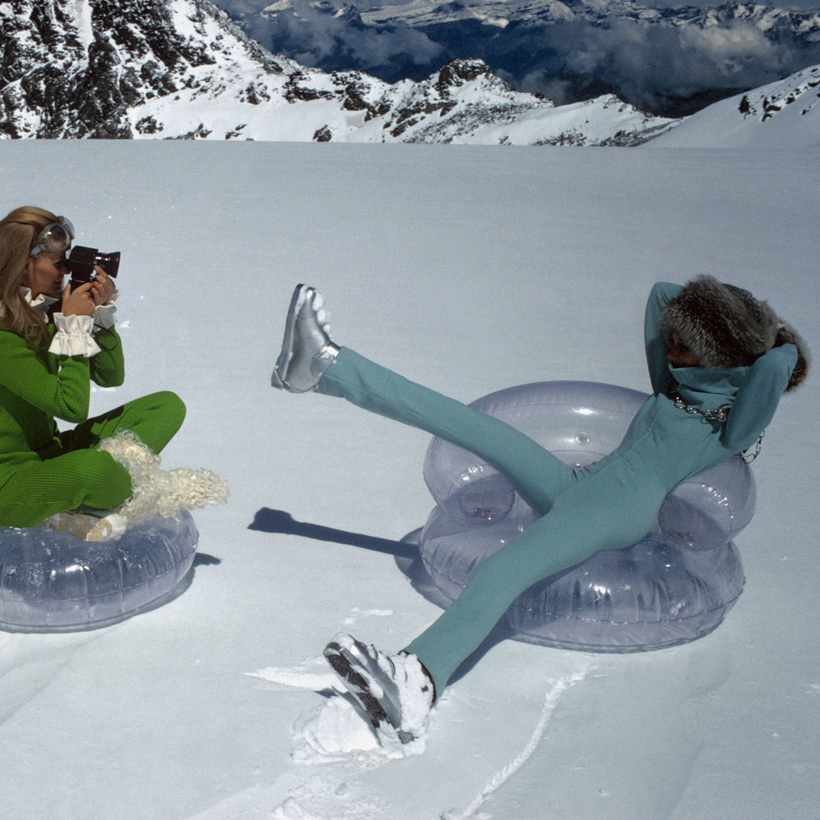
Then again, skiing and aspirational lifestyle have long gone hand in hand—arguably since the 1950s and 1960s, when Slim Aarons documented the glittering Alpine set from Cortina d’Ampezzo to Lake Tahoe. Or perhaps it goes even further back, to 1925, when Burberry pioneered luxury ski-and-winter sportswear utilizing their signature gabardine fabric.

Two Italian socialites on vacation in Cortina d’Ampezzo, photographed by Slim Aarons in 1976.

Skiing certainly continues to be a hobby limited to the ultra-privileged, with private lessons in Aspen ranging from $800 to $1,600 a day. Lift tickets in Vail cost upward of $300 per day—a roughly 60 percent increase in average day-pass prices from the 1990s. “Part of the appeal is to show off that affluence,” says the Wyoming instructor.

Will skiing for sport survive skiing for show? He seems to think so. “I know people who’ve been coming here for a long time who don’t recognize the mountain anymore and don’t come because of it,” he says of Jackson Hole. “But there will always be great skiers who want to come here. They just need a good tolerance for bullshit.”

Carolina de Armas is an Associate Editor at AIR MAIL