
Jeffrey Epstein is the most famous face in the world right now. And his case, like almost every major American story of the past decade, has been thoroughly checked for Russian connections: Was he a Russian agent? Was the island a Kremlin operation? Was Epstein connected to Vladimir Putin? And if so, how? Aside from several e-mails where Epstein tries to arrange a meeting with the Russian dictator, few things pointed to him passing information to the Russians.
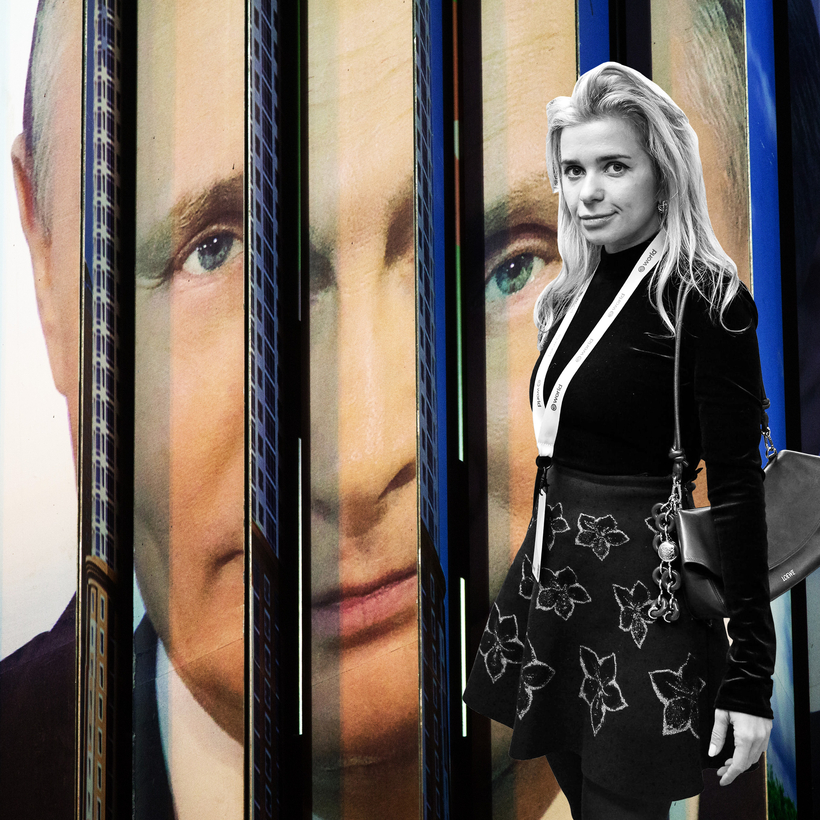
That changed when America found out about Masha Bucher (née Drokova), a Silicon Valley publicist and angel investor from Russia who’s been mentioned in the Epstein files over 1,600 times. The reason Bucher—and her extensive correspondence with Epstein—fueled the “Epstein was working with Moscow” theory isn’t merely because she is Russian-born. It’s because she is Kremlin-bred.
In the mid 2000s, Bucher was the teenage spokesperson for Nashi—roughly translated as “our own”—a Kremlin-sponsored youth movement whose stated goals were to combat Fascism and promote patriotism among millennials. In practice, it was built as an inoculation system against the “color revolutions” that toppled many former Soviet-bloc governments in the 2000s. At 19, Bucher received a medal from Putin for “informational support and active public outreach aimed at developing civil society in the Russian Federation”—Kremlin-speak for outstanding achievement in propaganda. The following year, at a youth forum on Lake Seliger, she kissed Putin on the cheek. Accordingly, the 2011 documentary following her rise through that machine and her eventual disillusionment with it was titled Putin’s Kiss.
In the beginning of the film, Bucher is asked to name the man of her dreams. “It would probably be Putin,” she replies. “He’s a very strong, charismatic, and intelligent man.” (As we now know, Bucher would later write to Epstein in a familiar register: “I trust you a lot. I love your intellect, sense of humor and charisma.”)
To many, this screams “Kremlin asset,” and the theory isn’t without merit. According to a declassified F.B.I. document, an informant alleged that Bucher’s company, Day One Ventures, was in Silicon Valley “to steal technology.” Still, most allegations of Bucher’s being a spy are based on her Kremlin past if not simply because she is Russian. But there is a more mundane way of explaining her trajectory: she can and perhaps should be viewed as someone climbing the American social ladder, much as she once climbed the Russian one.
Bucher’s official story is that of a village girl who took Russian youth politics by storm. But, as a Moscow acquaintance explained, the Kremlin likely saw Bucher as a safe choice, too. If she ever went rogue, her father—deputy head of the Tambov administration, a small city in central Russia—stood to lose his job. But while Bucher began as a “youth activist” who could be trusted to act according to script, she turned out to be a cunning political operator.
“I love your intellect, sense of humor and charisma.”
It was her luck that, in 2006, Vladislav Surkov, subject of Giuliano da Empoli’s 2023 novel, The Wizard of the Kremlin (soon to be a film starring Jude Law), was looking for an unofficial face of his “youth ideology group.” Bucher fit the bill: young, Slavic, attractive in a wholesome way, and not from Moscow. As the Russian saying goes, “She caught things mid-flight,” meaning that she understood everything that was required of her. Surkov personally took her under his wing.
It is said that Bucher distanced herself from the Kremlin around 2010 or 2011, especially after her friend the independent journalist Oleg Kashin was brutally attacked just outside his home. She made friends in the opposition circles but never joined the anti-Putin movement. When Bucher left the corridors of power, she faced no retaliation from the Kremlin. In the words of my Moscow acquaintance, “she became disillusioned [with Putin] back when it was still O.K. to become disenchanted.”
Bucher’s entry into the tech world came through Serguei Beloussov—now known as Serg Bell—the Russian-born founder of Acronis and Runa Capital. In time she was overseeing Bell’s international P.R., while also directing media strategy for the Russian Quantum Center in Skolkovo, the Kremlin-backed innovation hub. In 2014, Business Insider included her on its PR 50 list of the best public-relations professionals in tech.
In 2017, Bucher received a coveted EB-1 “Extraordinary Abilities” visa, granting her permanent residence in the U.S., where she opened a boutique P.R. shop in New York. Soon after that, Bucher moved to San Francisco, where she started Day One Ventures. The venture-capital firm was allegedly financed, in part, by Russian billionaires—some of them later the target of sanctions. (Bucher has denied being associated with or receiving any funding from Russian oligarchs multiple times, and declined to speak on the record for this story.)
In March 2017, Epstein received an e-mail from a redacted sender asking if he wanted to meet Bucher (then Drokova). He replied, “Too old.” To which the anonymous sender responded that she “doesn’t want to be assistant. She made her first million at age of 20, now she just invests in companies and creates her own VC…. She wants to meet you, get to know you and help me find you a young attractive assistant.”
When her e-mails with Epstein surfaced, Bucher wrote in a statement that, after a “huge attack” by the regime on her and her family in 2017, Epstein made her feel she could be safe from it. She did not go into detail about the alleged attack, nor about the nature of the safety Epstein provided.
But a May-June 2017 e-mail exchange shows that Bucher wasn’t asking Epstein for protection; she was doing what she does best: reputation management. Don’t let “anybody … control your publicity,” she told him. Media is “partially controlling your web presence and formulating how the world sees you.” She recommended building a direct-to-audience persona through Facebook broadcasts/YouTube or Medium/Twitter, with the explicit expectation that the “media will organically pick up the answers and quote you.” The e-mail—quick and offering nothing concrete—reads more like friendly advice than a paid PR strategy. Still, it’s a (somewhat lazy) attempt on Bucher’s part to fix Epstein’s damaged reputation.
Bucher’s claim of a Kremlin attack on her family is similarly suspect, considering that she participated in the St. Petersburg International Economic Forum—Putin’s Davos—in 2019. Getting a green card, opening up a V.C. fund, and tweeting “fuck Putin” after being accused of working with the most notorious sex criminal of our time is not something the Kremlin considers a threat. Bucher’s rise in the U.S., I’m told, was actually cheered in Kremlin-adjacent circles—“our own” woman in Silicon Valley.
As for her name appearing in the Epstein files, few in Moscow are paying attention. From what I hear, people are more interested in Shtorm, the Russian modeling agency that did casting for the Sochi Olympics opening ceremony in 2014 and appears once in the Epstein files. (Shtorm’s director has denied any wrongdoing or ties to Epstein whatsoever.)
As someone who, like Bucher, worked for the Kremlin in the late 2000s, I can say that the Kremlin’s most successful operation to date is getting millions of Americans to think that everything is a Kremlin operation. Bucher is no dissident. But it’s hard to imagine one of the most prominent Kremlin activists of the late 2000s—someone who starred in a documentary about her relationship with Putin—serving as a covert Russian asset while flying under the F.B.I.’s counter-intelligence radar for years.
Instead, her story illustrates that promoting Fascist “anti-Fascist” movements in Russia is good training for crisis P.R. for American billionaire pedophiles. It reads less like the trajectory of a Russian spy in the U.S. than that of a ruthless opportunist moving from one center of power to another—a person with a very particular skill set, one that is, sadly, always in demand.
Andrew Ryvkin is a lecturer and frequent contributor to Air Mail
