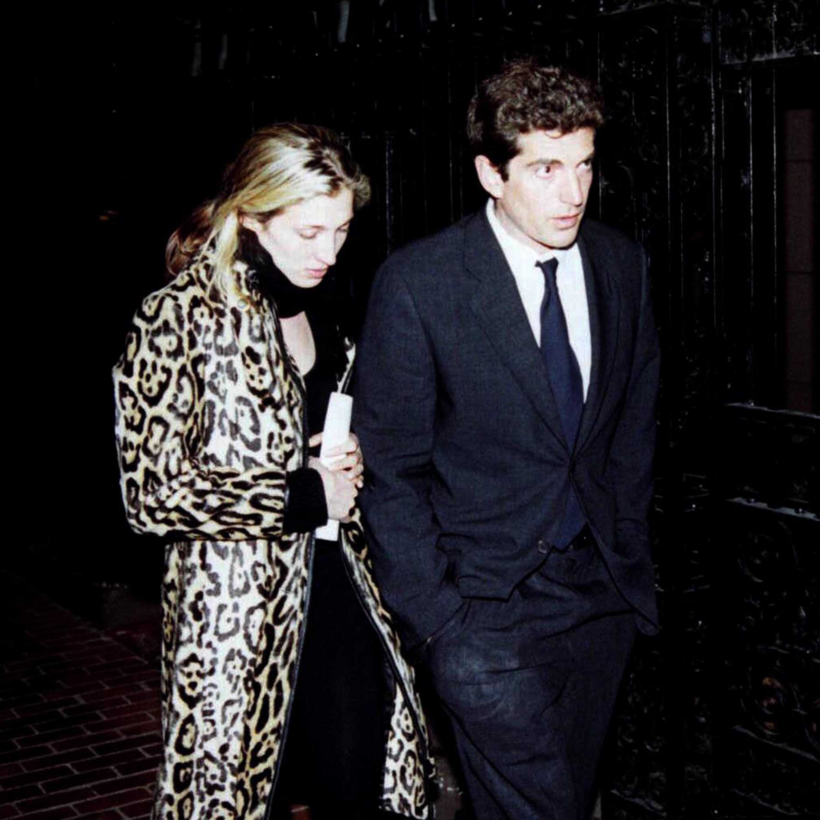

Having one’s book optioned for television feels like dropping your child off for the first day of school: Will they make friends or be hung upside down from the monkey bars? Now that I’ve seen the new FX mini-series Love Story: John F. Kennedy Jr. & Carolyn Bessette, it seems I needn’t have called the office of Color Force productions so often. The two leads—Paul Anthony Kelly, as Kennedy, and Sarah Pidgeon, as Bessette—are so appealing that, during the premiere at Carnegie Hall, I almost forgot the historical connections and was lost in the sun-splashed depiction of the era of cash transactions and newsstands with actual newspapers.
The process brought me back to the gestational period of writing my 2024 biography of Bessette, Once upon a Time, when it was just a spark of an idea, and reminded me why I wrote it in the first place. I felt Carolyn had been misrepresented by a misogynistic tabloid media and wanted to put her life and choices in this context. In hindsight, I wonder if part of the pull toward a Kennedy story was also a longing for a time when we moved forward on equal and civil rights, rather than sliding backward.
Connor Hines, creator, executive producer, and writer of the series, wrote sympathetically and intelligently about two people navigating life in the public eye, honoring the legacy of everyone portrayed. I was curious to know what drew him to the subject, and how he went about dramatizing it.
Elizabeth Beller: Connor, you wrote this series with tremendous care and sensitivity. Was part of your interest in the story the Kennedy legacy?
Connor Hines: I grew up in an Irish Catholic family with a deep affinity for the Kennedys, so their lore was essentially baked into my childhood. The reality is that, without the legacy and “Camelot” narrative Jackie cemented after President Kennedy’s death, there wouldn’t have been the same level of obsession and fanfare surrounding John and Carolyn.
E.B.: Did you always know you wanted to write for the screen? And who were your early influences?
C.H.: I’m an actor as well, so I’ve spent much of my life performing onstage. In my early to mid-20s, I began writing as an additional creative outlet and quickly fell in love with screenwriting. It feels like you get to play every character in your head. I grew up watching Nora Ephron’s movies with my mom, and even at a young age I was struck by how singular her voice was—and that no character, no matter how small the role, was ever wasted.
E.B.: You were quite young in the 90s, yet you depicted it so well. What was your mindset when re-creating that time?
C.H.: When you’re working on a Ryan Murphy production, you know you are going to be telling a story in a world that is rich and stunning and incredibly detailed. He assembles the best of the best, and no detail goes unnoticed.
“Without the legacy and ‘Camelot’ narrative Jackie cemented after President Kennedy’s death, there wouldn’t have been the same level of obsession and fanfare surrounding John and Carolyn.”
E.B.: What did you find the most challenging aspect of writing the show? And how did you overcome it?
C.H.: I think when you’re dramatizing real-life events, you have to do an incredible amount of research and become as fluent in the world as possible. But there comes a point when you have to let go of the homework, trust your instincts, and start telling the story. It took me a while to release the obsessiveness and trust that I was ready to begin writing.
E.B.: Was there anything in Once upon a Time that surprised you?
C.H.: Carolyn reconnecting with her father later in life. I thought it was very telling of her personal growth.
E.B.: What stereotypes were you trying to avoid in Love Story?
C.H.: I just didn’t want anyone to feel like they were watching a show about celebrities or American royalty. In fact, I wanted people to forget that aspect of their lives and just feel like they were watching multi-dimensional people fall in love and navigate a very complicated terrain.
E.B.: You were also a writer on Greg Daniels’s interstellar workplace sitcom, Space Force (perhaps more kismet with the Kennedy legacy), and gave John Malkovich’s Dr. Adrian Mallory uproarious takedowns and absurdist observations on the weaponization of space. Did you find a similarity in how you wrote Carolyn’s sharp wit and ironic observations of living life in a fishbowl?
C.H.: Honestly, my biggest influence with writing Carolyn is just growing up in a house with three sisters who are all ambitious, bright forces in their own right. And it helps that my mother is a brilliant, deeply funny therapist!
E.B.: What’s next for you?
C.H.: I don’t want to jinx it, but I’m developing a few things that are very different from Love Story. I will say none of them are in the romance genre—I think I’m tapped out for the time being! Plus, John and Carolyn are a tough act to follow!
The first three episodes of Love Story: JFK Jr. & Carolyn Bessette are out now on FX and Hulu, with the following episodes dropping weekly
Elizabeth Beller is the author of Once upon a Time: The Captivating Life of Carolyn Bessette-Kennedy
