A Biography of a Mountain: The Making and Meaning of Mount Rushmore by Matthew Davis

“When people first see Mount Rushmore, most are shocked by its size, though not in the way they expect,” Matthew Davis writes in A Biography of a Mountain: The Making and Meaning of Mount Rushmore. “Most find it smaller than their minds had conceived.”

I experienced the same disorientation when I first encountered the monument. The familiar sculpture called “Mount Rushmore” is only a small part of the mountain Mount Rushmore, which itself is only a small section of South Dakota’s Black Hills. It’s hard to keep the monument in perspective as a physical object; the image of the presidential faces is carved as deeply, if not more deeply, into each American imagination as it is into the billion-year-old granite.

Everyone knows those faces are immense—each one “scaled,” Davis writes, “to represent a man who stood 450 feet tall.” Gutzon Borglum, the chronically grandiose sculptor in charge of the project, gave a speech on the radio in 1931 in which he pictured his colossal creations rising out of the mountainside to wander the nation: “If they stood in the Falls of Niagara they would block the great cataract.... When they reached the Statue of Liberty, they would have to stoop to read by her dimming light.”

But aside from George Washington’s lapels—a hint of Borglum’s more expansive, unrealized ideas for the project—the presidents are only faces, not full-bodied giants, and they aren’t getting up and going anywhere. They are dwarfed not only by the natural cliffs around and above them but by the sprawl of construction rubble below. “There were always plans to remove that rock,” Davis writes, “but the memorial ran out of money.”

“An eyesore forever.”

Still, there was a kernel of truth in Borglum’s boastful fantasy about his creations interfering with and diminishing the continent’s other wonders. The sculptures were carved by outsiders into the mountain range that the Lakota—the Sioux people native to the region—call the Paha Sapa and consider sacred. Gerard Baker, the monument’s first Native American superintendent, described it as “an eyesore forever.”

After years of sustained and bloody Lakota resistance to the encroachment of white settlers and miners into their lands, the U.S., in the Fort Laramie Treaty of 1868, “unequivocally” yielded those hills to the Lakota as part of an allotment of 31 million acres encompassing the western half of South Dakota, with only official representatives of the federal government permitted to step foot on the land. But just six years after the establishment of the treaty, a military reconnaissance expedition led by Lieutenant Colonel George Armstrong Custer “found several panfuls of gold dust” in a creek in the Black Hills.

And that, practically if not legally, was the end of the Fort Laramie Treaty and the Great Sioux Reservation, as white settlers returned to the hills in droves to hunt for gold (a period that provides the basis for the HBO series Deadwood).

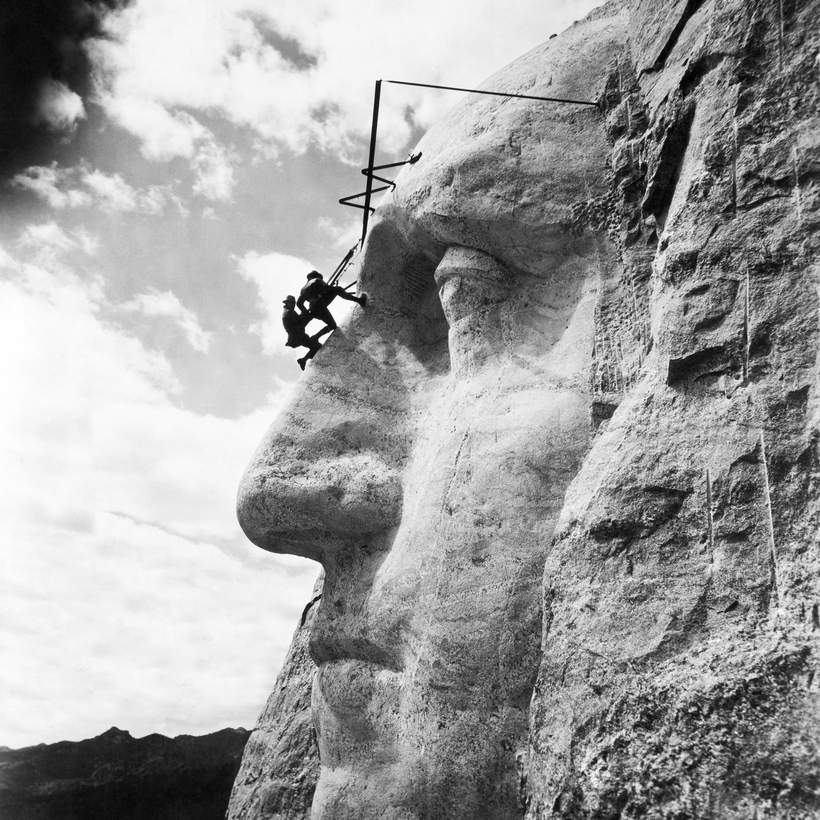
Whether it was an act of inspired creation or of vandalism, Mount Rushmore was a great feat of stone carving, carried out by a man with vast artistic ambitions but no education in engineering, with a team of local laborers and unemployed young miners who operated drills while hanging midair from harnesses. Borglum had tried to send up master stonecutters, only to discover that the older craftsmen “couldn’t balance their skills with their fears.” Incredibly, while 96 men died building Hoover Dam, a contemporary construction project, at Mount Rushmore “not a single man died on the job” (though silicosis, after the fact, was a different matter).

Borglum in his South Dakota studio, working on the first model of the colossal memorial, 1930.

The job began by identifying the tip of George Washington’s nose and working backward around it with power tools and measured blasts of dynamite, the crews going “sometimes through twenty to thirty feet of rock before they hit stone worthy of carving.” For all the careful measurement, the process and its results were wildly inconsistent. Thomas Jefferson was meant to be on the leftmost end of the row, but either sloppy work with explosives or the natural weakness of the rock made his face a failure, so he was relocated to the other side of Washington. “Borglum messed up Washington’s eyes, so that his left eye is two and a half feet shorter than his right,” Davis writes. “The part in Lincoln’s hair was initially supposed to go on the other side, but they had to leave it because of the quality of the stone.”

The funding was another act of improvisation, serially scraped together. In 1927, Borglum dropped a welcome wreath from an airplane onto the Black Hills lodge where Calvin Coolidge was summering, wooing Coolidge into giving a speech at the first drilling of the project. In his speech, the tight-fisted president declared that spending federal money on the monument was “certain” to bring “adequate returns in the nature of increased public welfare.” In 1932, under Herbert Hoover, South Dakota senator Peter Norbeck managed to get one-third of the state’s $150,000 allotment of Great Depression relief funds directed to the project, plus another $50,000 from Congress. In 1933, funding continued under F.D.R.’s New Deal, which sponsored 400 jobs for the project.

“Gutzon Borglum messed up George Washington’s eyes, so that his left eye is two and a half feet shorter than his right.”

By most tellings, the protagonist of this saga has to be Borglum: the firstborn son to the second wife of a bigamous Danish immigrant in Idaho; a commercially successful painter who gave it up for sculpture after watching Rodin at work in Paris; an “abusive, flippant, and dismissive” taskmaster. Davis gives Borglum plenty of room to show off his inspired and dysfunctional behavior—including how he “[used] cigars received on credit to pay for steaks he couldn’t afford”—but he refuses to let the sculptor run away with the story.

Instead, Davis brings forward South Dakota’s state historian Doane Robinson, the man who came up with the idea for Mount Rushmore in the first place. With South Dakota’s economy in ruins after the removal of World War I agricultural price supports, Robinson hoped to convince the eminent sculptor Lorado Taft to turn a series of granite pinnacles into monumental likenesses of “the old heroes of the west,” like Lewis and Clark and Buffalo Bill, in the hopes of attracting automotive tourists. When Taft was unreceptive, Robinson went looking for a fallback.

Borglum, meanwhile, was in the middle of falling out with the people who had hired him to create a vast tableau depicting three Confederate leaders on the face of Stone Mountain, in Georgia. After he was eventually fired by the project’s backers in a fight about the funding and scope of the work, Borglum demolished the model he’d made for them and fled Georgia ahead of the police.

Abortive though it was, Davis argues that Borglum’s work in Georgia taught him how to sculpt at scale using dynamite, and how to cobble together funds and support. “Stone Mountain,” Davis writes, “was the rough draft for Mount Rushmore.” In other words, Borglum’s homage to the United States government—which depicts presidents Thomas Jefferson, Abraham Lincoln, George Washington, and Theodore Roosevelt—grew out of his failed monument to those who tried to destroy the Union.

The pivot was in line with Borglum’s own messy personal politics. He was an admirer (and possible member) of the Ku Klux Klan—whose hatred of immigrants nevertheless left room for Borglum, in 1928, to sculpt a tribute to Sacco and Vanzetti, two Italian immigrants wrongfully convicted of murder in Massachusetts—as well as a worshipper of Manifest Destiny who, while hard at work desecrating the stolen Paha Sapa, wrote to Hoover to demand relief for the impoverished Lakota on the Pine Ridge Reservation, who he felt were “completely trapped by an alien imposed civilization, and by that civilization corrupted, beggared, and crushed.”

A worker hangs from Thomas Jefferson’s eyelid, 1934.

Equally messy are the ever shifting interpretations of Borglum’s magnum opus. The sculptor had set out, by his own account, to celebrate the awesome might of “empire makers.” Coolidge, in his speech at the groundbreaking, described it instead as a tribute to “leaders” and “principles.” The Sioux, for their part, still look at the monumental head of Lincoln, “the Great Emancipator,” and see the man responsible for the hanging of 38 Dakota men following the U.S.-Dakota War of 1862—still the largest mass execution in American history.

Borglum died in March of 1941 from a heart attack, leaving the job of finishing the monument to his son, Lincoln. Even after Lincoln declared work complete, in October of that year, the tale was not over. That same month, the federal courts heard and rejected the Lakota Nation’s claim to compensation for the Black Hills. But in 1980, when considering a renewed version of the claim, the Supreme Court declared the breaking of the Fort Laramie Treaty by the federal government to have been a “ripe and rank case of dishonorable dealing.” The plaintiffs were offered compensation of upward of $1 billion, but “instead of the money, the Lakota Nation wanted the return of the Black Hills.”

But the United States held on to the hills, including the most well-known mountain among them. Over time, Mount Rushmore has evolved from a rustic backwater to the tourist attraction of Doane Robinson’s dreams, drawing nearly 2.5 million visitors and $400 million in spending each year. For all its fame as a national icon, no president bothered to visit the completed monument until George H. W. Bush went in 1991 for its 50th anniversary. Donald Trump visited in 2020—and he is due to return for the nation’s semiquincentennial this summer—and Davis recounts how Native American protesters blockaded the roadway to the president’s speech.

What does all this teach Americans about America? Monuments scholar Paul Farber points out to Davis that Mount Rushmore—built in a region nearly devoid of other monuments, on contested land—is a monument to the power to make a monument. “I think that when we are talking about Mount Rushmore,” Farber says, “what is being commemorated is an act of carving the faces of presidents into rock.”

Tom Scocca is the editor of Indignity and a member of Flaming Hydra