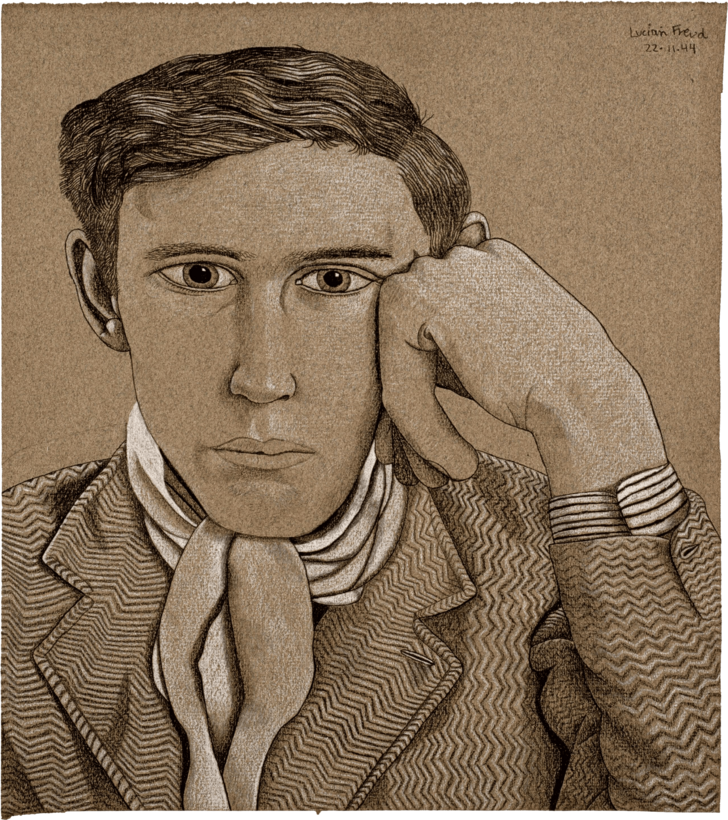
Four years after Lucian Freud’s death, in 2011, his childhood artworks, letters, and sketchbooks, filled with hundreds of drawings, were given to the British government in lieu of death duties, and the Lucian Freud Archive at the National Portrait Gallery was born. This collection provides the foundation of the exhibition “Lucian Freud: Drawing into Painting,” which has just opened at the gallery. Here, we can follow Freud’s artistic journey from the brightly colored sketches of a little boy who invented a “zebra unicorn” as a dream pony to the towering figure of 20th-century British art, whose work radiates postwar ennui with a limited “Londony” palette.

Freud in 1958.

“What makes this exhibition so interesting,” says Sarah Howgate, who organized the show and is the senior curator of contemporary collections at the N.P.G., “is how Freud’s work changed. At the beginning, his paintings were more like drawings. Ultimately, his drawings became like paintings. He drew all the time, even after the focus of his work shifted to painting. Sometimes he sketched his own paintings, as with After Watteau, a work in which he was emotionally invested. The sketch was an aide-mémoire.” The final expression of such memory-making is embodied in Freud’s etchings, a practice explored in the final room.

Among these fascinating personal documents is a wonderful love letter from Freud to Lady Caroline Blackwood, written in 1952. They married in London in 1953 and returned to Paris and life at the Hotel La Louisiane in 1954. It was there that Freud painted Hotel Bedroom. A remarkable painting, it makes us feel as though we have walked into their room by mistake. Re-uniting the work with its original sketches offers precious insight into a masterpiece of anomie, suffused with unmistakable Parisian light. Unsurprisingly, the couple divorced in 1959.

Girl in Bed, a portrait of Freud’s second wife, Lady Caroline Blackwood, 1952.

Sketchbooks were the handiest notebooks in Freud’s studio, and they are littered with telephone numbers, racing tips, and calculations, tantalizing clues to his complicated private life, which appears to have been a curious dance between concealment and exposure. While Freud assiduously defended his right to privacy, his entire oeuvre is essentially biographical. The generic titles he often used—Girl, The New Yorker, The Irishman, The Brigadier—offered little more than a transparent veil of modesty to the dramatis personae of his carefully compartmentalized world. According to family legend, Freud’s first word, uttered in Berlin, where he was born, was alleine—German for “alone.” In reality, it seems he rarely was.

Much has been made of the legions of women who gladly surrendered to the scrutiny of Freud’s objective gaze. Yet there is great tenderness in the drawings and paintings of loved ones—wives Kitty and Caroline, girlfriends and mistresses—many included in this show.

Bella in her Pluto T-Shirt, an etching of Freud’s daughter, 1995.

Devastatingly charming when he needed to be, and a devotee of the British food writer Elizabeth David, Freud would either cook for his subjects or take them out, assimilating them into his routine. This closeness was part of the process, and, as a picture came to life, intimacy informed every mark.

Which was more important to Freud’s art, drawing or painting? “Drawing into Painting” asks a good question. Do say: “I would love to see your etchings.” Do not say: “Lucian, it’s rude to stare!”

“Lucian Freud: Drawing into Painting” is on at the National Portrait Gallery, in London, until May 4

Sarah Hyde is a London-based art writer. She once passed Lucian Freud on a staircase at Christie’s. Sarah was going up and Lucian was going down