

In 1961, Tom Johnston and his wife Gladys left their jobs writing soft-drink commercials in Chicago in exchange for a life in the tropics. They settled on Bequia, a seven-square-mile island in Saint Vincent and the Grenadines, an archipelago in the southern Caribbean. Then, as now, Bequia had largely escaped mass tourism. Hunters still chased humpback whales using hand-thrown harpoons from traditional wooden sailboats. It was worlds away from the nearby Mustique, where sunburned billionaires such as Lawrence Stroll, the collector and Aston Martin Formula One team co-owner, rubbed shoulders with Mick Jagger and the Bernie Madoff associate Walter Noel.
Even in the 1960s, Bequia was the island Princess Margaret—a Mustique devotee—chose for quieter swims. The main beach, where clear water laps golden sand and palm trees, still bears her name. Nearby, a small, colorful port named after her sister, Elizabeth, remains flanked by frangipani, bougainvillea, and tamarind trees. Bob Dylan, too, passed through, once working with a local shipbuilder on a custom wooden schooner called Water Pearl, delighted that the unbothered locals did not recognize him.
By 1963, while running an inn called the Sunny Caribbee Hotel, the Johnstons often picnicked on Bequia’s western tip. When the surrounding land came up for sale, they bought 30 acres of cliff and rock for $15,000. There, they created Moonhole, a strange and visionary compound carved directly into the island’s edge.
Tom Johnston had no formal training in architecture. “If I knew architecture, I wouldn’t have put up a thing here,” he told The New York Times in 1975. From 1965 through the late 1970s, the couple built 19 houses using local stone, wood, and bones salvaged from Bequia’s small whaling fleet. “Fishermen on this pastel-hued little Grenadine isle were amazed when Tom and Gladys Johnston of Chicago moved into a giant rock hole overlooking the Caribbean Sea,” the paper added.
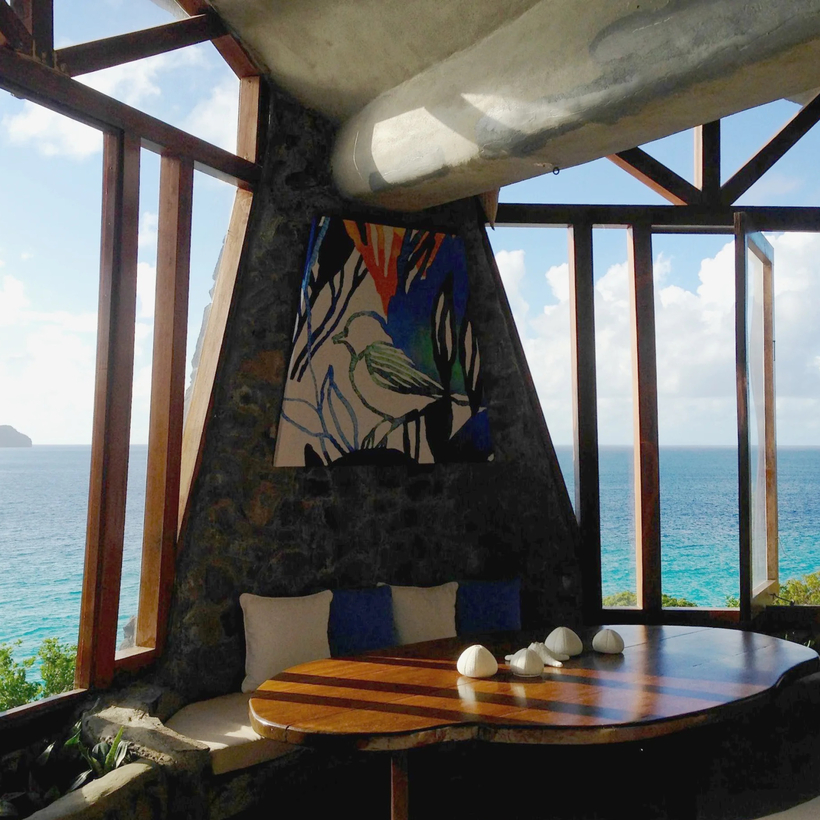
Johnston did away with doors and windows, leaving the houses open to the elements. Inside, whale vertebrae became chairs, jawbones framed indoor bars, and shoulder bones served as sculptural coffee tables. By 1976, the same year Lord Glenconner threw his Great Gatsby–style Golden Ball on Mustique, Moonhole was nearly complete. Johnston leased houses to old classmates from Princeton and became known, half-jokingly, as Moonhole’s “King.”
The project came to be seen as a rare example of organic architecture. Far from dismissing it as a collection of beach shacks, The New York Times compared it to Frank Lloyd Wright’s Fallingwater and Antoni Gaudí’s Park Güell, noting its imaginative integration of structure and landscape. Charles Brewer, an American architect who taught at Yale alongside Wright, lived there for a time.
Today, the main house, perched lowest and most precariously above the sea, has been overtaken by nature, like something out of Robinson Crusoe: a crumbling fortress dissolving back into rock. Many of the other houses are being restored. Some are for sale. Three are still available for weekly rental.
My husband and I spent a week at Agnew Hall House, listening to the island’s frigate birds squawk as seine boats glided by. In a Caribbean crowded with hulking, all-inclusive concrete resorts and endless mojitos, walking down stone steps to a turquoise bay where only a few fishermen passed felt like a different kind of luxury.
As with the other Moonhole properties, electricity at Agnew Hall comes from solar panels, and running water is collected in rain-fed cisterns. The house has views on all sides. On one, a cliff-edged bay opens toward Saint Vincent. On the other, Baliceaux, Battowia, Petit Nevis, Isle à Quatre, Mustique, Canouan, Union, and Pigeon Island rise above a strip of glittering ocean. Getting there takes only a short climb from the beach. The three bedrooms are spare but impeccably appointed, the décor minimal yet evocative: hand-printed cotton pillows in cobalt, butter yellow, coral, and rust; low, round stone tables; books; and rattan carpets. The kitchen faces the sea, and during sunset, the light turns orange before fading into darkness.
Every morning, a cook (the nightly fee includes both a chef and a housekeeper) climbed the hill to grill lobster on the terrace. There was no air-conditioning, but the trade winds moved freely through the openings, cooling the thick stone walls until midday. Lying in bed at night, I kept returning to something Johnston once said: “A house should not be built to be looked upon, but designed so its occupants can look outward and live outwardly, enjoying the world.”
House rentals at Moonhole begin at $2,500 per week between July and October, and $3,000 between November and June
Elena Clavarino is a Senior Editor at AIR MAIL
