
It seems that Emmanuel Carrère still smarts from the day his brunette mother came home with her hair dyed in a sculpted blond crop, never for it to be altered again. In his new autobiographical book, Kolkhoz, he describes that fateful day as “perhaps the strangest and most disturbing in my life.” Carrère, now 68, would have been in his mid- to late teens, roughly the same age his mother had been when she experienced her own capillary shock: seeing her beloved father for the very last time, but shorn of the dark mustache she had grown so accustomed to.
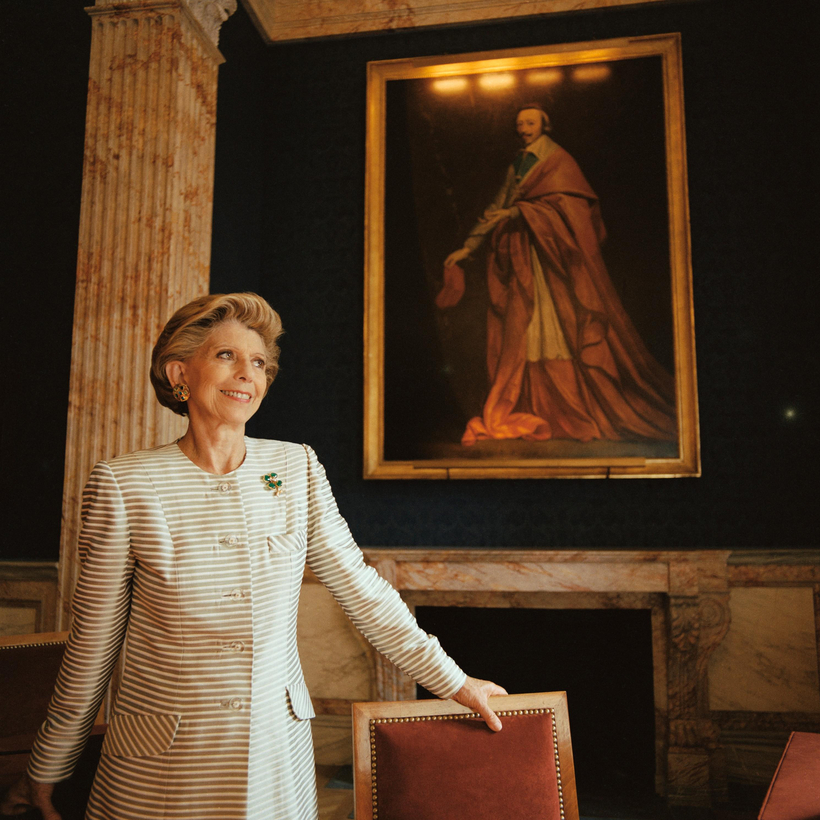
He had shaved it off to evade detection, but to no avail. In 1944, a few weeks after the liberation of France, Georges Zurabishvili, who had emigrated to France from Georgia in the 1920s, was bundled into a car by three men with machine guns. It spelled the end of his brief career as a Nazi collaborator, and he was never to be seen alive again. To his daughter, Hélène Carrère d’Encausse, a French politician and historian who in 1999 became the first woman elected as permanent secretary of the Académie Française—the 40-member institution founded by Cardinal Richelieu in 1635 to safeguard the French language—this past was a stain on the family’s reputation that should be kept secret at all costs. But Hélène’s son saw things differently, and in 2007, Emmanuel decided to reveal the truth of the matter in his book My Life as a Russian Novel, dividing the family.