
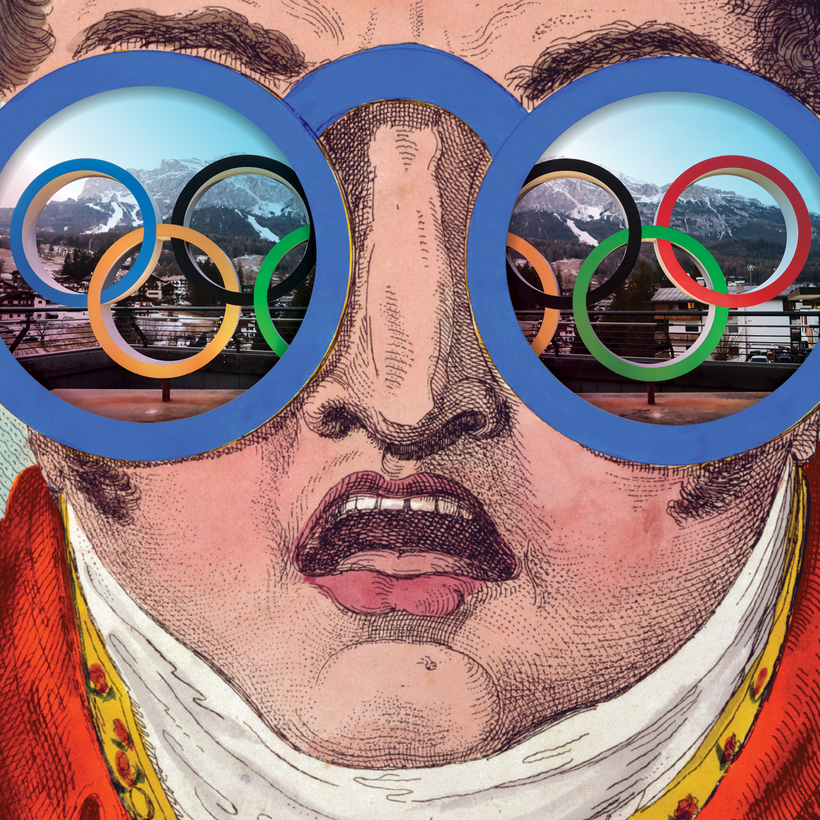

Last week, the population of Cortina d’Ampezzo breathed a collective sigh of relief: snowflakes were finally descending from the gray sky. A little over a week before the Milano Cortina 2026 Winter Olympics were set to begin, on February 6, the town was experiencing its first real snowfall of the year: 22 inches’ worth.

By the time the flakes arrived, reports detailed cars stuck on the roads, tires slipping and sliding. A 55-year-old security guard died during an overnight shift at a construction site near Cortina d’Ampezzo’s ice arena as temperatures dropped to 10 degrees. When I asked a Cortina regular if there was any controversy surrounding the Olympics, she said, “Just that it hasn’t snowed.” She called me a couple of days later: “Just that it has.”

“By the midcentury, there will remain practically just 10 to 12 National Olympic Committees who could host these snow events,” said Thomas Bach, the current president of the International Olympic Committee. Italy may not be one of them. According to a study by the University of Trento, snowfall in Italy has halved over the past 100 years, and the snow season has shrank by a full month.

Yet increasingly it doesn’t seem to matter. As it stands, 90 percent of Italy’s slopes already rely on artificial snow. TechnoAlpin, a company based in Bolzano, in Northern Italy, is blanketing some of the major Milano Cortina slopes, a $32 million operation that requires 17 million gallons of water. Its “SnowFactory” technology can now generate snow even when temperatures exceed 68 degrees Fahrenheit.

The company’s reach extends far beyond the Alps. Founded in 1990, TechnoAlpin exports some 5,000 snow machines around the world each year. At the indoor mall Ski Egypt, near Cairo, you can experience “frozen tundra” in a box, complete with a colony of gentoo and king penguins you can waddle with for a fee.

In the newest of these structures, the artifice is total. China’s Harbin Ice and Snow World has experimented with L.E.D.-integrated “scent cannons,” which release fragrances during synchronized light shows on the slopes.

The snow that powers these frozen tundras is often perfect. The technology—blowing water into freezing air with turbines—was invented 60 years ago, but today it employs A.I. to optimize exactly where and when to spray. At a microscopic level, this isn’t the delicate, six-sided crystal of a natural flake; it’s what insiders call “snow caviar”: perfectly round beads of ice that are denser, heavier, and far more resilient.

The “winter season” is the creation of an enterprising Saint-Moritz hotelier.

Skiing started as a mode of transport in Europe’s northernmost countries—unlike wagon wheels or horse hooves, which would sink into the snow, a long, flat pair of skis stayed on the surface—before turning into a leisure activity in the 1860s. Saint-Moritz is where the “winter season” was truly invented in 1864, after the hotelier Johannes Badrutt promised four adventurous British guests that they would enjoy the winter sun as much as the summer.

That belief endures to this day, even when the snow itself is unreliable. A 2024 University of Cambridge study titled “All Downhill from Here?” found that house prices in Swiss ski resorts have depreciated by 3.6 to 6 percent for every 3.2 degrees Fahrenheit of warming, yet the market holds because of the region’s perceived safety and prestige. The last time I went to Gstaad, there was no mistaking where the slope had been cut into the mountain—a bright white strip amid green and muddy slush. But, as I was reminded by a family friend, “Gstaad will always be Gstaad.”

Designer brands are continuing to churn out ski-wear at an unprecedented rate to meet demand, something that was popularized by Giorgio Armani when he launched Giorgio Armani Neve, in 1995. Sporty Arc’teryx gear has been upstaged by DiorAlps, Louis Vuitton’s LV Ski, Coco Neige by Chanel, Gucci Altitude—the list goes on.

The snow (or lack of it) is just one controversy that has emerged ahead of the Games. Following the announcement by U.S. Immigration and Customs Enforcement (ICE) that it will be there “to vet and mitigate risks from transnational criminal organizations,” Milan’s mayor, Giuseppe Sala, took to national radio to announce they are “not welcome.” He continued: “This is a militia that kills…. It’s clear that they are not welcome in Milan. There’s no doubt about it. Can’t we just say no to Trump for once?”

To rebuild Cortina’s historic Eugenio Monti bobsled track, which had been abandoned since 2008, builders felled hundreds of ancient larch trees, in an operation that protesters dubbed “larchicide.” In Milan, demonstrators unfurled a banner depicting the Olympic rings, each circle inscribed with the words “concreting,” “gentrification,” “greenwashing,” “privatization,” and “eviction.”

Environmental protests are increasingly a staple of the event. The Beijing Winter Olympics in 2022 were labeled “the most unsustainable Games of all time,” by Carmen de Jong, a Strasbourg University professor, after it emerged that the arid mountains would be covered in 100 percent artificial snow—made from water diverted from local farmers—and that ski runs would be cut through the Songshan National Nature Reserve.

Taken together, the ICE backlash and the climate crisis raise broader questions about what hosting the Olympics now entails—not just controlling the weather but tamping down political dissent, too. Gian Franco Kasper, the longtime president of the International Ski Federation and an Olympic Committee member who died in 2021, once admitted that “it is easier for us in dictatorships…. From a business view, I say: I just want to go to dictatorships. I don’t want to fight with environmentalists anymore.”

According to the Associated Press, Saudi Arabia had planned to host the 2029 Asian Winter Games in Trojena—an artificial, year-round ski resort in Neom, its still-unbuilt metropolis in the northwest desert—where planners envisioned nearly 19 miles of outdoor ski slopes and a man-made lake cut into the desert mountains, complete with “the Vault,” a vertical village inside the mountain itself. The idea was to create a micro-climate where the “outside” is technically “inside,” turning the mountain into a giant refrigerator. As of this writing, those plans have been postponed.

So why not host the next Winter Olympics in Dubai? It has big mountains—albeit desert ones—and stable weather, with none of the chaotic hurricanes or blizzards currently rattling the West. No pesky environmentalists or protesters, either. I’m told that a few thousand feet above sea level, temperatures drop to a manageable 68 degrees Fahrenheit—the magic number for TechnoAlpin’s machines. So you might just be able to wear your Loro Piana jacket in the desert.

Elena Clavarino is a Senior Editor at AIR MAIL