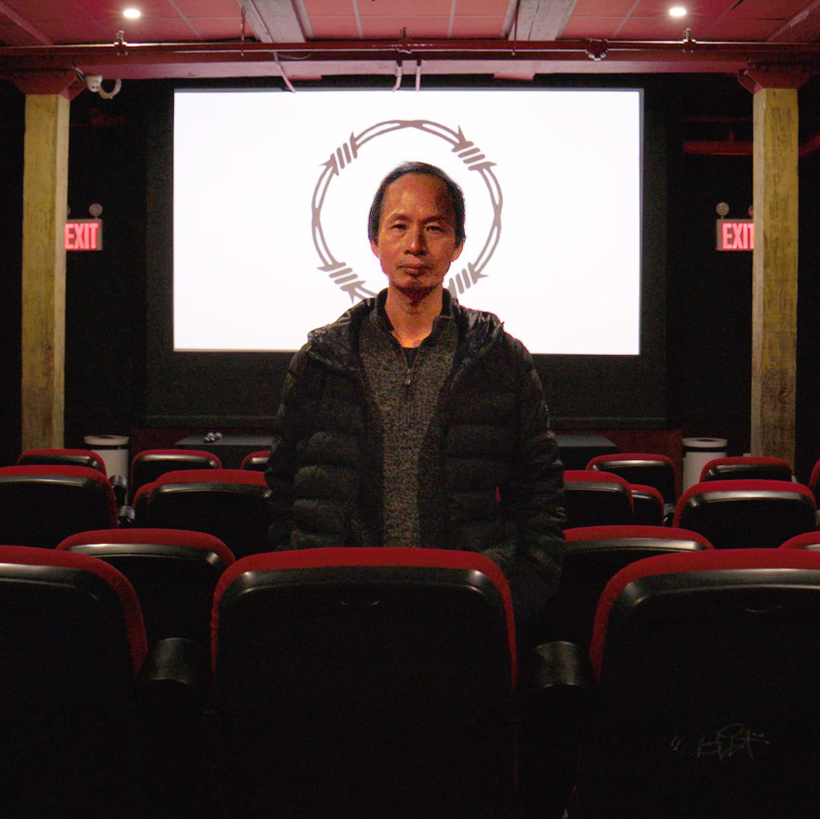
While Xi Jinping purges his military leadership at home, he is also ramping up repression of perceived enemies within the United States. Last November, one week before the opening night of Brooklyn’s inaugural IndieChina Film Festival, its organizer, Zhu Rikun, was woken by the insistent vibration of the phone he uses to speak with friends and relatives back in China.
Zhu picked up to hear his father’s voice and knew immediately that something was wrong. His father, who lives in Guangdong, told him to be careful and not to do anything that would be bad for China. He then began to repeat himself.
Zhu stopped him. He knew his father was referring to the film festival and suspected the Chinese authorities had forced his father to call him. This was confirmed not long afterward when Zhu heard from a friend who shares his old studio space in Beijing. “She told me she was taken away by [security officers],” Zhu says. “She was very scared.” The officers had questioned her and searched the studio premises, she said, and given her a message to pass on to Zhu: his actions were dangerous, and he would face consequences for them if he returned to China.
There were more calls, messages, and e-mails from filmmakers and other contributors to the festival over the following days. Not only those based in China but also in the U.S., as well as Europe, the United Kingdom, and Japan. They all sounded scared and told Zhu they no longer wished to be involved. He decided he would have to cancel IndieChina.
“Based on the current events,” he wrote in a statement posted to the festival’s Web site, “anyone involved in the festival, whether directors, forum participants, external parties, volunteers, or even audience members, could be threatened or harassed.”
Zhu has lived in the U.S. since 2014. When he was an active member of Beijing’s independent-film scene, he recalls, a number of festivals were pressured, interfered with, or shut down. But he had not expected that a small event in New York City would be attacked in the same way. Some of its 48 films did include topics Chinese authorities consider controversial, including L.G.B.T. themes and the heavy societal restrictions imposed during the coronavirus pandemic, but he did not see it as an overtly political program. Other films covered the popularity of Western-style birthday cakes in China and the daily life of primary-school children. “Maybe I should have … thought that it could happen,” he says. “But I didn’t.”
IndieChina had fallen victim to China’s vast campaign to intimidate and control diaspora populations far beyond its borders. It’s a campaign that is waged extensively on American soil and includes online threats and surveillance as well as physical violence and the targeting of loved ones back home. These tactics, often known as “transnational repression,” are increasingly employed by authoritarian governments around the world. Meanwhile, the Trump administration is dismantling human-rights programs aimed at curtailing them, putting dissidents at risk of deportation, and embracing high-profile offenders.
State targeting of exiles is not new. Russia has long engaged in overseas harassment and assassination operations as have other traditional U.S. adversaries such as North Korea and Iran. This week, a Brooklyn pipe fitter was sentenced to 15 years in prison for his role in a failed plot to murder the Iranian dissident Masih Alinejad in New York at the behest of the Iranian authorities. But an interconnected world and the ongoing erosion of international norms have made it more common among U.S. allies, too.
Saudi Arabia’s crown prince, Mohammed bin Salman, notoriously had the journalist Jamal Khashoggi killed and dismembered in Istanbul in 2018. In 2024, the U.S. charged an Indian-government employee for directing a plot to assassinate a U.S. citizen of Indian origin—a Sikh dissident—living in New York. This echoed findings by Canadian authorities that Indian diplomats had been involved in murder, extortion, drive-by shootings, and home invasions in Canada.
The Chinese Communist Party (C.C.P.) routinely targets exiles in America—many of them U.S. citizens—including democracy activists from both Hong Kong and mainland China, as well as minority groups such as Tibetans and Uyghurs. In 2022, U.S. authorities shut down what they described as a secret-police station in Manhattan being operated on behalf of the Chinese government, and when Chinese president Xi Jinping visited San Francisco the following year, groups linked with the C.C.P. attacked protesters with flagpoles and chemical sprays.
“Maybe I should have … thought that it could happen. But I didn’t.”
Last year, Michael McMahon—a retired New York City police officer turned private investigator—and two Chinese citizens living in New York were convicted of charges including stalking and acting as illegal foreign agents. They had been targeting a former Chinese official and his family in New Jersey and trying to force him to return to China to face purported corruption charges. The Chinese agents harassed the official’s daughter, pounded on his front door, and left a note informing the former official that “his wife and children will be okay” if he returned to China. This was just one part of China’s forced repatriation program known as “Operation Fox Hunt.”
Zhou Fengsuo, a Chinese human-rights activist who was involved in the Tiananmen Square protests of 1989 and now lives in the U.S., says the issue is far more pernicious than the legal record suggests. “Overwhelmingly, these cases are not reported,” he says. “We only hear 1 percent of it.”
Anna Kwok, a U.S.-based democracy activist whose father was arrested by Hong Kong police last year as part of a campaign against the families of exiled dissidents, believes these attacks sow fear throughout the diaspora. “A lot of the time you hear stories of people like me who are more public with our work,” Kwok says. “But in reality a lot of transnational repression is actually directed against people who are relatively more anonymous. It’s an attack on the entire community.”’
While the Biden administration prioritized recognizing and countering transnational repression—and enjoyed rare bipartisan support in doing so—the Trump administration has cut or gutted a number of human-rights bodies and programs involved in these efforts, instead directing law-enforcement agencies to focus on immigration issues.
“Overwhelmingly, these cases are not reported. We only hear 1 percent of it.”
These policy shifts have had a major impact on U.S. efforts to counter transnational repression, says Nate Schenkkan, an independent human-rights expert who works extensively on the issue. “It’s not 100 percent, but the vast majority of it has been curtailed, eliminated, and shifted as the administration has shifted priorities and shifted resources,” he says.
Trump often brags of being tough on China, but his focus has been on trade policy rather than on breaches of American sovereignty or protecting dissidents—even U.S. citizens—whose safety appears to be of little concern to him. Last year, he welcomed Mohammed bin Salman to the White House and shouted down a press question about Khashoggi’s murder. In November, he pardoned the retired police officer convicted in the New Jersey stalking case.
Dissidents have also been put at risk by Trump’s deportation program, and Russian asylum seekers ejected from the U.S. have been detained or given draft notices on arrival in Moscow. Last year the Department of Homeland Security attempted to deport a Chinese asylum seeker named Guan Heng, who secretly shot video footage of China’s Xinjiang region, where authorities have carried out a campaign of repression, detention, and forcible assimilation targeting Muslim minorities that the U.S. determined was genocide. But a public outcry drew attention to Guan’s plight and on Wednesday an immigration judge granted him asylum status, an increasingly rare victory in the Trump era.
In the end, it was too late for Zhu to cancel IndieChina’s screening venues, so he attended throughout the week as a form of protest, sometimes alone, sometimes with friends, sometimes watching private screenings of the canceled films. He plans to continue staging film festivals but believes a different approach will be necessary to escape Chinese pressure. “Maybe I’ll have to do it in an underground way in New York,” he says. “It sounds ridiculous, but I’ll have to.”
John Beck is a journalist and the author of Those Who Should Be Seized Should Be Seized: China’s Relentless Persecution of Uyghurs and Other Ethnic Minorities