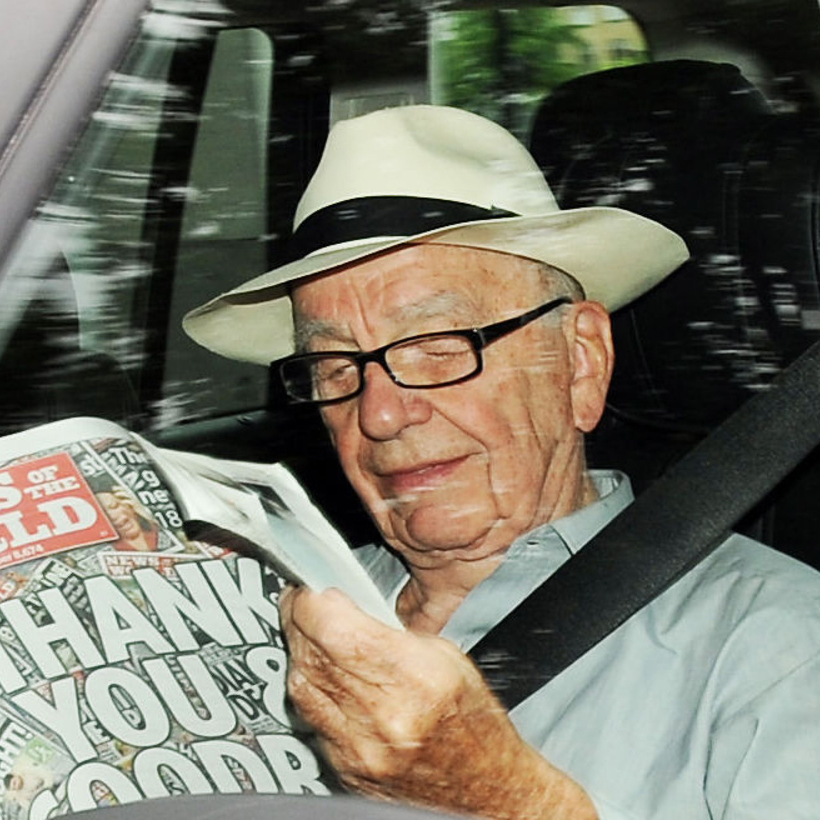
Last summer, a rumor circulated through the media industry that Rupert Murdoch, the media titan at the helm of the News Corp. empire, was gravely ill. A Fox Corp. spokesperson dismissed it, but the denial carried little weight with those who have watched the company for years. Back in 2018, Murdoch’s representatives insisted he was fine after he broke his vertebrae falling on his son’s yacht—an injury that was far more serious than the public was led to believe.
The speculation about Murdoch’s health forced a question that has long loomed over the industry: What does the media landscape look like without its most dominant figure? Murdoch turns 95 in March and is now rarely seen in public. I believe his most influential properties—Fox News, the New York Post, and The Sun—have poisoned public discourse in the U.S., the U.K., and Australia. And yet, after 20 years of covering him, I know I will miss him when he’s gone.
Murdoch is a throwback to an era of press barons like Northcliffe, Hearst, and Pulitzer. He may be the last true lover of newspapers. While the tech billionaires who now own newspapers treat them as trophies or cost-cutting exercises—Jeff Bezos at The Washington Post or Patrick Soon-Shiong at the Los Angeles Times—Murdoch views them as the lifeblood of his influence.
He has spent hundreds of millions of dollars to keep the New York Post alive. He aggressively expanded The Wall Street Journal after buying it in 2007. This week, at 94, he launched the California Post—a West Coast edition of his New York tabloid, complete with “Page Six” and an ambition to set the news agenda in America’s most populous state, where the governor, Gavin Newsom, is a likely Democratic presidential candidate. Since 2005, roughly two-thirds of American newspapers have closed, but Murdoch continues to launch them.
Murdoch is also the antithesis of the risk-averse C.E.O.’s who now dominate the media business. He doesn’t rely on focus groups or management consultants. He doesn’t treat programming as a data-driven “content play” in the vein of Netflix. Covering Murdoch is compelling because he operates by gut instinct. Because he controls the family’s voting shares, he can act unilaterally. In the 1980s, he paid $3 billion for TV Guide’s parent company without consulting his board. He nearly bankrupted his company in the early 1990s to launch a British satellite service to compete with the BBC. No modern publicly traded company would allow a C.E.O. this much latitude.
While the tech billionaires who now own newspapers treat them as trophies or cost-cutting exercises, Murdoch views them as the lifeblood of his influence.
The media beat will be significantly duller without the rivalry among Murdoch’s children. This family drama, which inspired the HBO series Succession, is the focus of my new book, Bonfire of the Murdochs. I have spent years chronicling Rupert’s obsession with passing his empire to his most capable heir, a Darwinian process that finally reached a conclusion in a Nevada courtroom in late 2024.
In an attempt to secure the empire’s future, Murdoch sought to alter his irrevocable family trust to ensure his eldest son, Lachlan, would remain in control. Last September, Lachlan paid his three siblings—James, Elisabeth, and Prudence—$1.1 billion each to relinquish their voting shares. I have met Lachlan, and while he shares his father’s conservative politics, he lacks Rupert’s primal interest in gossip and daily scoops. It is telling that Lachlan plans to preside over the family’s holdings from Sydney.
There is also much I won’t miss. Andrew Neil, who worked for Murdoch for years, once compared the senior ranks of News Corp. to the court of Louis XIV. “All authority comes from him,” Neil noted. Murdoch fostered a corporate culture where loyalty was often prized over ethics or the law. He tolerated egregious behavior as long as his executives remained profitable.
This philosophy even took precedence over his own family; Murdoch famously backed Roger Ailes for years after Ailes bullied Lachlan into quitting the company. Across the Atlantic, the same culture led to the phone-hacking scandal at News of the World, where employees intercepted the voicemails of crime victims to generate headlines.
When Murdoch dies, his legacy will be a matter of fierce debate. Many conservatives will praise him for breaking the mainstream media’s monopoly on news. Liberals will continue to blame him for the rise of Donald Trump and the coarsening of the public square. I agree with much of the latter critique. But as a journalist who has spent a career in his orbit, I will also mourn the loss of the last great media mogul. The world may be a more stable place without him, but the story will be far less interesting.
Gabriel Sherman is the author of the book The Loudest Voice in the Room, a biography of Fox News president Roger Ailes