I drove the Jaguar down Benedict Canyon for an eight a.m. breakfast meeting with Marty Ransohoff, one of Hollywood’s most successful producers, whose credits ranged from The Beverly Hillbillies to Catch-22. Marty knew the industry class system and offered attendees a sliding menu: bagels and cream cheese for sitcom writers; screenwriters were given smoked salmon with their bagels; studio executives, major stars, and directors were served eggs Benedict.

Marty had a reputation as a tough guy. He supposedly once said, “If I can find a way not to screw you on this I won’t, but if I can’t, God bless.” But when we met he was polite, and I got a bagel with cream cheese.

I pitched my pilot idea, Marty liked it, and we took it to Michael Eisner in a meeting brokered by Mike Ovitz. Our pilot was produced but didn’t make the schedule. Nonetheless, Marty and I developed a mutually beneficial relationship: Marty would ask me to read a screenplay, as a favor, and give him notes. In return, he let me use his tennis court.

Michael Elias and Steve Martin: Elias co-wrote The Jerk with Martin and Carl Gottlieb, and worked on many of Martin’s comedy recordings.

Back in 1974, Holmby Hills was a piece of expensive real estate—it still is—along Sunset Boulevard between Beverly Hills and Bel Air. Marty’s home there was a Tuscan palazzo with all the trimmings: library, screening room, gym, and wine cellar. He led me past the swimming pool, through the rose garden, and down the steps to a covered pavilion overlooking what was the most beautiful tennis court I had ever seen. It was flanked by towering eucalyptus trees on the deuce side and by Marty’s house on the other. I could feel its aura, its divinity—it was a holy place, Seneca’s Scythian glade, Oedipus’s sacred grove at Colonus, the Temple Mount.

“Hey, Elias. Where are you? You listening to me?,” Marty said.

“Sorry. I was admiring the court. You were saying?”

“Here’s the drill: You call Theo; if nobody is playing, you can use it. The pool’s off-limits. You bring your own tennis balls.”

I followed the rules. Theo made an unexpected appearance in the pavilion. He delivered the bad news as a butler should, with a mixture of regret and cruelty.

“Mr. Ransohoff’s on his way home. He’ll be playing with Warren Beatty. You have to vacate immediately,” Theo said. “Sure,” I said, figuring there was no point in being Warren Beatty if you can’t kick someone off a tennis court.

My skills on Marty’s court improved exponentially; serves landed deeper, bounced higher. I heard the orgasmic pong of the ball hitting the sweet spot on my racket more often. I was on my way to really good.

Eventually, as in most matters, I found a way to fuck it up.

“He Likes Being Underground”

It began when my lawyer friend Dennis Roberts called.

“Are you playing tennis these days?”

“Yes.”

“Are you any good?”

“I’m O.K.”

“I have a friend who likes to play tennis. He’s in L.A. He’s looking for a game. Maybe you could play with him.”

“Do I know him?”

“He works in the subway.”

“I don’t know any subway workers.”

“Go figure. He likes being underground.

It had to be Abbie Hoffman. He’d been on the run from trumped-up drug charges for nearly a year.

Cocaine blues: Hoffman is led into a police station in 1973 on drug charges.

“What’s he doing in L.A.?”

“They’re making a movie out of his book. He’s working with the writers. I told him about you. He wants to play tennis with you.”

“Fine. How will this be arranged?”

“He’ll call you. I gave him your number. His cover name is Barry Freed.”

“Got it.”

“Don’t tell anyone.”

“Tell anyone what?”

“Atta boy.”

Dennis was one of the lawyers working on the Chicago Seven trial, which is how he and Abbie became friends. After the trial, Abbie continued political activism, organizing demonstrations against the Vietnam War, the Contras, Monsanto, and two Republican conventions; he also dropped balloons filled with pig’s blood on the floor of the New York Stock Exchange.

Articulate, funny, rock ’n’ roll handsome, he made the cover of Rolling Stone twice. Although the press sometimes portrayed him as the “clown of the revolution,” he was deadly serious in his dedication to overthrowing the military-industrial state and achieving justice for the oppressed. Then, just when there was talk of a political career, he was arrested for selling cocaine to an undercover New York policeman. Abbie, out on bail, disappeared.

Over the years there were sightings; rumors placed Abbie in France, Cuba, Algeria. Others said that he’d had plastic surgery, burned off his fingerprints, and was teaching kindergarten on Long Island. And now he would be my tennis partner on Marty Ransohoff’s court.

I parked at the corner of Sweetzer and Fountain, a neighborhood of old apartment buildings, perfect for stashing a mistress or housing a fugitive. A man in tennis whites holding a racket rapped on the window. I opened the door.

“Abbie?”

“I’m Barry now. Barry Freed.”

“Cool.”

He nodded and got in the car.

As we drove west along Santa Monica Boulevard, I wondered if I would have recognized Abbie from the F.B.I. posters in the Beverly Hills Post Office. The neatly bearded man sitting next to me still owned a strong chiseled face, but the hair was different; the long Mick Jagger pageboy was now a curly mop. This Abbie wore thick tortoiseshell frames. “I’m still twenty-twenty,” he said. “The lenses are clear. But my nose is different.”

I drove into Beverly Hills and parked in front of Marty’s house. I led Abbie to the carport; we squeezed between a Mercedes 380SL and a Jaguar XJ6 into the rear gardens.

“Nice pool.”

“It’s off-limits.”

“Who owns this place anyway?”

“Marty Ransohoff. A producer. He’s made some big movies.”

I was uneasy walking through a rich Hollywood producer’s landscape with Abbie. If this was a people’s republic, Marty would surely be an enemy, the Mercedes would be introduced as evidence, and Abbie would condemn Marty to a lifetime of shoveling pig manure in a re-education center in a Burbank commune. Abbie whistled.

Have racket, will travel: Elias in his Jaguar in Los Angeles in the 1970s.

“Wow, this court is out of fucking sight. You get to play here whenever you want?”

“Not whenever. But enough.”

Abbie had been on the Brandeis tennis team, he was that good, and would have been better now if a policeman’s horse hadn’t stepped on his ankle at a demonstration. Abbie still had a strong first serve that could be followed by a nasty spinning second one. Fortunately, I had just returned from a week of lessons at John Gardiner’s Tennis Ranch in Carmel, where I majored in nasty spinning serves, and, combined with my improvement on Marty’s sacred court, we split two sets.

Afterward, we toweled off in the pavilion.

“Why can’t we use the pool?”

“I don’t know. Rules.”

Abbie frowned.

“Fucking rules.”

“The Butler Will Tell Him”

On the way back to West Hollywood, Abbie explained that a director had bought his book, and that Universal had paid for a screenplay and arranged for Abbie to come to Los Angeles to work with the screenwriter.

“He wants it to be accurate. But here’s the thing—I’m wanted by the F.B.I., I’m working in Hollywood. Is that so hard to find out? Or, if they can’t, what does that say about the F.B.I.? Maybe they do know where I am. Did they make a deal with Universal? Nobody tells me anything. Can I relax? Can I stop looking over my shoulder, eat in restaurants, go to a Dodgers game and not be so paranoid, or is the F.B.I. just incompetent?”

“You’re in Hollywood. I would stick with paranoid.”

Driving away, I thought playing tennis with Abbie might get me points in the revolutionary struggle with my ex-wife, Caroline. She had studied with Angela Davis at U.C.L.A. and was a committed feminist who held me personally responsible for everything from whalebone corsets to Sylvia Plath’s suicide. “I do more for humanity in one day than you do all year in Hollywood,” she had told me. Now I could say, “Oh, yeah? Guess who I played tennis with for the revolution?”

Even thinking about Caroline was depressing. In my last session, I confessed to Dr. Grotstein that I was growing tired of hoping that the people I met—movies stars, writers, directors, and now a Chicago Seven hero—would make me more desirable to her. Dr. Grotstein said I was making progress.

A week later, Abbie got in my car carrying a new Babolat racket.

“I also brought a bathing suit just in case,” he said.

“Out of the question.”

“He’ll never know.”

“The butler will tell him.”

I invited my deli-owner friend Jerry to play with us, winner stays on the court, introducing Abbie as an old friend from New York. The next time we played, Jerry brought his wife, Dottie, so we could play doubles. Abbie and Dottie teamed up against me and Jerry and won easily.

“You know what would be nice?,” Abbie said. “Let’s all have dinner Saturday night. ” After Dottie and Jerry left, Abbie said, “If you want to invite a few more people who are cool, it’s cool. I want you to meet Johanna. I told her all about you.”

I made a guest list: Abbie’s partner, Johanna Lawrenson, was a ceramist, so Lenore Zola, a site-specific artist who carved faux fossils on canyon walls and then “discovered” them in the Borrego Badlands, would be a good choice, along with the writers Eve Babitz and Paul Ruscha [brother of the artist Ed], and my tennis partners, Jerry and Dottie. Could I ask for vows of silence, sworn on the lives of their children, at least until Abbie left town?

I introduced Abbie and Johanna to my guests.

“He doesn’t look like Abbie Hoffman,” Eve whispered to me.

“He’s had work.”

During dinner we talked about art. Eve read a passage from her new novel, about a lousy weekend in Palm Springs. “I don’t want criticism,” she said. “Just tell me how much you love it.”

In the end, it was just a dinner party. All topics of interest to a group of Angelenos and the visiting fugitive couple were covered: movies, sports, politics, religion. Out of sensitivity to the revolutionary perspective of Abbie and Johanna, no one complained about their portfolios or business managers. I asked Abbie to talk about life on the run. “It’s about staying active, trying to change the world, being political while swimming underwater,” he said. “It’s a lower profile, but we’re O.K.”

Johanna told how they had toured Europe with forged credentials that identified them as food critics for Time magazine. “We ate our way across France in three-star restaurants for free,” Abbie said. “Typical Abbie,” Paul said.

After dessert, we went out to the deck, passed joints, stretched out on chaises, and stared up at a rare, smog-free night sky.

“You have a nice place here,” Abbie said.

“Thanks.”

“So, what is it like to live in the maw of the mind-fucking capital of the world?,” Johanna said.

I told them a story. It wasn’t mine, but came in useful for such moments.

“There was this famous sitcom writer. He took his family to Italy, rented a house in Vernazza. The writer traded his Nikes for sandals, sipped espressos every morning at a café in the piazza, and carried a Moleskine notebook with a fountain pen. He instructed his wife and children, ‘If anyone asks what I do for a living, do not say I write sitcoms. You are to say I am a poet.’

“Toward the end of their stay, the local newspaper announced an episode of Mia Madre L’Auto and listed him as the writer. That night a television was set up in the piazza, and the entire village came and watched the show. Afterward, they paraded to his house. The mayor presented him with a bouquet of flowers: ‘All this time we thought you were merely a poet.’”

Abbie smiled.

“One more game, tomorrow?”

“No Appeals Allowed, Pal”

Monday, I was working in my Warner Bros. office when I got a call.

“Marty, how are you?”

“I’ll get right to the point. You’re eighty-sixed from my tennis court.”

“What?”

“You violated my trust. With me you only get one shot. You blew it with your friend.”

“I’m sorry, I swear I didn’t know he was a fugitive.”

“Who?”

“Abbie Hoffman.”

“Is that his name?”

“He also goes as Barry Freed.”

“What the fuck does that have to do with anything?”

“Did the F.B.I. talk to you? I am so embarrassed.”

“F.B.I.? He jumped in my pool. My butler saw him. He was naked.”

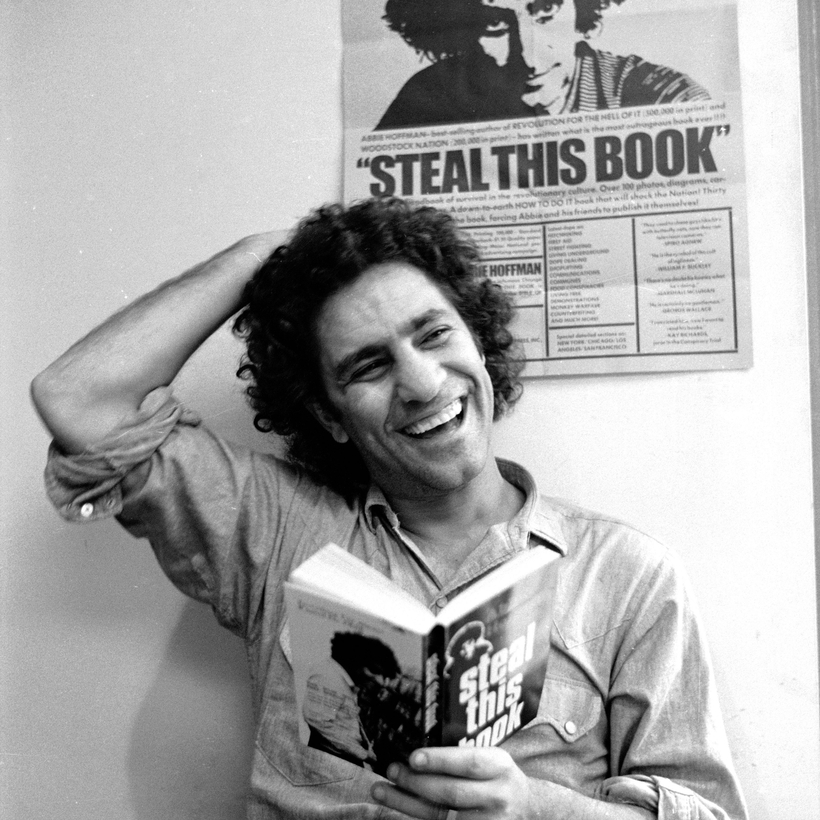
“It’s about staying active, trying to change the world, being political while swimming underwater.” Abbie Hoffman in 1974.

“I am so sorry.”

“You know the rules. The pool is off-limits.”

“Marty … ”

“No appeals allowed, pal.”

Marty hung up. The court was gone. My Scythian glade, my Colonus. My improvement. I lowered my forehead on the desk and cursed Abbie.

I went back to playing at the public courts at Rancho Park; my serve withered, my backhand went astray, I hit balls into the adjacent court while players waiting their turn laughed at me.

A few weeks later, Marty called.

“Look, I’m willing to revisit the issue of the putz who jumped in my pool which led to your temporary suspension.” I suppressed a cry of joy at temporary but knew Marty wanted something in return.

“Would you take a look at something for me?”

“Of course.”

“A pilot. Give me some notes, maybe polish a couple of scenes?”

“Send it over.”

I called my friend Jerry.

“I got the court back.”

Then my ex-wife, Caroline.

“Did I tell you I played tennis with Abbie Hoffman?”

“Like I give a shit, Michael. He’s a clown.”

“So what? We need clowns. And I liked him.”

At therapy the next day, Dr. Grotstein didn’t see my call as a complete setback. “For once, Mr. Elias, you disagreed with her. You may be reclaiming your own opinions. Who knows, one day you might admit to not liking Sylvia Plath.”

Michael Elias has written for film, television, and theater. His latest novel is You Can Go Home Now. “Playing Tennis with Abbie Hoffman” is adapted from Bender’s L.A., forthcoming from Sticking Place Books