Suppose you know something no one else does.
That gives you an advantage.
But even better: suppose they don’t even suspect you have this big secret.
Now that makes you truly powerful.
So let the fools believe they’ve boxed you into a corner.
Because the joke’s on them. You have this knowledge, this masterful mystery—and it’s all you need. It sustains you.
The fishing is always good in Idaho, but any angler will tell you that when spring turns to summer the hatches are near to bursting. Only Bill Thompson, inveterate fly fisherman, longtime Latah County prosecutor, and the state’s hard-charging lead attorney in the case against Bryan Kohberger, had been forced to postpone his annual fishing trip indefinitely. After two and a half years of combative legal wrangling, Thompson and his team were hunkered down in Moscow, Idaho, finalizing their legal strategy last June for the start, at long last, of the following month’s murder trial. Yet, just as Thompson’s fishing trip had fallen by the wayside, so would the trial.
After fervently maintaining their client’s complete innocence, Kohberger’s defense team reached out to Thompson and disclosed they were ready to discuss a plea deal. And with hardly a pause, Thompson obligingly pivoted, too. Despite all the vitriolic motions and counter-motions they had hurled at each other, the veteran legal combatants moved forward in their deliberations with astonishing speed. By the end of the weekend, it was agreed that Kohberger would plead guilty, and in return for the state’s not pursuing the death penalty, he would serve four consecutive life terms, as well as relinquish his right to any appeals.
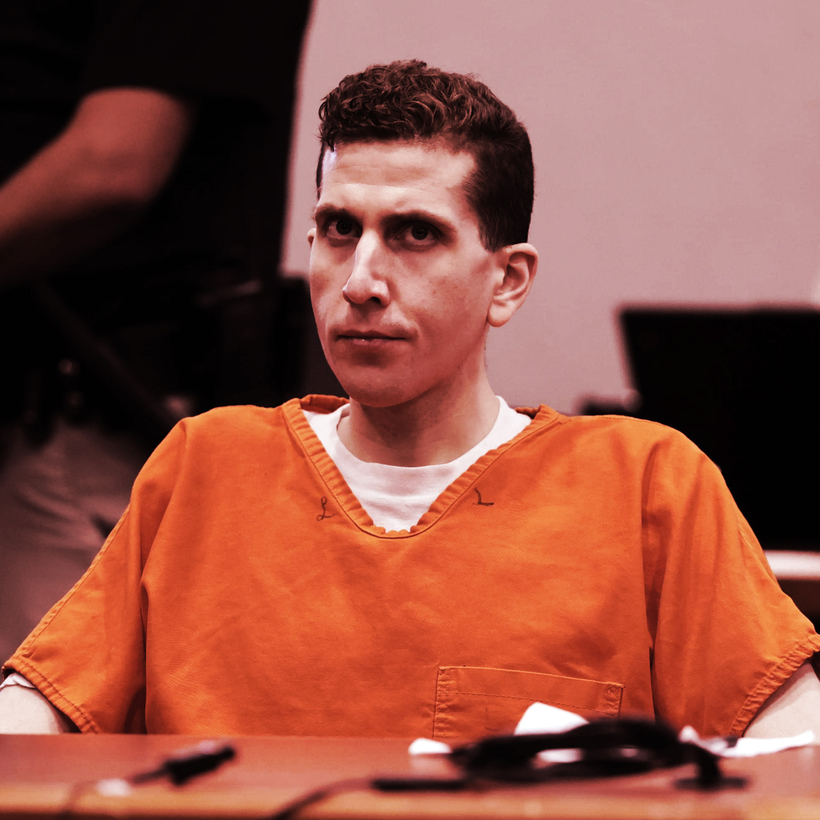
The next day, the stunned families of the victims learned of the impending settlement in an e-mail notification. Two days later, there was Kohberger in the courtroom, his hollow eyes fixed on a spot in the distance. In a flat, indolent voice, he confirmed with one terse “guilty” after another that he had murdered Maddie Mogen, Kaylee Goncalves, Xana Kernodle, and Ethan Chapin. Two weeks later, Kohberger was formally sentenced, and after “respectfully” declining the judge’s offer to make a statement, he hobbled out of the courtroom in chains to begin serving a sentence that will only end with his death.
I watched all this unfold with a mix of bewilderment and exasperation. I had first headed off to Moscow, Idaho, three years earlier, to report on the case in the tense days before Kohberger had even been identified as a suspect, and I had developed a deep personal connection to the events. When Kohberger suddenly pleaded guilty, I was sure that justice had been done, but it struck me as incredible that both the prosecution and the judge had sanctioned a resolution that allowed so many of the essential questions about what had occurred to go unanswered.
There remained no apparent motive for the murders; no confirmed connection between the killer and any of the victims; no explanation of how Kohberger fled from the scene without leaving a trail of blood in his wake; no understanding of why two residents of the house—including one young woman who had stepped out of her bedroom to find herself staring into the killer’s black-masked face—had been spared; and no murder weapon.
Firm in the belief that the right man had been convicted yet still troubled by these lingering enigmas, I looked forward to making my way through the law-enforcement documents and videos that would be released in the aftermath of the case’s settlement and the lifting of the judicial gag order. Yet when I was done, I found myself confronting a possibility I had never previously considered.
I am, by both instinct and a reporter’s longtime breeding, someone who looks to facts, to objective realities, to get a handle on events. I have little truck with a worldview that chases after furtive bogeymen lurking in clandestine shadows for answers. And yet, I have come to consider a startling hypothesis: Bryan Kohberger may not have acted alone.
What do the authorities think of this? When I reached out, several declined to comment. But one knowledgeable official who did not wish to be identified, told me this: “If we said there was an accomplice, we’d look like fools for negotiating the plea bargain. The truth is, we made a deal to avoid the time and expense of a trial, but there is a lot that we don’t know. Or that we will ever know.” Indeed, there is.
Unanswered Questions
According to neighborhood-surveillance-camera footage, Kohberger parked on the bluff above the victims’ house at about 4:00 a.m. He then walked down the icy hill, and, the law-enforcement reconstruction posits, entered the second-floor sliding glass door at approximately 4:07 a.m. His car was then seen speeding away from the neighborhood at 4:20 a.m. Using this time frame, the authorities contended he had around 13 minutes to commit four murders on two separate floors of the house.
Moscow police performed two test runs, and on each occasion the officers demonstrated that one killer could accomplish four fatal stabbings within the allotted time. Yet this does not take into consideration the time that would have elapsed after he walked out the sliding kitchen door. Kohberger would have needed to trudge back up the icy slope to his car, remove and dispose of his bloody clothes, enter and start his car, and proceed down the hill. Those activities would surely have reduced his actual time inside the residence by several minutes.
My timeline suggests that all four assaults were committed in nine minutes or less. Still, a nine-minute window might—just might—have been sufficient for four people, on two separate floors, to have been fatally stabbed.
Only this, as the autopsy reports that have been released sporadically since September as well as gruesome photographs from inside the blood-spattered murder house that the Idaho State Police put online this week (only to remove inexplicably hours later) document, was a massacre.
Here’s the evidence: Xana Kernodle was stabbed more than 50 times, and many of these were defensive wounds. That is, she fought back. Kaylee Goncalves was stabbed more than 20 times; her family put the precise number of wounds at 34. She also resisted her assailant, and his response was ferocious and brutal. There was evidence of asphyxia injuries, which meant that she had been strangled and perhaps gagged. And there were also blunt-force-trauma injuries; her nose had been broken and her face beaten beyond recognition. Madison Mogen and Ethan Chapin were both stabbed “multiple times”; the exact counts have not been publicly released.
There were, I conservatively estimate, well over 100 separate knife wounds. How long would it have taken to deliver 100 or more blows? And two of the victims fought back; the killings were neither easy nor neat. In addition, one of the young women was savagely beaten, perhaps also strangled and gagged. Could one assailant have carried out all this carnage in nine minutes over two floors in a pitch-black house? Or even in 13, as the police suggest? I remain skeptical.
And throw this, too, into the ruminative mix. After Kohberger’s sentencing, Bill Thompson told Kevin Fixler of the Idaho Statesman, “There were injuries that appeared to have been caused by something other than the knife, although it could have been the knife. I don’t think we can exclude the possibility that there was an additional weapon involved.”
Four separate victims, two of whom fought back, on two floors of a dark house. More than 100 separate stab wounds. Possibly an additional weapon. All done in 9 minutes, or, supposing the authorities are correct, 13. All the work of a single individual. I don’t buy it.
What about the DNA on the knife sheath found lying on the bed next to the body of Maddie Mogen? Yes, the speck of touch DNA on the button snap belonged to Kohberger. However, Blood Sample 1.4, which was also found on the sheath, according to the DNA-quantification-lab report recently released by the Moscow Police Department, does not.
An analysis of the sample indicated the presence of a Y chromosome. That is, it was male DNA. And after further tests were performed, the state-police lab excluded its belonging to Kohberger, Chapin, or several other men who, earlier in the investigation, had come under suspicion because they frequented the house.
So whose DNA was it? The man’s identity remains unknown. Yet I know this: it’s DNA that persuasively reinforces speculation that another man may have been in the top-floor bedroom with Kohberger when the killings took place.
Also: It’s long been established that unknown male blood DNA had been found on a first-floor handrail and on a glove outside the home. Is the DNA on the back of the knife sheath a match for either of these two still unidentified samples? Or have the complacent and satisfied authorities decided there’s no need for further investigation? That it would be foolish to ask a question when the last thing you want is to hear the answer?
A Vexing Moment
And what about the motive? There isn’t one. In fact, as Bill Thompson admitted to the court on the day of the sentencing, the state has no evidence Kohberger had ever spoken to any of the victims, followed them on social media, or entered the house on King Road before the night of the murders. All that can be definitely stated is that a knife sheath bearing his DNA was found in the bedroom on the second floor. So, we are left with this: a graduate student, intent on murder, randomly picked a house to enter at four in the morning.
It’s certainly possible. But it doesn’t work for me. Here was a criminal-justice student who was meticulous in his planning, who didn’t leave a drop of blood in his car or apartment, who didn’t leave a fingerprint in the King Road house, and who managed to avoid having his face or license plate appear in any frame of the videos that captured the white car at the scene. Would he have chosen that specific house on a whim?
It would have been a risky business. There were five cars parked out in front on the night in question; that suggested a lot of people were inside and would have to be dealt with. Also, he undoubtedly saw the DoorDash driver at 4:00 a.m.—minutes before the murders—making a delivery. Which was a sure sign that at least someone was awake and might not be taken by surprise. Entering 1122 King Road unprepared would be the height of recklessness. And Kohberger, the scholar who had studied crime scenes and police investigations, tended to be calculating, not impetuous, in his actions.
From the inception of the crime, things appeared to have proceeded with a careful logic. And this logic was initiated by a distinct and compelling motive. Only here’s the thing: I have come around to suspecting that Kohberger was not the catalyst for all the horror—that it wasn’t his idea.
I believe Kohberger had tagged along that night on somebody else’s mission. And if pressed to speculate further, I would argue the case can be made that Kohberger didn’t have an accomplice. Rather, he was the accomplice. He had hooked up with someone (and I have some still-inchoate thoughts on this, but stay tuned) he’d met after he arrived in Washington State. It was this individual who wanted the students in the house on King Road dead. And Kohberger, perhaps eager to use all his book knowledge to help plot the perfect crime, went along with it.
But that’s just conjecture. It’s a trail of thought that, I will admit, might lead to a very dead end. Or maybe, when mixed into the bubbling stew of suspicions churned by the volumes of new evidence, a pot worthy of further stirring.
In the end, I am still left puzzling over one vexing moment. On the night of Bryan Kohberger’s apprehension, at his parents’ home in Pennsylvania, he was led in handcuffs to the back of a police vehicle. And that should have been the end of the story, or rather the beginning of the end. But before the car drove off to the state-police barracks, Kohberger reportedly asked a single question: “Was anybody else arrested?”
At the time, it was easy to fit this anomaly into the case’s conventional narrative: Kohberger, the concerned son and sibling, had been eager to learn if either his parents or his sisters had also been taken from the family home in the middle of that wintry night.
But when illuminated by the cache of new evidence, a different, more ominous interpretation surfaces. For it has grown increasingly probable that, while Kohberger has been justly incarcerated, someone else who was also in the house on King Road that savage night could still be out there.
Howard Blum is the author of the New York Times best-seller When the Night Comes Falling: A Requiem for the Idaho Student Murders and the forthcoming Stranded! The Untold Story of the Mission That Changed Space Travel