
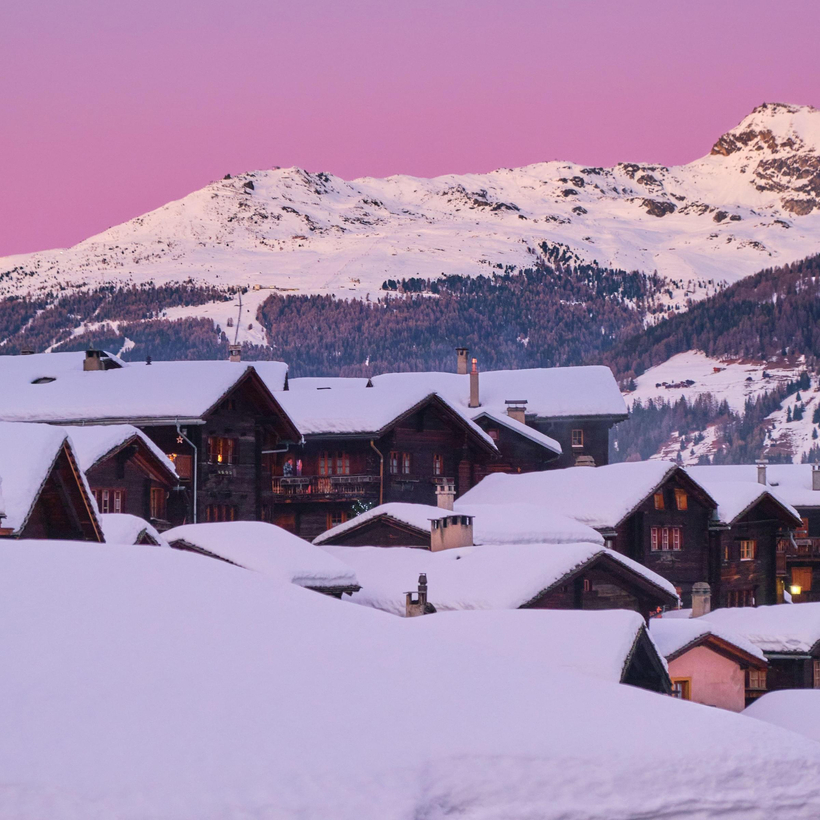
A boulder, dislodged from the Alpine cliff above, had embedded itself in the asphalt in front of our taxi. It could have killed our entire family, but I saw it as a sign that we had come to the right place.

The road to Val d’Anniviers is notoriously challenging, a dizzying staircase of hairpin turns beneath steel nets designed to catch falling rocks like the one that had landed in front of us. Being Swiss-built, it is an impressive work of engineering, and fatalities are rare. Nevertheless, it is the kind of road that limits traffic to the highly motivated. No one is just passing through.

At the summit lies not only Europe’s highest ski resort but its most unusual, almost an anti-resort. Over the last few decades, the global ski industry has changed from a business scattered among individual owners (often local families) into one dominated by multi-nationals. Millions have been spent on high-tech improvements, such as chairlifts and snow-making machines, often at the expense of a place’s soul.

Off-piste skiing on Mount Zinalrothorn.

Val d’Anniviers is different. Sometimes described as a country within a country, it is a secluded valley in French-speaking southwest Switzerland, three hours by train from Zurich and Geneva, though it feels further. The resort is actually a cluster of small resorts, each communally owned. Here, unlike Gstaad or Zermatt, there is a tradition of minimizing the glitz.

My ex-wife and I started taking our children to Val d’Anniviers during the pandemic. I ski; she, who does not, wanted to be someplace with a life of its own, not a seasonal pop-up that turns into a ghost town come spring. Skiing is central to the economy of Val d’Anniviers, but it is seen as a means of supporting one of the most authentic and well-preserved Alpine regions in Switzerland.

At the deepest part of the valley, in the shadow of the cruelly shaped Zinalrothorn (red horn), daredevils can find off-piste skiing as exciting as any. Thrill-seeking isn’t the valley’s specialty, however. The skier who will feel most at home is the one whose goal is a leisurely, high-altitude lunch of raclette and Valaisan wine at eye level with one of the most sublime horizons in Europe. As my teenage son put it over a bucket of fondue on the outdoor terrace of the Cabane Bella-Tola, a “chalet d’altitude” (ski in only), “It’s not like crazy, competitive skiing. It’s just about enjoying it.”

The ski-in only Cabane Bella-Tola.

You will not enjoy it if your taste for throwback skiing does not include mechanical drag lifts. For the oldest of old-school experiences, there is a two-mile long Poma ride—the world’s longest, supposedly—that hauls skiers by their crotches to the top of the mountain, zigzagging in a way that leaves some hanging on for dear life.

Much of the local economy is devoted to leisure. The Val d’Anniviers is known for its saucisson and other air-dried meats, which you can order with a raclette made with raw milk from the local Hérens cows at Becs de Bosson, a restaurant run by an old ranching family. Like the local wine, both products are prized by the Swiss and difficult to obtain outside the country. The sherry-like Vin du Glacier is stored in barrels and never leaves the valley. For a taste, contact the Office du Tourisme de Grimentz, which organizes cellar tours.

You will not enjoy Val d’Anniviers if your taste for throwback skiing does not include mechanical drag lifts.

Ironically, leisure was never much part of the valley’s history. The challenge of farming nearly vertical slopes gave residents a hard-won solidarity. When tourism arrived, they made sure its profits didn’t leave the valley, either. “The ski lifts are ours,” I heard a local historian say. “The hotels, it’s all ours.”

This is the secret to the valley’s appeal. Because there’s little outside investment, the scale of tourism is checked. At a resort such as Zermatt, the road where the boulder crashed in front of us would be a highway or a train line. The T-bars would be heated gondolas.

The best example of Anniviard hospitality is the Grand Hôtel Bella-Tola, in the mountainside community of Saint-Luc. Traditionally, Swiss grand hotels were stopping points for Victorian mountaineers and aristocrats on their way to Florence. The proprietors received guests almost as refugees, pampering them with steaming-hot baths and hearty breakfasts before returning them to the trail. Today, there are around 100 such hotels left, some more sprawling than others.

“Here, unlike Gstaad or Zermatt, there is a tradition of minimizing the glitz.”

The Bella-Tola is no Dolder Grand or Badrutt’s Palace. It is a country inn, the kind where at night you smell the stone pine burning in its fireplace before you see its glow. The Bella-Tola calls itself a “living museum,” which suggests stuffiness. There is something ancient about it—the dried carnations, the oil landscapes made by artists who traded their work for stays.

The Grand Hôtel Bella-Tola, in Saint-Luc.

Built during the Belle Époque over an Iron Age tomb filled with gold and silver, the Bella-Tola stayed in one family for its first 100 years. It is owned today by another local hotelier, the urbane, ever present Claude Buchs. Like our family, half the hotel’s clients are repeat visitors. Most are Swiss. Only in summer does a surge of Americans arrive, walking the Haute Route from Chamonix to Zermatt. After a stay in the mountain huts, they stumble in like pilgrims who have found “an oasis in the desert,”says Buchs.

Your appetite for a traditional Alpine experience may end with the Poma lift, but if you truly want to earn your pleasure, in what some would call authentic Swiss fashion, the valley also offers an extraordinary lodge for the adventurous, the Hotel Weisshorn. No roads connect with the 30-room Weisshorn, which occupies a commanding precipice half a mile above Saint-Luc.

Mountain views at the Grand Hôtel Bella-Tola.

The 19th-century hotel, which has been abandoned multiple times, has a monastic feel, with its rough-hewn stone floors, shared bathrooms, and air of splendid isolation. (The hotel has its own power supply, a miniature dam over a mountain stream.) During winter months, a snowcat nimbly chauffeured by a chain-smoking driver named Ivan hauls guests up to the ridge; at the end of their stay, they can ski out if they want. One morning at dawn, my kids and I did just that, gliding back to civilization under glowing pink bluffs, not a single other skier or chairlift in sight.

Ben Ryder Howe is a frequent contributor to New York magazine, The New York Times, and Air Mail. He is the author of My Korean Deli: Risking It All for a Convenience Store