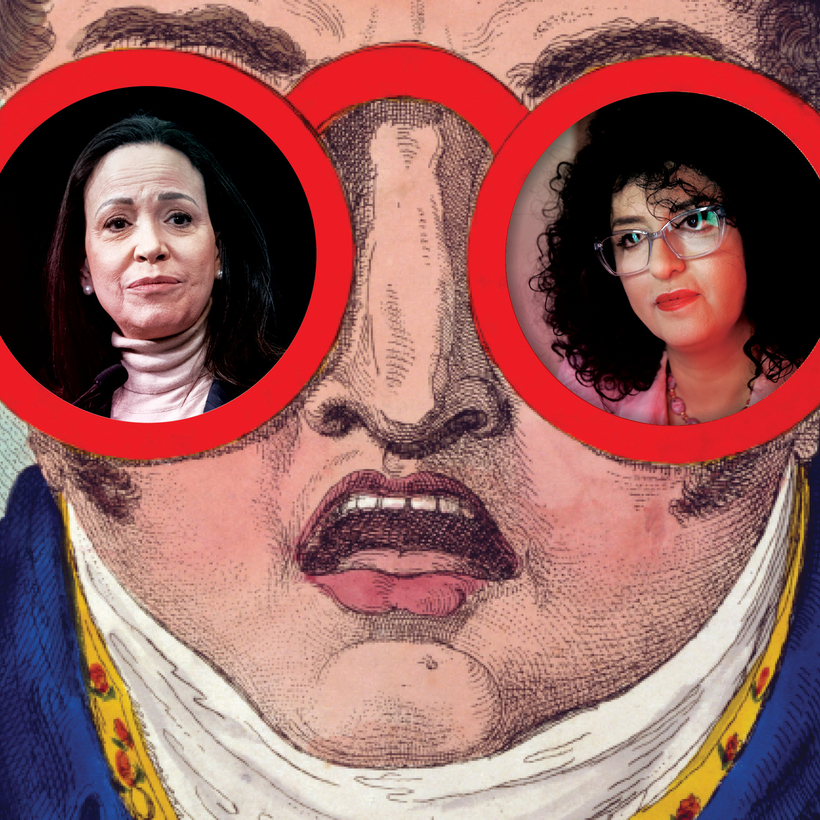

As Iran burns—with thousands jailed, tortured, and killed by a theocracy that is desperate to preserve its power—and as Venezuela reels from the U.S. capture of Nicolás Maduro, two female Nobel Peace Prize winners who helped undercut these regimes now stand alone. One has been restrained by state repression inside her homeland, the other sidelined by geopolitical currents outside it.

On October 10, 2025, María Corina Machado, Venezuela’s most prominent opposition leader, was awarded the Nobel for her decades-long struggle to achieve, in the Nobel Committee’s words, “a peaceful transition from dictatorship to democracy.” Before Machado could accept it, she first had to receive it, which she did by fleeing Venezuela in darkness and in disguise on a small fishing skiff to Curaçao, then boarding a private jet to Oslo.

Then came the capture earlier this month of Maduro. But while Machado praised his arrest, she found herself ignored by the Trump administration. Many put this down to her acceptance of the Nobel—a prize Trump has long coveted. “If she had turned it down and said: ‘I can’t accept it because it’s Donald Trump’s,’ she’d be the president of Venezuela today,” a source close to the White House told The Washington Post.

So, on Thursday, in a private meeting at the White House, Machado presented the award to Trump as a “sign of the brotherhood” between both countries “in their fight for freedom against tyranny,” and vowed to be elected president of Venezuela “when the right time comes.” It seemed the only way to ensure her voice was heard. This was especially necessary as, on the same day, Delcy Rodriguez, the acting president of Venezuela, whom Machado has called “one of the main architects of torture, persecution, corruption, narcotrafficking,” met with John Ratcliffe, the director of the C.I.A., to discuss future cooperation.

Before Machado could accept it, she first had to receive it, which she did by fleeing Venezuela in darkness and in disguise on a small fishing skiff to Curaçao, then boarding a private jet to Oslo.

Meanwhile, in Iran, Narges Mohammadi, who won the Nobel Peace Prize in 2023 for her “fight against the oppression of women in Iran and her fight to promote human rights and freedom for all,” remains in prison, having been arrested for the 13th time in two decades in December. Mohammadi emerged as the defining voice of Iran’s Woman, Life, Freedom movement after the 2022 killing of Mahsa Amini, a 22-year-old woman detained and beaten to death by Iran’s morality police, who hadn’t liked the way she wore her hijab.

Unlike Machado, Mohammadi does not lead a political party. But her courage—sustained through years of imprisonment, torture, and forced separation from her family—inspired Iranian women to take to the streets. What began as a fight for women’s rights, however, has grown into a broader demand against clerical rule itself.

For Mohammadi’s mentor, fellow Iranian Nobel laureate Shirin Ebadi, Mohammadi’s recent arrest appeared to be the last straw. Iranians, Ebadi wrote in a statement released by the Nobel Women’s Initiative on January 6, have “reached the conclusion that this system cannot be reformed—it must end.” Mohammadi’s jailing, along with the economic upheaval in the country, seems to have united different groups and socio-economic classes—male, female, young, and old—and tipped the country into open revolt.

Suzanne Nossel, a former deputy assistant secretary of state and former president of PEN America, was in Oslo when Mohammadi was awarded the Nobel Peace Prize in absentia. Mohammadi managed to smuggle the text of her acceptance speech out of jail, which was read at the ceremony by her husband and two children—just one of the extreme measures she has taken simply to remain part of the very conversation she started. Exiled in France, her children haven’t seen their mother in 12 years.

Children of the revolution: Kiana Rahmani and Ali Rahmani, the children of Narges Mohammadi, accept the 2023 Nobel Peace Prize on behalf of their imprisoned mother.

“She was so committed to the future of her country that she was willing to give up raising her children,” says Nossel. “She’s a feminist. Outspoken and fearless. When she’s had the occasional furlough from prison, she’s out talking to people and urging them to stand up—knowing that’s going to land her right back inside. She has sacrificed so much to be a champion of this movement.”

And yet, Nossel continues, “it’s very hard to judge what kind of political resonance she has inside Iran. She is respected as a prominent figure in the Woman, Life, Freedom movement. If they had free elections in Iran, would she attract significant political support? That’s a real question.”

“They are both women of incredible strength and courage,” says Louise Shelley, an expert on transnational crime and terrorism. “[They are] extremely charismatic and know how to reach the citizens of their countries, which is very important if there is a transition—the problem is, there is no indication that a transition is going on.”

“In Venezuela, it’s not as if Machado was sidelined by the Venezuelans, but she had been sidelined by Trump, who has not had a strategy to change Venezuela’s political picture,” Shelley says. “He removed the capo, but there is no strategy to remove the political system.”

In Iran, Shelley says, the government jailed Mohammadi to lessen her ability to influence the masses. “And so it comes down, in both cases, to domestic- and foreign-government strategies to neutralize these women.”

The authoritarian machinery in Tehran and Caracas could not be more different on the surface. In Iran, women are jailed, tortured, and even beaten to death by religious fanatics who brutally force them to cover their bodies. In Venezuela, by contrast, a deeply sexist culture of “machismo” prefers women to be as uncovered as possible, says Shelley.

Yet the links between Iran and Venezuela run deep. Strengthened by years of sanctions-dodging trade and a shared hatred of the U.S., Iran has established Hezbollah cells in Venezuela using the country as its South American hub, according to a 2022 report by the Washington Institute for Near East Policy. Whatever one thinks of the legality of the Trump administration’s removal of Maduro, one of the U.S. goals—besides securing oil and mineral deals—was to eradicate Iran’s ability to use Venezuela as a staging ground for anti-democratic terrorist activity, including transnational assassinations.

Perhaps a new, more hopeful bond between the two countries is being formed. Last year, when Mohammadi was arrested while attending a memorial service for a slain human-rights lawyer, Machado called for “her immediate and unconditional release.” It was a call from Nobel laureate to Nobel laureate, a call between two women who are bound together by their refusal to be silenced.

Jennifer Gould is a columnist at the New York Post. She covers real estate, money-laundering, and global corruption, among other things