“I want the most dramaticals you’ve got to offer,” teases the choreographer Hope Boykin, addressing a roomful of sweaty dancers at the Martha Graham Dance Company headquarters, in Manhattan’s West Village. Seeing that the troupe has been mining primal drama for 100 years now—Greek myth, political rebellion, human sacrifice, and every shade of grief—that’s a big ask. Whether it’s Medea’s rage, Joan of Arc’s passion, or the desires of a young bride in Appalachia, the Graham dancer knows how to conjure engulfing emotion through spinal twists, pelvic contractions, the deft manipulation of fabric, and roaring commitment.

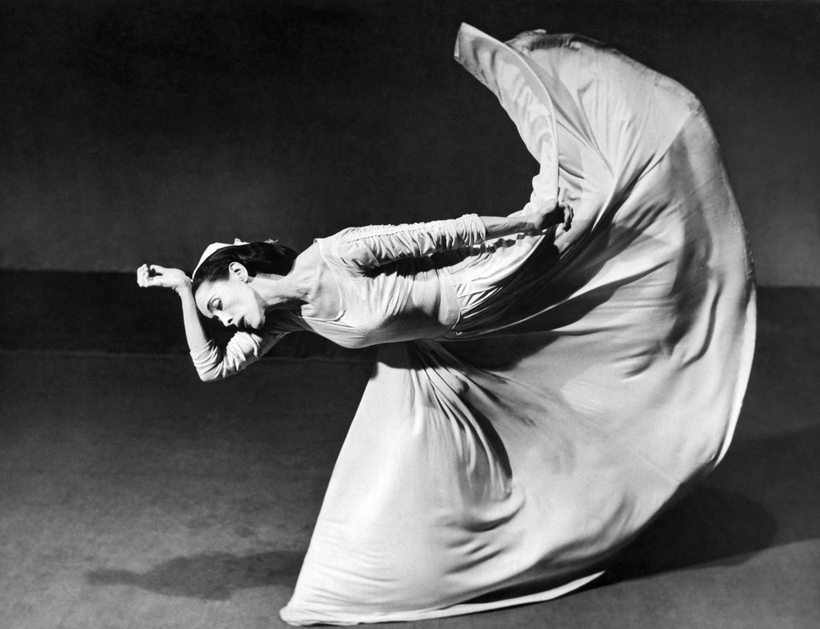
Rehearsing her new dance, En Masse, before the company hits the road for its centennial tour, Boykin knows well the power she’s invoking. In another section, for instance, she dials things down, instructing the cast to be “full out, but without the lashes.” En Masse was created last fall in just three weeks, and Boykin is tweaking the work before its Midwestern premiere—next Saturday, January 24—at Chicago’s fabled Auditorium Theatre. It fits into a program of Graham classics that includes the solo Lamentation (1930), a famously seated portrait of suffering; Chronicle, an anti-Fascism protest from 1936; and Diversion of Angels (1948), an exploration of love in a Kandinsky-inspired palette.

Hope Boykin, a choreographer and former member of the Alvin Ailey American Dance Theater.

Though freshly minted, Boykin’s dance is rooted in Graham history. The music is a distillation of Leonard Bernstein’s Mass, into which the composer Christopher Rountree has spliced a recently unearthed 49-second musical sketch that Bernstein wrote for Graham. The company’s artistic director, Janet Eilber, explains that this fortuitous discovery led to a search for the right choreographer for the score, which is not the norm. “It’s usually the other way around,” Eilber says. “We commission the choreographer and then work with them on the music.”

Enter Boykin, an Alvin Ailey American Dance Theater alumna who already knew the Bernstein composition intimately. In 2022, she choreographed the full Mass for the Kennedy Center’s 50th anniversary. (Ailey himself choreographed Mass’s 1971 premiere, which marked the center’s inauguration.) “I wanted an American woman,” says Eilber, “and Hope’s been an emerging and rising talent. She was the logical choice.”

“Knowing the music was helpful,” Boykin affirms. “I feel like I had a head start.” She stresses that the pieces are completely different, though they share the theme of struggle that Bernstein and Stephen Schwartz worked into Mass’s libretto—a fusion of Catholic liturgy and anti-war lyrics. In En Masse, the dancers’ wrists are initially bound by stretchy blue bands, which Boykin describes as “a physical manifestation of what holds us back, a bound mindset.” This fighting against and inside oneself is in direct conversation with Graham’s Lamentation—a body trapped in a taut jersey column, elbows and knees distorting Cubist planes to convey a claustrophobic sorrow.

Struggle and protest have emerged as key themes of the Graham100 tour—on through May 30 and traveling to 13 American cities as well as to Italy and Latvia. Jamar Roberts’s We the People is another defiant centennial commission. Eilber believes this owes more to Graham’s timelessness than to current politics. “The country is very divided right now, as it was in 1936,” she says. “Nationalism and immigration were huge topics in the 30s, as they are today. Martha was getting to the essence of being human, of existing in a community of humans; she was dealing with the same issues. It’s the American conversation. It really hasn’t changed.”

The Martha Graham Dance Company will perform at the Auditorium Theatre, in Chicago, on January 24, as part of their centennial tour, on now through May 30

Faye Arthurs is a former dancer with New York City Ballet. She writes about dance for Fjord Review, Dance Magazine, and the George Balanchine Foundation