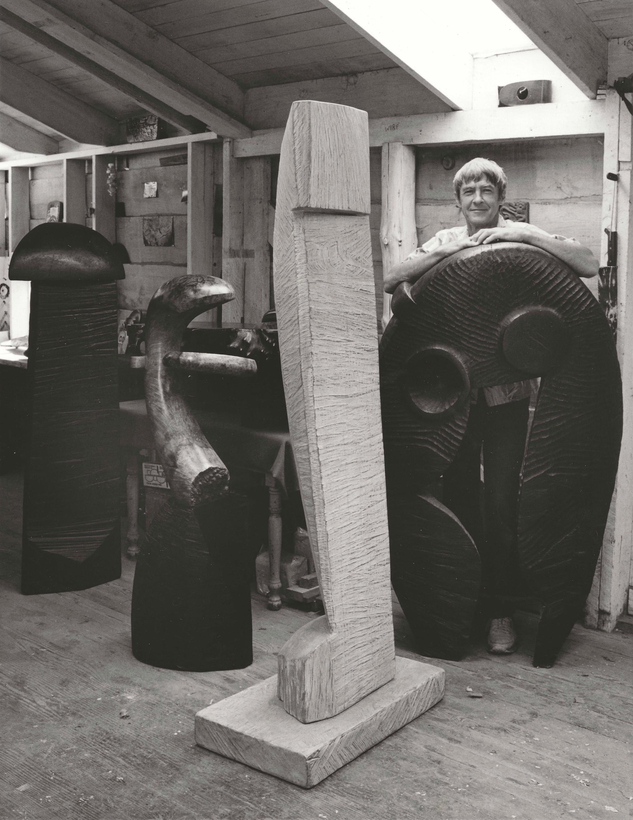
“I think life is a series of beginnings,” said the sculptor JB Blunk, who lived from 1926 to 2002, “and the one who feels they are always a beginner is the one who has the best chance.” A student of Zen Buddhism, Blunk saw work as a source of infinite inspiration, a medium, if you will, unencumbered by the constraints of time. “When you’ve created something that makes a difference to someone, that juice, that energy, occurs through us. See, I think all the discoveries, all the essence is already in existence.”

Born in Kansas, James “JB” Blain Blunk moved to California when he was 20. At U.C.L.A., he initially studied physics, then switched majors to ceramics, where he came under the tutelage of Laura Andreson, who had created the program. A class field trip to see work by the esteemed Japanese potter Shoji Hamada proved revelatory for Blunk. “It was a shock,” he recalled. “I walked into the room and something went ping! I have to figure out a way to get to Japan.”

Clockwise from top left: Apple Arc, by Iris Delphine, 2025; Ambo I, by Marina Contro, 2025; Candlestick Candlestick, by Nick Makanna, 2025; Dinner Party, by Nathan Lynch, 2023.

Soon after graduating, Blunk was drafted to serve in the Korean War, which became the perfect way to visit Japan and meet Hamada. After his discharge, he apprenticed under two revered Japanese potters—first, Kitaoji Rosanjin, in Kamakura, and later Kaneshige Toyo, in Bizen. These immersive studies essentially made Blunk the first American to absorb the country’s tradition of unglazed, woodfired stoneware. “I’d like to show the people in the States this material and way of using just earth, water, and fire,” he wrote.

In 1955, Blunk moved to Northern California, where he and the British-born painter Gordon Onslow Ford bonded over their shared reverence for Japanese aesthetics—and Zen Buddhism—a friendship that would last both of their lifetimes. When Onslow Ford and his wife acquired a large plot of virgin woodlands in the unspoiled hills of Inverness, Blunk helped them build a house and studio that was integrated into the mountainous landscape. In 1958, when construction was completed, Onslow Ford gave Blunk and his wife, Nancy Waite, an acre of the land on which to build their own home.

Outside Blunk House, the artist’s hand-built home in the hills of Inverness.

Comprising salvaged materials and built by hand over several years, Blunk’s house in the woods, said Onslow Ford, “was his first masterwork. It was built with wholehearted dedication stone by stone, beam by beam, and plank by plank.” Just about everything inside—from candleholders and mezcal cups to the doors and furniture—was handmade by Blunk and Waite.

In his Inverness home studio, where cypress and redwood were added to his arsenal of materials, Blunk produced explosive pieces. Weighing in at two tons, for instance, with a 13-foot diameter, his 1969 seating sculpture The Planet was carved out of a single mammoth ring of redwood burl. Today it lives at the Oakland Museum and is referred to as “one of the most touched pieces of sculpture” in America.

Clockwise from top left: Holder, by Joel Tomlin, 2025; Dancer in the Dark, by Tung Chiang, 2025; Tour, by Tiago Almeida, 2025; Knobbed Candelabra, by Minjae Kim, 2025.

Since Blunk’s death, his “back to the land,” “made by hand” legacy has only grown. Mariah Nielson, his daughter with second wife Christine Nielson, a textile artist, is the director of the JB Blunk Estate, of which Blunk Shop and Blunk Space are a part. Located nearby in Point Reyes Station, the shop offers artisan-made reproductions of Blunk’s original objects, and the space, founded by Nielson in 2021, presents exhibitions like the one that opens next Saturday—“100 Candleholders.” Modeled on Blunk’s own 1981 exhibition, “100 Plates Plus,” and following 2023’s “100 Hooks,” this show features work by more than 100 international artists and designers. Their brief? “To create a candleholder of any material inspired by JB Blunk, his work, or the Blunk House.”

“100 Candleholders” will be on at Blunk Space, in Point Reyes Station, California, from January 17 to March 28

Spike Carter is a writer and filmmaker