
Last week, on his journey to Brooklyn’s Metropolitan Detention Center aboard a Department of Justice Boeing 757, Venezuela’s dictator, Nicolás Maduro, made an unscheduled stop—rumors swirled about a medical emergency—at Ramey Air Force Base, a former U.S. base on the west coast of Puerto Rico.
Although Ramey was officially closed in the 1970s, it—along with the giant Roosevelt Roads Naval Station, on the east coast—has seen a surge in military activity since the fall, reviving both good and bad memories for Puerto Ricans, depending on whom you ask.
Puerto Rico became a U.S. territory in 1898 when Spain ceded it after the Spanish-American War. But its deep ties to the American military began during World War II, when Ramey and Roosevelt Roads were both built.
Roosevelt Roads gained notoriety as the base for bombing exercises on the nearby island municipality of Vieques. For decades, thousands of tons of munitions, laced with uranium, napalm, and mercury, were detonated there, contaminating the picturesque island and contributing to heightened rates of cancer among its residents.
Local resistance simmered for years before erupting into island-wide protests after a civilian security guard was killed by a stray bomb in 1999. Demonstrations drew more than 100,000 people, and hundreds were arrested for occupying the Vieques bombing range. Now some are wondering whether they’re going to have to fight the battle of the bases all over again.
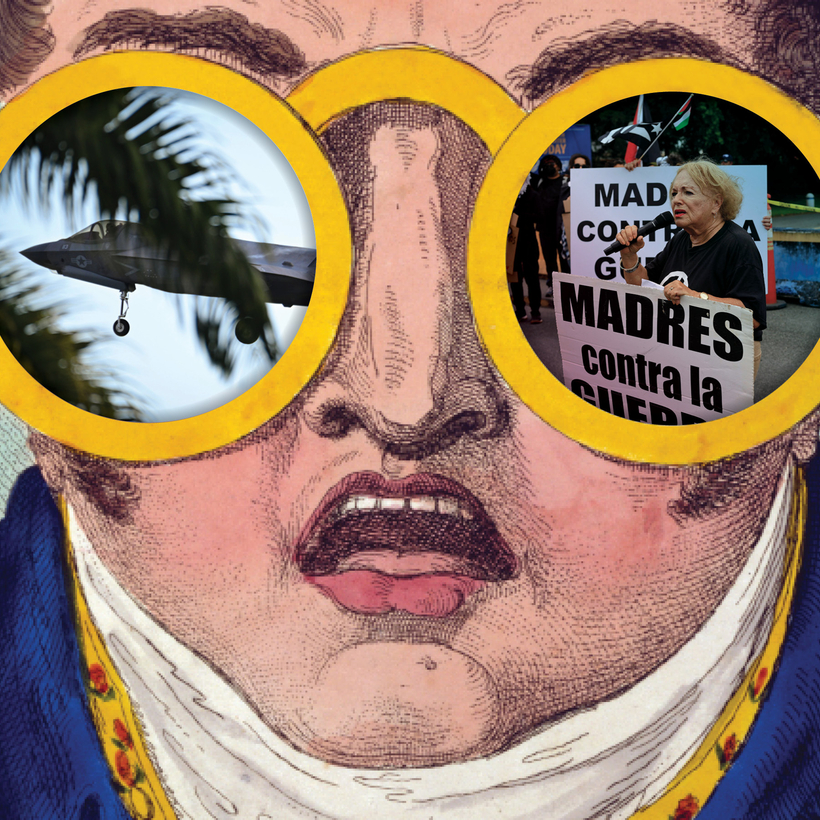
“It all started in September,” says Sonia Santiago, founder of Madres Contra la Guerra, a pacifist group of soldiers’ mothers who are opposed to military activity and recruitment on Puerto Rico. A friend had called her in a panic: the sound of military planes taking off at Ramey was shaking her entire house in nearby Aguadilla. “I started asking around,” says Santiago, “but nobody knew anything.”
Pablo José Hernández, Puerto Rico’s representative in Congress, dismissed rumors of an expanding military presence on the island. “I’m not going to fight for something that is not being considered,” he told the national newspaper El Nuevo Día. But events were escalating quickly.
On September 7, Santiago organized a protest of around 300 people outside the Luis Muñoz Marín International Airport, in the island’s capital of San Juan. The following day, at the same airport, the island’s governor—and Trump ally—Jennifer González-Colón, welcomed Secretary of War Pete Hegseth and General Dan Caine, chairman of the Joint Chiefs of Staff.
“We thank @POTUS Trump and his Administration for recognizing the strategic value Puerto Rico has to the national security of the United States and the fight against drug cartels in our hemisphere, perpetuated by narco-dictator Nicolas Maduro,” González-Colón wrote on X. Since then, the island has seen a deployment of between 5,000 and 10,000 troops, as part of the large-scale military buildup in the Caribbean that ultimately led to Maduro’s capture.
While Puerto Rico’s military bases have not been officially reopened—they are currently being used on a temporary basis—some are hoping they will be permanently revived. Frank Worley, a former public-affairs officer at Roosevelt Roads who now lives in South Carolina, has run a popular Facebook group since 2009 calling for the reopening of the base. “It would be good for the local economy,” he says. “It would be good not only for national security but for local public safety with more anti-drug operations.”
Since September, he has seen his group gather more than 10,000 new members—“Many of them are Puerto Rican,” says Worley—who post pictures of docked warships on the southern coast of the island as well as videos of F-22 Raptors roaring over residential homes in Aguadilla. The comments on the videos are nearly all positive: “The sound of freedom,” reads one, while another says, “I feel safe.”
Similarly, many local Puerto Rican businessmen, such as Milton Cruz, the C.E.O. of Insignia Senior Living, a health-care company, are also calling for the re-militarization of the island. Cruz says it is a “gift that we should embrace and support.”
But such statements do not ring true to Santiago. She believes the economic argument for reopening the bases is spurious. “What local economy?” she says. “[The soldiers] eat and drink and consume everything at the commissary!” She also points to the damage the military has already inflicted on the island’s environment and public health, citing investigations her group has conducted that uncovered worrying levels of petroleum hydrocarbons and heavy metals at former bases. “Nobody here is talking about it,” she says. Madres Contra la Guerra has so far held seven protests across the island with another scheduled to take place next weekend. But can it stop what seems inevitable?
“Puerto Rico has recovered the strategic importance it once had during the Cold War,” says Waldemar Arroyo-Rojas, a professor of political science at the University of Puerto Rico at Mayagüez. “Trump has made it very clear the Caribbean is his new priority…. Everything is pointing at an increase in military presence. If Trump’s democratic commitments are weak in the United States, just imagine how weak they’ll be when it comes to Puerto Rico.”
Trump has shown little fondness for the island in his time as president. In 2017, he questioned the number of Puerto Ricans who had died in Hurricane Maria, allegedly called Puerto Rico “dirty” and its people “poor,” and suggested he would trade the island to Denmark in exchange for Greenland. He has also called Puerto Rico’s most popular export, the reggaeton star Bad Bunny, “an absolutely ridiculous” choice for this year’s Super Bowl halftime show.
Despite this hostility, Arroyo-Rojas believes the re-militarization of the island won’t spark Vieques-like tensions. “Puerto Ricans have become too emotionally dependent on the United States since then. My premonition is that if anything happens, it won’t be anything significant.” Worley feels the same way. “This is likely the best chance we’ve had [to reopen Roosevelt Roads] in more than a decade,” he wrote to his Facebook group. It has left Santiago grim-faced about the future. “They don’t care whether we want them here or not,” she says. “They act based on their own interests—what benefits them.”
Carolina de Armas is an Associate Editor at AIR MAIL
