
Behind the concierge desk in Milan’s newest luxury hotel hangs a portrait of a woman by Erminia de Sanctis, an obscure 19th-century painter whom my late grandfather would definitely have claimed as a relative. This classical touch amid the gleaming, modernist lobby is one of many inspired design details at Rocco Forte Hotels’ latest property, the Carlton, which opened in November.

It has quickly become a destination for well-to-do Milanese ladies (le sciure), and Spiga, its gastronomic restaurant, led by chef Fulvio Pierangelini, now draws their international friends, too. Come February, Olympians will be passing through for dinner ahead of the Milano Cortina 2026 Olympic Winter Games.

Via della Spiga, one of the main arteries for Milan’s alta moda.

With today’s burgeoning demand from high-end travelers to Italy’s most refined city, a wave of luxury hotels has electrified the hospitality sector. The Carlton is leading this renaissance, with Six Senses, Soho House, and Rosewood expected to follow suit this year and next. Even French all-business-class airline La Compagnie now has nonstop flights from Newark to Malpensa.

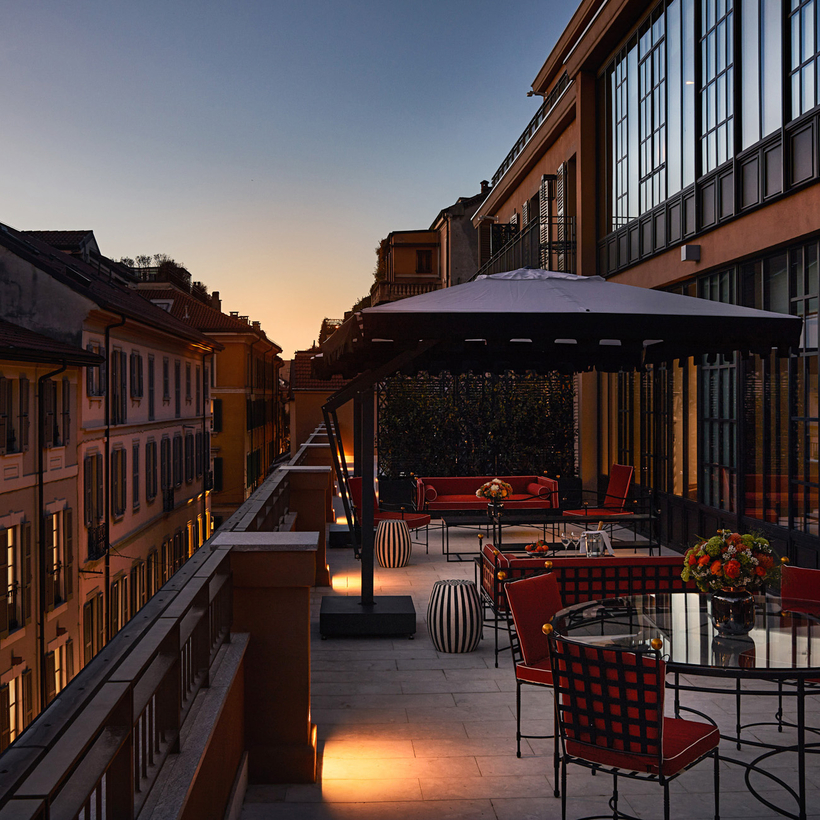
The Carlton, though, is the only hotel in town with doors that open onto Via della Spiga—a cross street off Via Montenapoleone and one of the main arteries for Milan’s alta moda. That rear entrance is through the renowned florist Vincenzo Dascanio’s boutique, which was brimming with winterberries and crimson ranunculus when I visited. Outside, Carlton bellmen and -women are dressed in dramatic capes called mantelle—a nod to coachmen of the past—modern versions of which appear in nearby Gucci windows.

Top, a guest bedroom at the Carlton in pomegranate red and celadon; above, a green marble vanity in one of the hotel’s bathrooms.

I usually brace myself for a certain snootiness or hauteur at luxury hotels. Upon checking in, I encountered the opposite at the Carlton. The atmosphere there is unfailingly glamorous, but it’s also part of the brand’s DNA to temper five-star service with genuine human kindness.

At a holiday party celebrating the opening, I met 80-year-old Sir Rocco Forte, the head of the British-Italian hotel group that bears his name. “We are growing, but I like to think that we are still small enough to maintain our culture, which is quite friendly and warm,” he said. “And family is very important.” Family includes his children, Lydia, Irene, and Charles, all of whom hold major leadership roles within the company, as well as his sister, Lady Olga Polizzi, the group’s design director.

Polizzi collaborated with the London-based interior-design duo Paolo Moschino and Philip Vergeylen on the refurbishment of the original Hotel Carlton, built in 1961. Rocco Forte kept the name and conjoined the building with a neighboring private home from the 1850s. The resulting aesthetic recalls Milan’s midcentury economic boom, when, following the stagnant postwar period, the city became Italy’s first manufacturing powerhouse.

Top, midcentury-inspired furnishings in one of the Carlton’s bedrooms; above, the hotel’s neoclassical façade at dusk.

The crisp interiors pay homage to stars of Italian design. In-room desks and spa mirrors reference Gio Ponti, while studded leather headboards recall the architect and designer Paolo Buffa. Lines and geometrical patterns decorate the wood, stone, and carpeted floors throughout, and the motif is duplicated on glassware and Ginori 1735 porcelain.

The Carlton is awash in natural sunlight. That, along with Moschino’s white plaster sconces and the original Murano fixtures on the Carlton Bar ceiling, gives the hotel a refreshing brightness, hearkening back to an age before dimmers made hotel spaces feel dreary. Brighter still is the glass-domed Cafe Floretta, a green urban oasis that also serves as the breakfast room, where the omelet with pancetta is served alongside a spray of white anemones.

My room palette was a sophisticated combination of pomegranate red and celadon, reflected in antiqued mirrors on the closet doors. The green marble vanity in my bathroom felt like a throwback to a time before homogenization erased character from luxury hotels. And the Pedersoli towels were soft enough to use as a throw blanket after a lunch of risotto allo zafferano.

Top, the sitting area of a suite at the Carlton; above, a guest bedroom overlooking Via della Spiga.

A large photograph dominated my room’s living area, and Google Lens revealed it was the dome of Chiesa di Santa Maria Presso San Satiro. I went out to investigate and soon found the quiet little church off Piazza del Duomo. The chapel turned out to be a masterpiece by Donato Bramante, the father of Renaissance architecture. It was a startling revelation, one which confirmed my long-held belief that the finest hotels, such as the Carlton, do more than echo the culture and history of their surroundings. They offer a way in. You might even meet an ancestor hanging on the wall, saying “Welcome.”

The writer was a guest of the Carlton, where room rates begin at $1,518 per night

Marcia DeSanctis is a contributing writer at Travel + Leisure and writes essays and stories for Vogue, Town & Country, Departures, and BBC Travel. Her collection of travel essays is called A Hard Place to Leave: Stories from a Restless Life