Last fall, a picture of Jeremy Strong walking down the street in New York with Karl Ove Knausgaard made the rounds online. The Succession star, known for his unabashed sincerity, had previously described the Norwegian writer as his “idol.” Once, in a video, he called Knausgaard’s autobiographical novel, My Struggle, “the most honest expression of life that I’ve ever read,” and named the six-volume series his favorite book of all time.

Knausgaard inspires this sort of rapturous praise. His legion of admirers grew with each volume of My Struggle, which Archipelago Books began releasing in translation in 2014. His new novel, The School of Night, comes out January 13. The fourth installment of his Morning Star cycle, it’s a propulsive, horror-tinged, and very fun retelling of Christopher Marlowe’s Doctor Faustus. It follows a 20-year-old photography student in 1980s London as he makes a deal with the devil (presenting as a vaguely menacing hippie) to achieve artistic success.

To me, the book seems poised to find a new readership for Knausgaard, maybe because it goes down so easily. In advance of its publication, I spoke to writers, critics, and avowed fans about the cult of Knausgaard, what is so compelling about the work, and why he tends to inspire not just interest but obsession.

Christian Lorentzen, the book critic (and, recently, podcast host), who reviewed The Morning Star for this publication, has not read the other books in the series yet but told me he is saving a stack of them for “a substantial treat.” He recalls walking through Times Square with the author once, “flabbergasted that nobody recognized the greatest literary rock star of our time.”

“As with what Holden Caulfield says about your favorite writers, you just want to call the guy up and talk to him,” Lorentzen says. “I got to do a bit of that with him. At the end of our conversation, I was just listing off the greatest bands of the Boston area from the 80s and 90s. And he just goes, ‘Those are great. Thank you.’”

Rumaan Alam, author of Entitlement and National Book Award finalist Leave the World Behind, read My Struggle because everyone he knew was suddenly talking about it. “I would distinguish the phenomenon I’m describing from simple ‘buzz,’” Alam says. “Writers I admire were making serious arguments for the work of this writer, whose name I’d never heard before.”

The enthusiasm might have something to do with the length of the work. “Readers become obsessed with Knausgaard because you can’t spend this much time with someone and not have some strong feeling,” says Alam. “If that feeling is antipathy, you’re likely not going to finish the novel. So if you finish it, you’re half in love with the guy. Or, like Patty Hearst, you’re identifying with your captor and would rob a bank for Karl Ove.”

“As with what Holden Caulfield says about your favorite writers, you just want to call the guy up and talk to him.”

Jeremy Gordon, author of See Friendship and a senior editor at The Atlantic, said his interest began as a lark but quickly became serious. “The concept of diving into a six-volume autobiographical series titled My Struggle initially felt kind of funny. I mean, what’s the deal with this guy? I once participated in a book group where me and four other guys met every year, when each new volume was released, to ponder that exact question.” But Gordon was immediately drawn in by Knausgaard’s “total vulnerability, his lack of self-flagellation or reflexive irony—the willingness to reveal himself, in all his shades.”

This is something I hear a lot: men in particular love K.O.K. Knausgaard’s striking appearance—he is tall and really good-looking—gives his fame among men a homoerotic edge. On an episode of the influential podcast How Long Gone, co-host Jason Stewart has talked about being a big fan. And on the fashion blog Blackbird Spyplane, Jonah Weiner wrote in December about reading My Struggle books one and two as part of his “predawn Literary Brain Re-training Regimen.”

The novelist August Thompson, whose debut, Anyone’s Ghost, was published last year, told me, “It felt, for a time, that there was a government program that handed out the first volumes of My Struggle to every cis white male above the age of 25.” A professor first recommended it to Thompson, calling the opening pages some of the best in literature. “So I went to a bookstore and read the first few pages to see just how wrong said professor was. He was, of course, absolutely correct.”

Brandon Taylor, a book critic and the author of Minor Black Figures, says, “Knausgaard’s work appeals to a lot of people for the same reason Lynch, Pynchon, and Paul Thomas Anderson appeal to people: his vision of life is one you’d find conjured around Boy Scout firepits. There’s something essentially innocent about Knausgaard that makes him receptive to the strangeness of the world. He then conveys that strangeness in codes and references that are particularly resonant to Gen X and elder millennial guys because they grew up listening to their dads’ music.”

“You can’t spend this much time with someone and not have some strong feeling. So if you finish [My Struggle], you’re half in love with the guy. Or, like Patty Hearst, you’re identifying with your captor and would rob a bank for Karl Ove.”

Chip Cheek, author of the novel Cape May, pointed to the accumulation of detail that “[speaks] to us on the same level at which we actually live our lives: through our interaction with the world via the senses.” He added that the first sentence of My Struggle alone makes him cry: “For the heart, life is simple: it beats for as long as it can.”

In 2025, the critic Federico Perelmuter caused a stir online when he wrote an essay for the Los Angeles Review of Books in which he coined the term “brodernism,” which he used to refer to male writers who tend to be described as “maximalist,” “difficult,” “avant-garde,” “excessive,” and so on. Fans of this type of book were furious, but the term was widely and instantly adopted.

I was curious where Knausgaard fell in relation to this cohort. Perelmuter told me (with the caveat that “there aren’t really brodernist writers, since brodernism is a post hoc critical/reception-end thing”) that, bro fans notwithstanding, Knausgaard doesn’t really fit the description. “My sense is that Knausgaard, despite the extreme length, doesn’t have the same superficially and recognizably modernist aspirations as, say, Krasznahorkai, among other things because his work is so explicitly autobiographical and not much interested in formal contrivance or experimentation.”

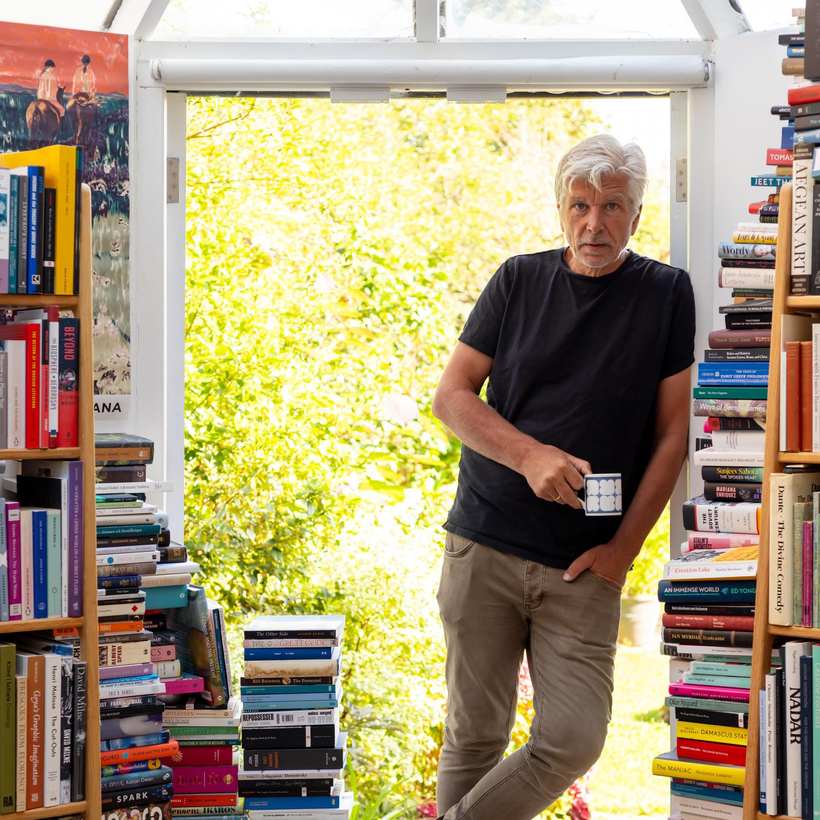
Knausgaard’s striking appearance—he is tall and really good-looking—gives his fame among men a homoerotic edge.

Kim Adrian, author of Dear Knausgaard, a book of lyric criticism about My Struggle structured as a series of letters, suggested that his cult status is at least partially due to articles like this one. For instance, Adrian initially pitched her imprint a book on Lydia Davis. “They said, Well, we’d love you to write something, but not about Lydia Davis,” she says. She suggested Knausgaard instead, and they were crazy about the idea. “So I think it kind of is circular,” she says. “It just feeds itself.”

I was reminded of Adrian’s remark recently as I flipped through T magazine and happened upon a fascinating bit of ephemera. The editors had commissioned a courtroom sketch artist to produce an image of the narrator of The School of Night, who is never described. (“The only way I can write is from within him,” Knausgaard told the magazine. “That’s why there’s no description of him visually in the book.”) The image is funny—it’s just a generically handsome man—but it’s doubtful that was the intent. This has to be the apex of author-as-celebrity: a straight-faced courtroom sketch of its conventionally attractive narrator.

So it’s all a little engineered, a little pre-determined. You see the courtroom sketch or you read this article or you see the Jeremy Strong video and maybe you pick up the book. The media fuels the myth. But at least, in this case, the work backs it up.

Erin Somers is the author of the novels Stay Up with Hugo Best and, most recently, The Ten Year Affair. Her writing has appeared in The New York Times, The Nation, Esquire, The New Republic, and elsewhere