Whether it’s U.S.C. vs. U.C.L.A., the Crips and the Bloods, or Mötley Crüe brawling with Guns N’ Roses at the V.M.A.’s, Los Angeles is infamously factional. But its most aged beef is about beef. For more than a century, the two oldest restaurants in the City of Angels—Philippe the Original and Cole’s Pacific Electric Buffet—feuded over the true provenance of the French-dip sandwich, which (this much is undisputed) was first served in 1908. In Cole’s version, the eureka moment occurred when the original house chef soaked the bread in savory broth to soften it for a sore-gummed customer.
This month, the quarrel will be settled by forfeit, as Cole’s makes its last dip in the au jus. The restaurant’s imminent closure was first announced this past summer in a statement from owner Cedd Moses (son of the Ferus Gallery artist Ed), who blamed the lingering aftereffects of the pandemic, the Hollywood strikes, bureaucratic regulations, and the exorbitant costs of labor, food, and rent.
Confronted with the death of a historic landmark, longtime devotees of the restaurant flocked to the old Pacific Electric Building on Sixth Street for a final meal at the former haunt of Charles Bukowski and Mob boss Mickey Cohen. The size of the crowds convinced management to prolong the stay of execution until New Year’s Eve. Then, the day after Christmas, it was postponed until the end of this month.
When I walked in on a Friday night in early December, the place was half empty. A mortuary gloom hung over the stuffed deer head above Cohen’s favorite corner booth. Both pool tables were occupied; joyous 70s funk played from the speakers, but the melancholia was unmistakable. This was a place counting the days on its fingers. Ordering at the antique mahogany bar, I offered my condolences to the server. He shrugged. “I was hired in July to help out for the final week,” he said. “I’m surprised to still be here at all.”
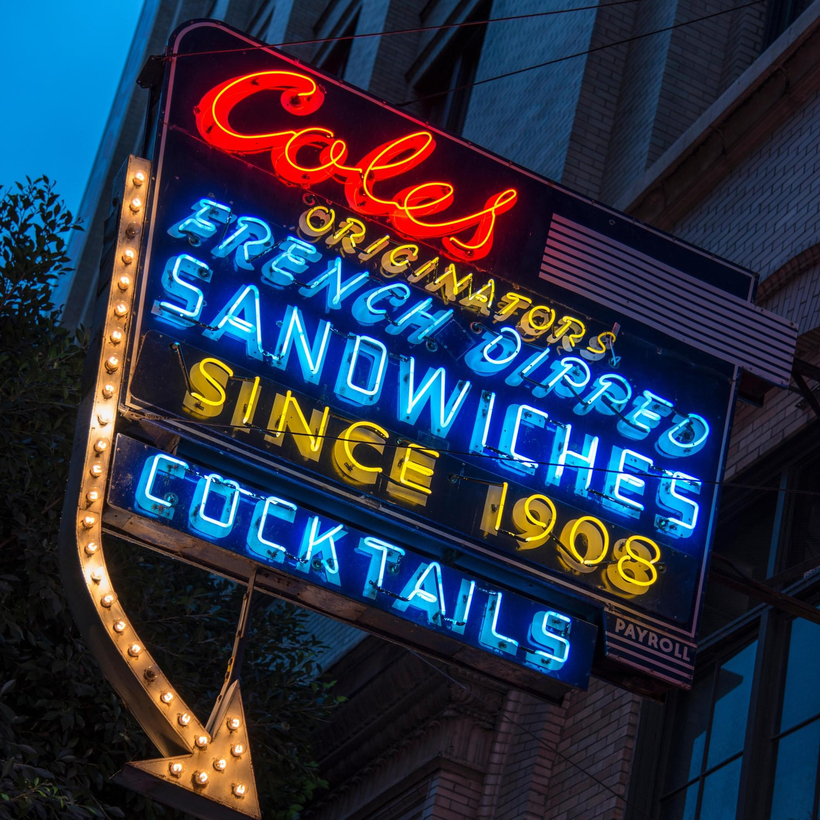
Maybe it’s surprising that Cole’s has survived this long. After decades of decline, it was bought by the 213 Hospitality group (now Pouring with Heart) in 2007. They exterminated the rats that had become regulars and preserved Cole’s original neon frontage, Tiffany lamps, red velvet wallpaper, kitschy signs (We do not extend credit to stockbrokers), and framed black-and-white photos that depicted a bygone L.A. The original recipes had been lost to time, but the owners hired the redoubtable Neil Fraser (Top Chef Masters, Iron Chef America) to tastefully upgrade the original lunch-counter-for-lushes concept.
In the Obama era, one of the quintessential L.A. nights was a beef French dip and an old-fashioned at Cole’s, followed by a descent into the Varnish, accessible only through an unmarked door in the back. You could often find the Pulitzer Prize–winning food writer Jonathan Gold sipping one of the nationally lauded cocktail bar’s imaginative concoctions.
It was the apogee of second-wave downtown revival, where the grimy metropolitan core finally upended the Dorothy Parker cliché about L.A. being “72 suburbs in search of a city.” The Smell, a D.I.Y. venue near Skid Row, was hailed in The New Yorker as a cradle of avant-garde punk. Monthly art walks invariably turned into raucous parties. Hospitality groups poured tens of millions into turning the neighborhood’s elegant Art Deco and Beaux Arts skeletons into vibrant bars and music venues. For a minute, it seemed like every prominent E.D.M. D.J. on the West Coast was living in a refurbished DTLA loft. Right on cue, an Ace Hotel popped up.
Barely a decade later, downtown L.A. has reverted to its natural entropy. Once-hyped “industrial chic” establishments have closed or become a shell of their former selves. Ridership on the subway is roughly half of its 2013 peak. The building that housed the Ace is now Stile Downtown, a hotel that has been described as an “Airbnb on Steroids.” José Huizar, the city councilman who presided over the boom, is now serving a 13-year prison sentence for corruption. As for the E.D.M. D.J.’s, most left during the pandemic and didn’t leave forwarding addresses. The Varnish served its last hot buttered rum in 2024.
Cole’s, the location for alcoholic benders in Mad Men and Forrest Gump, endured World Wars, Prohibition, the Great Depression, the Great Recession, earthquakes, and riots, but it couldn’t survive the affordability crisis of the 2020s. Upon its resuscitation, the new owners boasted that no sandwich, save for the lamb dip, cost more than $10. Now a full Cole’s French dip costs $23. Add a drink and a side or two, and the tab runs north of $60. A simple workingman’s meal has become the province of tourists reveling in an unremembered past.
On that full-moon December night, my fifth-generation roast-beef dip was better than your average bodega’s, but you wouldn’t waste gas on getting it. The pork dip was grizzled, the tomato soup bland. The coleslaw would have gone untouched at a BBQ. And as for the once-vaunted old-fashioned, it was solid but underpoured.
Still, it’s impossible not to have been charmed by Cole’s. The atmosphere of weary dissolution remained intact, right to the bitter end. This building once housed the western terminus of the Pacific Electric Railway Company, the “Red Car” line founded by the Huntington family, and immortalized in Who Framed Roger Rabbit? (Cole’s allegedly inspired a bar scene in the film). One chief appeal of the original Cole’s was that it cashed checks for train workers, so as to better help them blow their pay on a few pints before making it out of the station.
Before I left, I soaked up the bordello-red light one last time, squinting at the newspaper clippings, the sepia photos of horse-drawn buggies and long-dead Los Angeles burghers. I considered all the sordid anecdotes, comic banter, bar-napkin poems, and bloody conspiracies that were hatched over French dips and whiskey for 117 years.
It was an unusually foggy night, and downtown L.A. was largely deserted. I slinked past unhoused men slouching in the shadows, shivering junkies twitching on the corner, and several bars that looked like they’re next in line to join Cole’s in the shambolic dive-bar hereafter. A piece of Los Angeles history will now be forever lost. Warren Zevon said that you should enjoy every sandwich, and for a very long time Cole’s rarely failed to deliver—even if I always preferred Philippe’s.
Jeff Weiss is the author of Waiting for Britney Spears: A True Story, Allegedly
