
One would think that the war on drugs would include at least a battle or two against crypto. After all, crypto-currency is how drug lords—and narco-state presidents—often fund their criminal enterprises.

But as the U.S. military was blowing up alleged drug smugglers in the Caribbean, Juan Orlando Hernández, the former Honduran president who had been serving 45 years in jail for trafficking more than 400 tons of cocaine into the United States, was being pardoned by the president. And it was the crypto bros, it seems, that won him his pardon.

Hernández once said that he wanted to “shove the drugs right up the noses of the gringos.” But Trump, writing on Truth Social, declared that Hernández had been, “according to many people that I greatly respect … treated very harshly and unfairly.” His pardon caused a rare bipartisan uproar.

“Why would we pardon this guy and then go after Maduro for running drugs into the United States?” asked Republican U.S. senator Bill Cassidy on X.

The reason seems clear: Hernández helped some big-time American crypto bros turn their dream of a government-free utopia into a reality. And these broligarchs—the best known of whom is Peter Thiel—are the same people who helped fund President Trump’s first presidential campaign, and J. D. Vance’s political career.

Hands across Próspera: Donald Trump gets handsy with Peter Thiel during a meeting at Trump Tower in 2016.

Officially it was Trump’s longtime adviser Roger Stone who requested the pardon for Hernández. (Thiel’s representatives denied he was involved with the pardon.) But it is the crypto bros who are the ones to benefit most, says Kristofer Harrison, who heads the Dekleptocracy Project, a Virginia-based anti-corruption nonprofit.

In 2013, Hernández pushed legislation that created law-free zones known as ZEDEs (Zones for Employment and Economic Development) in Honduras. These were meant to attract investment by creating fully autonomous zones where investors could have their own laws, police, and tax system, separate from the national government of Honduras.

Their creation was hugely controversial, and in 2022, then Honduran president Xiomara Castro—who ran on a promise of ending the ZEDEs and won in a landslide victory—repealed the law that formed them, calling it a violation of national sovereignty. No new ZEDEs have been created since then, but the fate of the existing ones remains uncertain. The most well known of the ZEDEs—Próspera—filed a $10.7 billion arbitration claim against the Honduran government, and because the ZEDEs were established by a constitutional amendment they remain in legal limbo.

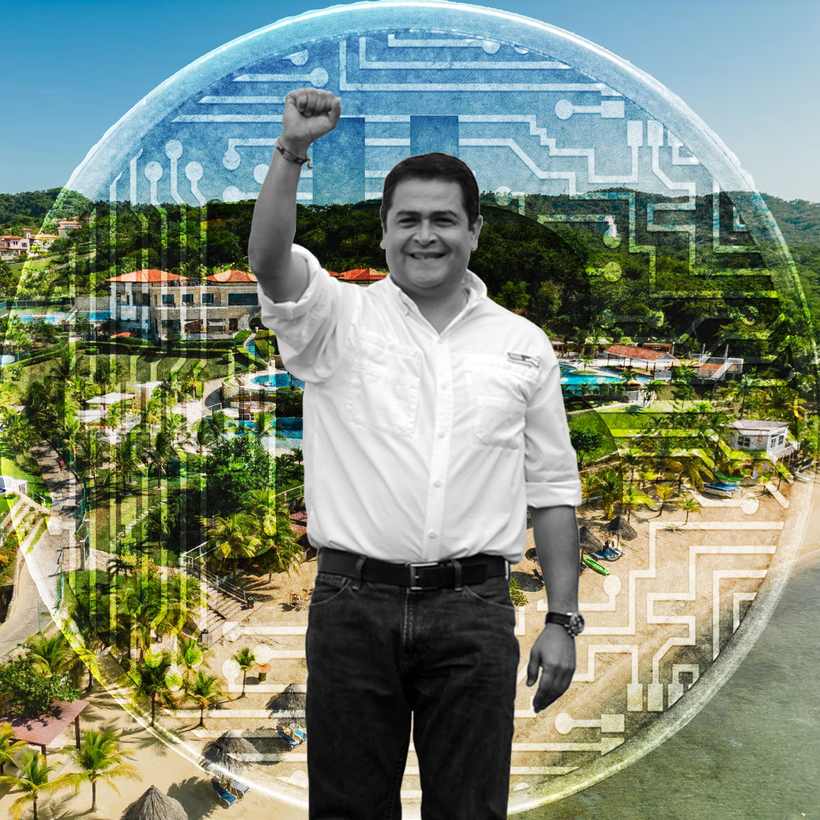
Próspera is located on Roatán, a popular tourist island about 40 miles off the coast of Honduras, famed for its diving and snorkeling. It was backed by Pronomos Capital, a venture-capital firm supported by Thiel, the venture capitalist Marc Andreessen, and Balaji Srinivasan, the former C.T.O. of Coinbase and author of The Network State: How to Start a New Country. Bitcoin is legal tender in Próspera.

Próspera: all the crypto you can eat.

It sounds radical, but in some ways it hearkens back to a 20th-century innovation: “Think United Fruit company towns for the cyber age…in the country that gave us the term ‘banana republic’ no less,” Harrison wrote on his Substack. The result is a kind of feudalist tech state.

Próspera has more e-residents—people given virtual access to its special economic zone without having physical residency—and businesses than inhabitants, says Harrison. “I can’t say definitively that’s tax evasion, but that’s tax evasion. Listing more businesses than people is extremely weird.”

But it isn’t just those wishing to avoid tax that backed Próspera. Biotech bros were just as enthralled as their crypto brothers. The infamous biohacker Bryan Johnson travels to Próspera to receive longevity-boosting injections at the island’s Garm Clinic, a private stem-cell-and-gene-therapy facility that is unregulated by the U.S. Food and Drug Administration. Patri Friedman, the founder of Pronomos Capital—and Milton Friedman’s grandson—allegedly had a key to his Tesla implanted into his hand on the island.

“This Próspera place has almost religious appeal,” Harrison says. “There is a whole network of crypto bros, and they all voted for Trump and support Próspera. They want [Hernández] out of prison. He helped them build their shining beacon on the hill. He defended it, and now they want to defend him.”

How does Harrison know it’s the crypto bros who pushed for the pardon? Because there’s no other group of people except the drug cartels who would want him out of jail, he says. “Whoever was pushing for this pushed for the pardoning of a really bad drug dealer who was not only bad for Honduras but who indirectly killed a lot of Americans…. It puts the interests of Próspera over the United States.”

Louise Shelley, the founder of the Terrorism, Transnational Crime and Corruption Center, at George Mason University’s Schar School of Policy and Government, agrees: “It’s just like Dread Pirate Roberts, the mastermind of drug trafficking on the dark net who was pardoned because the crypto [bros] and libertarians were lobbying for him,” says Shelley, referring to the pseudonym of Ross William Ulbricht, founder of Silk Road, an illegal online drug marketplace in which all transactions were conducted in crypto-currency. Ulbricht, who had been serving a life sentence for conspiracy to commit drug trafficking, among other crimes, was pardoned on the first day of Trump’s second presidency. Such pardons, Shelley says, “help whitewash crypto.”

Pardon me: Ross William Ulbricht, the founder of the illegal online drug marketplace Silk Road, during the Bitcoin 2025 conference, in Las Vegas.

Hernández’s pardon came just two days before Honduras’s hotly contested election was to take place. At the time that Air Mail went to press, the election was still too close to call, although it appeared that the candidate of Hernández’s party, the Trump-backed Nasry “Tito” Asfura, was leading. His rival—and anti-Próspera candidate—Salvador Nasralla has already claimed the election was rigged.

James S. Henry, a Global Justice Fellow at Yale University and co-founder of the nonprofit United Against Money Laundering, has reported on Honduras since the 1980s. He sees what’s happening now as the “latest chapter in a series of U.S. interventions in Latin America. It’s a new version of wealthy Americans and their companies having their way with Honduras,” as in the Iran-Contra affair.

It probably won’t be the last time the crypto bros get Trump to do their bidding—he has a well-known weakness for rich white men who own private Caribbean islands on which they can act out their perversities with impunity. However, the Hernández pardon also highlights a more troublesome partnership: the strengthening of ties between organized crime and the top levels of national government in Latin America.

“This is a very worrying phenomenon,” says Shelley. “You see it in parts of Brazil … and in Mexico at the top of the military [with] the generals. It is very frightening that this crime-state relationship is so close. It’s in our backyard … and that fuels illegal immigration to the U.S.” The very illegal immigration that Trump has sworn to do away with.

Jennifer Gould is a columnist at the New York Post. She covers real estate, money-laundering, and global corruption, among other things