
Around the middle of the 18th century, Anton Raphael Mengs was the most renowned painter in Europe. Still, you’d be forgiven for not knowing his name. Few artists have fallen as fast, or as hard, from favor. The exhibition “Anton Raphael Mengs (1728–1779),” which just opened at Spain’s national art museum, the Prado in Madrid, brings the artist back into the spotlight.

Born in Bohemia, Mengs was just 18 when he was appointed court painter to Augustus III, Elector of Saxony. By 23, he was promoted to principal painter. Six months after that, Mengs left for Italy. In Rome, the art of antiquity shaped his vision for neoclassicism, and he began to shift from the bloodiness of the Baroque and the frivolity of Rococo toward polished symmetry, balance, and moderation. At 33, now a wildly successful painter of Grand Tour portraits and allegorical frescoes, Mengs entered the service of Charles III of Spain, taking charge of the decorations of the Palacio Real in Madrid. He outshone his rival Tiepolo and taught Goya, and his treatise on art reverberated across the Continent.

A self-portrait by Mengs, 1773.

Mengs’s friend Johann Winckelmann, a pioneering classical archaeologist, rhapsodized that Meng was “the greatest artist of his time and perhaps of succeeding times, reborn like the phoenix from the ashes of the first Raphael to teach the world about beauty in art.”

Yet shortly after his death, in 1779, Mengs’s reputation went into an eclipse from which it has never recovered. In 1782, the English dramatist Richard Cumberland described him as “an artist who had seen much, and invented little.... He dispenses neither life nor death to his figures, excites no terror, rouses no passions and risks no flights.” As recently as 1993, the art critic Andrew Graham-Dixon called him “a hopelessly mediocre painter.”

Octavius Caesar and Cleopatra, 1760.

So what caused the reversal of opinion regarding Mengs? “The emergence of a new sensibility that we now know as Romanticism,” says Andrés Úbeda de los Cobos, the head of the Eighteenth-Century Painting Collection and Goya at the Prado, and the curator of this show. “It clashed head-on with the ‘ideal beauty’ derived from classical statues, as defended by Mengs. Furthermore, his meticulous and detailed technique was greatly misunderstood with the emergence of Impressionism and the avant-garde, which regarded his fanatical perfectionism as alien.”

In short, the Establishment mistook Mengs’s restraint for dullness.

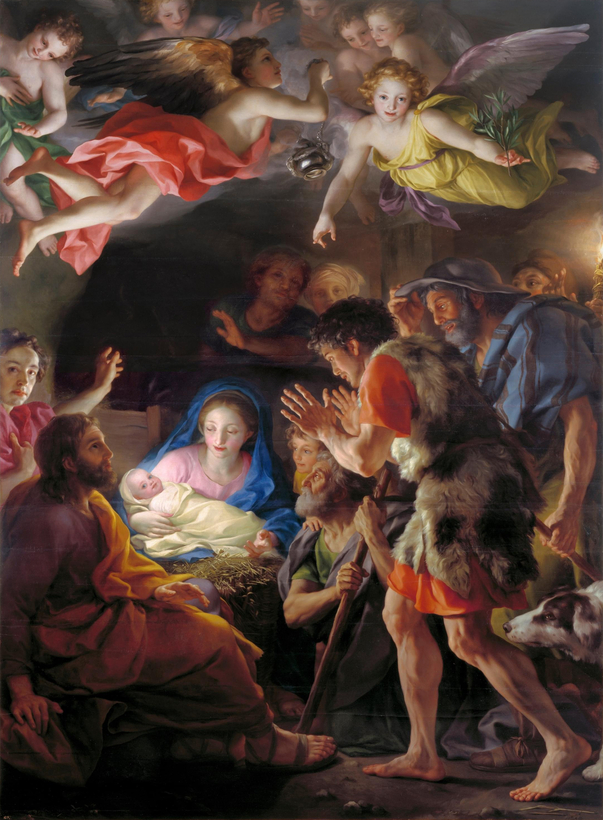
In an effort to correct the prejudices of the past, de los Cobos has gathered around 150 works—oils, watercolors, pastels, drawings—to create the largest and most important show ever dedicated to Mengs. A significant portion comes from the Prado’s own collection, which has approximately 40 securely attributed works by the artist, including nearly 20 royal portraits, some half-dozen devotional pictures, and a supremely confident self-portrait.

Jupiter and Ganymede, a forged Roman fresco by Mengs, 1760.

These are joined by key loans—perhaps most notably Jupiter and Ganymede, from Rome’s Palazzo Barberini. A Roman fresco unearthed in 1760, it was praised by Winckelmann as “one of the most beautiful figures to have survived from Antiquity.” It is, in fact, a forgery. Mengs confessed on his deathbed that he had painted the fresco with the intention of publicly fooling his friend.

“At the Prado, we believe that museum visitors are now perfectly capable of admiring his best paintings and discovering the artist for themselves,” continues de los Cobos. “In this sense, the exhibition will be a great surprise.”

“Anton Raphael Mengs (1728–1779)” is on at the Prado Museum, in Madrid, until March 1

Harry Seymour is a London-based art historian and writer