My father did not golf or ski or train birds of prey to be dependent on him. He was a doctor who continued to treat people even when their insurance companies stopped paying—one of the reasons that when he was ejected from his 1993 aquamarine Chevy Cavalier at many miles per fatal hour, my mother and I were forced to sell his practice and, later, our home, before his ashes had settled.
Because everything is connected, I had just been telling Fox, my daughter, about the grandfather she has never met, about how he had passed along his unpropitious opinion of men who participated in the “sport of kings,” as we participated in such an activity over this past Thanksgiving weekend.
Falconry, the sport of hunting with trained birds of prey, has long been a pastime for the elite. The specialized knowledge is erotic to those who swallow it all and still thirst. The man taking us and a few other families for a forest spin was very proud of his red-tailed hawk, and at the exact same time that I was trying to video my daughter as the fancy hawk landed on her arm, I was receiving messages from other writers and people in all of the creative industries I have been unlucky enough to experience the underbelly of, asking whether I had seen the latest dispatch from a scorned man about his former fiancée.
I first met Olivia Nuzzi when she interviewed me at the Politics and Prose bookstore in Washington, D.C. She was very late to our event and, when she finally arrived, the effect was as though she had parachuted in, a C.I.A. agent. Little apology, but utter professionalism. She wore black and I wore red and I think people liked hearing us talk to one another. That tends to happen when you have two women on a stage who are generally fearless, until the world reminds us why we shouldn’t be.
After the event, Olivia and I kept in touch. We had both lost our fathers around 23, and I had spent years turning over sewer grates looking for a replacement. I recognized Olivia’s pain. I think because it’s the same sort of pain as mine, but mostly I think it’s the same pain our country is in, which is why her book—that a select layer of humanity savaged recklessly and, quite frankly, irresponsibly—is two love stories, both of which have been scooped by third-party information that didn’t belong to the scooper.
In the future, I would think of her as someone I could call. What I mean by that is, in the throes of a severe depression after the death of my mother, I called a very good friend and told her I wanted to die. That friend told me to go to a hospital. She sounded less worried about me than about the legal ramifications of not prescribing me the correct next step, since she sounded busy. It was Easter, I knew, but she didn’t celebrate, which is why I’d called her. When Olivia checked in on me at a time that she was in a high place and I was in a low one, she acted the opposite of that former friend of mine. Olivia doesn’t change her spots. She’s always, in my experience, been a leopard.
Pieces like Leigh Haber’s Los Angeles Times review of American Canto (titled “Yes, We Give You Permission to Hate-Read ‘American Canto’”) might be an interesting part of the conversation, were it not for the savage way a woman’s pathology and history were undressed towards its end—but headlines meant to garner the exact sort of attention that the pictures of Olivia in leopard print do are not the way to show ourselves to have neat moralistic American stripes.
And here is where the story, as ever, folds back into itself. Because while Olivia was in that feverish, disorienting orbit centered around a man who knew how to hold out his glove but shellacked the girl instead, I was standing in a field in the Berkshires watching this hawk be a hawk and a man be congratulated for it, and I thought, Well, this sport of kings must be a pretty small community. So I asked the man who was so excited—like all men with their specialized hobbies are—if he knew “Bobby.”
Oh, his whole face lit up! In fact! This was actually Bobby’s bird! This was Bobby’s bird, Choco, that he had raised from a baby! By the way! It’s called manning it, “it” being the bird, when it’s a baby, and a man has to watch over it constantly. Imagine that—sitting with something small until it is big enough to haul off on its own—this practice is known as “manning” it. Said this man to my daughter.
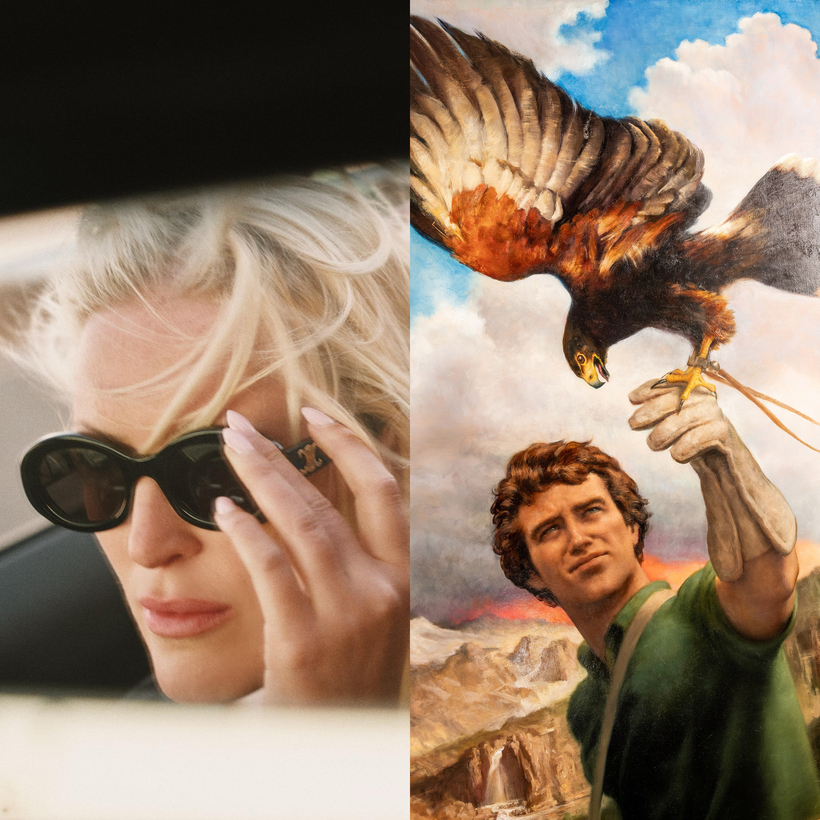
Just then, Choco dropped out of the sky like a brown lump and landed smack drab on my daughter’s arm. A hawk does not land anywhere. It lands where the glove is. It lands where it has been trained to believe the food and the safety are.
Now, standing there, filming my daughter with this predatory creature on her arm, a creature that could have zippered her open in a flash, I realized: every woman I have ever admired, including myself, has at some point flown to the wrong glove. Not because she was weak, but because someone else—usually a man with a skinny tie and a big ego—was wearing it. Someone had made her feel safe, and we all fly to safety.
“This was actually Bobby’s bird! By the way! It’s called manning it, ‘it’ being the bird, when it’s a baby, and a man has to watch over it constantly.”
At nearly the same time that Bobby’s bird landed on my daughter, Olivia Nuzzi texted me: “It’s like everyone is helping this man try to kill me.” Olivia meant her ex-boyfriend Ryan Lizza. In that moment, I realized my daughter was holding on her little arm the precious bird of the same man who had done nothing to save the young woman who had once checked on me when I wanted to die.
In this dirtbag culture of ours, the “glove” is power. Access. Proximity. The pretense of protection. The hawk does not go to the best person. The hawk goes to the best glove. Olivia went to the glove. She knew it. She knew Ryan wasn’t the glove. That doesn’t make Bobby good. But it makes him, for Olivia, better.
She wrote about Bobby training ravens, feeding them morsels until they became dependent, and she recognized that he had done the very same thing to her. She wasn’t blind. She wasn’t naïve. She was self-aware in the very middle of the trap. She was also in love and seems to still be. I wonder, has anybody who has written about her as though she committed the greatest ethical crime in modern journalism, when our president just last week called a journalist “Piggy,” never been in love, never been so undone by another person that you would undo yourself?
“The hawk does not go to the best person. The hawk goes to the best glove.”
When people ask, “Why do you defend her?,” I say, first, why would anybody savaging her have a problem with somebody else defending her? We each say our own versions as loud and true as we can say them.
But also for another, potentially more world-shifting reason: Because she got into the room with the glove. Because she had the courage and the damage and the hunger and the gift to make it into all these 7,000 bars and offices—Oval and theatrical and Marriott—and was able to communicate her time with words that made me and many others feel connected to the experience, that also left airspace for thinking people to make their own deductions, which is what good writing is to me.
While some writers—who would never bring attention to themselves in their personal or professional lives, by talent or scandal—are able to present their neat “facts” and never get in trouble for them, I caution the world of readers that the facts of someone without a third eye are primordially useless, like most politicians and boarding schools.
Writers used to be people who had experiences and were honest about them with vibrant words but also civility. Now they are people who know where a comma goes but not when or how the next thought to free womankind might come shooting from their incelious, incurious brains.
Finally, I defend Olivia because her story—not necessarily her book, which, by the way, I could not stop reading, and provides an intimate understanding of matters of importance that should also be read between the lines, but her story—could be an opening salvo to dismantling the corruption that is so baked into our world that we barely see it anymore. We see the leopard print, because people with spots aren’t the actual ones hiding.
“Every woman I have ever admired, including myself, has at some point flown to the wrong glove.”
A man, her former lover, an ex, like the kind we have all had or have been, driven to the brink, self-immolating in a manner utterly free of holiness, has stolen her story from her because she broke his ego. As a rule, an affair is something between two people behind another person’s back.
I wrote to Olivia moments after receiving this assignment on Wednesday afternoon. I like that even in pain, or in whatever mood she is in, her manner is always curious. I asked her several questions. About her ex, she wrote back:
“He thinks the keyhole through which he could observe some things, or what he could hear pressed against the door, or what he could extract when he jumped from the shadows and terrified the object of his obsession, makes him an authoritative narrator of what occurred inside the room. It’s a classic reporter’s fallacy that what you obtain through your skills and schemes outweighs the words and perspective of the people about whom you’re writing.”
There is an honesty in her sentences, there is more of a beat on life than in what I have read on Substack, which feels limited by existential smallness. I understand that smallness, by the way. I have felt that way. I have felt that petty and rageful and the only thing that releases it is revenge. I bet I’d do exactly what Ryan is doing, to be perfectly honest, though maybe in a book. In my mind, the problem is not Ryan, it is everyone else, and now it is also myself, but I was asked to write something at the exact moment that I felt compelled to say something, because what’s going on out there is egregious and revelatory.
I am speaking about those people directly quoting from this unchecked stream, or at the very least using it for background in their continuing appraisal of Olivia. They are critiquing her book for what it is not, for the fact that it is missing the misleadings of a very angry former lover. Much as I say to my husband when he is doing something that has nothing to do with advancing the actual point of our day, “What is your goal?” I ask now, the community of intelligent people who have a lot of intelligent things to say but a lot of them are often mean and utterly unhelpful, What is your goal?
Because the early results are in, and the goal seems to have been to crush the woman who doesn’t make the laws we live by: until just yesterday, Olivia had a starry job and her ex did not, and jobs are important in America, because we must all do our daily bidding for the billionaires, so he sounded the call and everyone piled on to destroy her while the people who still get to keep their jobs—the ones making the rules for our very health—are whistling for their hawks.
In her book, Olivia wrote, “A politician’s greatest trick is to convince you that he is not one. And what is a politician? Any man who wants to be loved more than other men and through his pursuit reveals why he cannot love himself.” She knows she fell for someone who is incapable of giving her what she needs. But his glove is still out there, his presence is more safekeeping and capable, it seems, than the rest of the world is showing themselves to be. Just as Trump was to the former deplorables.
I think Olivia is smarter than she is beautiful, though she is unquestionably beautiful. I think Olivia is able to write something beautiful overnight and not a lot of people can do that, and her intrigue and wisdom are amplified, in my opinion, by how very young she still is. Her prose is never boring, even when it’s precious, and when I look at her I see a little girl, like my daughter, like myself, like us all, which is what she actually still was when all these older, powerful men navigated her, and, through that, she learned how to navigate them, and the world, in a way that I think has gravitas. But mostly I think the attempted patriarchal mass murder of this woman’s career and her personhood is a freaksome lynching the likes of which we will look back upon with a dazed compunction.
Every single person is an unreliable narrator at some point in their life. I’d take my unreliability from someone who wrote about an unreliable time in their life, rather than one of the thousand writers who shouldn’t be allowed to write for reputable publications because of how limited and even classist their moral view is, and they don’t even know it. I don’t care how many politicians or hawks she’s slept with, and neither does the United Kingdom. Unreliability is in the eye of the beholder.
The point is that Olivia was not a piece of prey, unless we the people let her be. In this beholder’s opinion, she is the counterforce to the bedraggled patriarchs who feel entitled to their birds. She is someone who writes the truth about the glove itself because she’s sharp and tuned in enough to remember the feel of the fabric, note the breadth, casually ask after the provenance. Who knows what next truths she’ll tell. My bird’s-eye view is, we should be careful what—and who—we lynch for.
Lisa Taddeo is the author of Three Women, Animal, and Ghost Lover